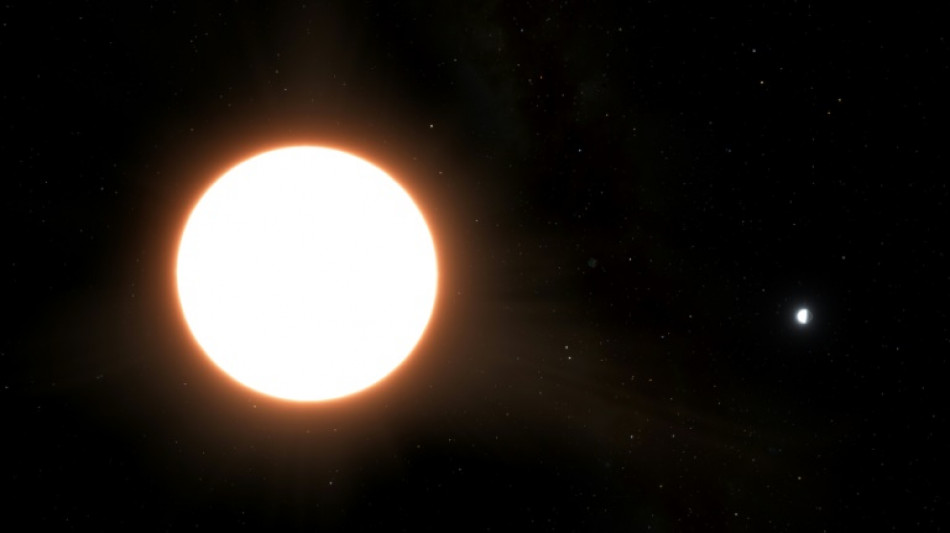
'Like a mirror': Astronomers identify most reflective exoplanet / Photo: Handout - EUROPEAN SPACE AGENCY/AFP

 NASA scan discovers new, 'once in a century' Moon crater

 Most stocks rise as Fed hikes and indicates drive to curb inflation

 UK-Sudanese author pens book to give children 'African history of Africa'

 US Congress passes sweeping Russia sanctions bill

 US stocks fall, dollar gains after Fed lifts interest rates

 US Fed raises rates to tackle 'too high' inflation in move sure to rile Trump

 US Fed raises rates to battle inflation in move likely to rile Trump

 US House faces test on sweeping Russia sanctions bill

 British PM says to make 'difficult decisions' as inflation rises

 Global fuel price demos: a round-up

 Leverate Launches MCP for Traders to Connect AI Assistants With Trading Platforms

 MEXC Launches $1M "Discover Your Wall Street DNA" Campaign to Help Traders Find Their Market Fit

 Stocks edge higher ahead of US Fed rate call

 BASIS.pro Expands On-Chain Infrastructure with XDC Network Partnership and Zypher DAO as Auto Earn Goes Live

 Pickle-flavoured tart? AI inspires Japan's convenience stores

 EU chief hosts Canada's Carney in push to 'deepen' alliance

 Meta chief pushes back on AI slowdown calls

 US Fed to deliver rate decision with markets betting on hike

 i-payout Expands U.S. Money Transmitter Licensing Footprint and Advances European EMI Strategy

 US Senate crypto bill collapses amid partisan deadlock

 OpenAI, Anthropic and Google are working to create an AI standards body

 Protesting shepherds, farmers clash with Romanian police

 Foundation Lets Ledger Users Switch to Open Source Without Starting Over

 EU to propose curbing social media, online games for under 15s

 FX Junction Reaches 40,600 Members and 26 Million Trades

A scorching hot world where metal clouds rain drops of titanium is the most reflective planet ever observed outside of our Solar System, astronomers said on Monday.
This strange world, which is more than 260 light years from Earth, reflects 80 percent of the light from its host star, according to new observations from Europe's exoplanet-probing Cheops space telescope.
That makes it the first exoplanet comparably shiny as Venus, which is the brightest object in our night sky other than the Moon.
First discovered in 2020, the Neptune-sized planet called LTT9779b orbits its star in just 19 hours.
Because it is so close, the side of the planet facing its star is a sizzling 2,000 degrees Celsius, which is considered far too hot for clouds to form.
Yet LTT9779b seems to have them.
"It was really a puzzle," said Vivien Parmentier, a researcher at France's Cote d'Azur Observatory and co-author of a new study in the journal Astronomy and Astrophysics.
The researchers then "realised we should think about this cloud formation in the same way as condensation forming in a bathroom after a hot shower," he said in a statement.
Like running hot water steams up a bathroom, a scorching stream of metal and silicate -- the stuff of which glass is made -- oversaturated LTT9779b's atmosphere until metallic clouds formed, he said.
- Surviving 'Neptune desert' -
The planet, which is around five times the size of Earth, is an outlier in other ways.
The only exoplanets previously found that orbit their stars in less than 24 hours are either gas giants 10 times bigger than Earth -- or rocky planets half its size.
But LTT9779b lives in a region called the "Neptune desert", where planets its size are not supposed to be found.
"It's a planet that shouldn't exist," Parmentier said.
"We expect planets like this to have their atmosphere blown away by their star, leaving behind bare rock."
The planet's metallic clouds "act like a mirror," reflecting away light and preventing the atmosphere from being blown away, according to the European Space Agency's Cheops project scientist Maximilian Guenther.
"It's a bit like a shield, like in those old Star Trek films where they have shields around their ships," he told AFP.
The research marks "a big milestone" because it shows how a Neptune-sized planet could survive in the Neptune desert, he added.
The European Space Agency's Cheops space telescope was launched into Earth's orbit in 2019 on a mission to investigate planets discovered outside our Solar System.
It measured the reflectiveness of LTT9779b by comparing the light before and after the exoplanet disappeared behind its star.
A.Leibowitz--CPN