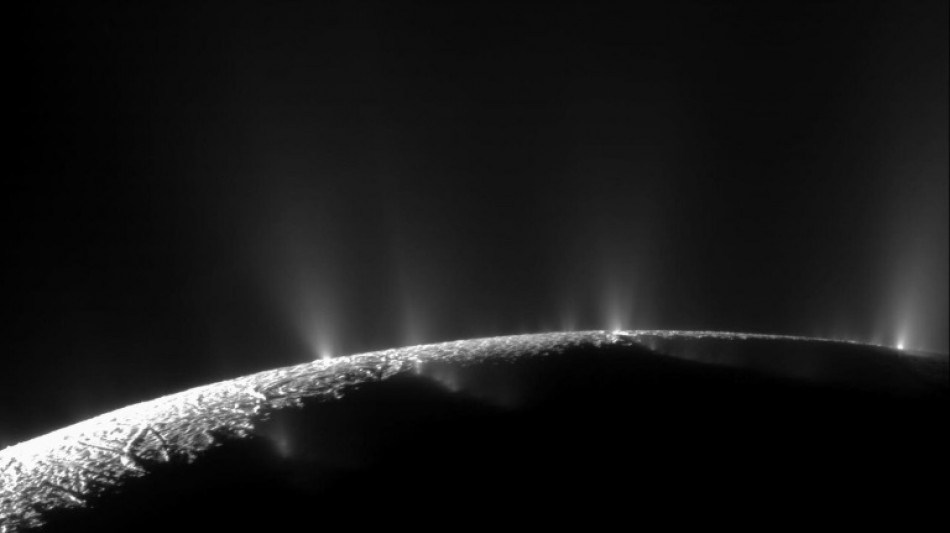
NASA finds key building block for life in a moon of Saturn / Photo: HANDOUT - NASA/AFP

 NASA scan discovers new, 'once in a century' Moon crater

 Most stocks rise as Fed hikes and indicates drive to curb inflation

 UK-Sudanese author pens book to give children 'African history of Africa'

 US Congress passes sweeping Russia sanctions bill

 US stocks fall, dollar gains after Fed lifts interest rates

 US Fed raises rates to tackle 'too high' inflation in move sure to rile Trump

 US Fed raises rates to battle inflation in move likely to rile Trump

 US House faces test on sweeping Russia sanctions bill

 British PM says to make 'difficult decisions' as inflation rises

 Global fuel price demos: a round-up

 Leverate Launches MCP for Traders to Connect AI Assistants With Trading Platforms

 MEXC Launches $1M "Discover Your Wall Street DNA" Campaign to Help Traders Find Their Market Fit

 Stocks edge higher ahead of US Fed rate call

 BASIS.pro Expands On-Chain Infrastructure with XDC Network Partnership and Zypher DAO as Auto Earn Goes Live

 Pickle-flavoured tart? AI inspires Japan's convenience stores

 EU chief hosts Canada's Carney in push to 'deepen' alliance

 Meta chief pushes back on AI slowdown calls

 US Fed to deliver rate decision with markets betting on hike

 i-payout Expands U.S. Money Transmitter Licensing Footprint and Advances European EMI Strategy

 US Senate crypto bill collapses amid partisan deadlock

 OpenAI, Anthropic and Google are working to create an AI standards body

 Protesting shepherds, farmers clash with Romanian police

 Foundation Lets Ledger Users Switch to Open Source Without Starting Over

 EU to propose curbing social media, online games for under 15s

 FX Junction Reaches 40,600 Members and 26 Million Trades

The long hunt for extraterrestrials just got a big boost.
Scientists have discovered that phosphorus, a key building block of life, lies in the ocean beneath the icy surface of Saturn's moon Enceladus.
The finding was based on a review of data collected by NASA's Cassini probe, and was published Wednesday in the prestigious journal Nature.
Cassini started exploring Saturn and its rings and moons in 2004, before burning up in the gas giant's atmosphere when its mission ended in 2017.
"This is a stunning discovery for astrobiology," said Christopher Glein of the Southwest Research Institute, one of the paper's co-authors, adding: "We have found abundant phosphorus in plume ice samples spraying out of the subsurface ocean."
Geysers on Enceladus' south pole spew icy particles through cracks on the surface out into space, feeding Saturn's E ring -- the faint ring outside the brighter main rings.
Scientists previously found other minerals and organic compounds in the ejected ice grains, but not phosphorus, which is an essential building block for DNA and RNA, and is also found in the bones and teeth of people, animals, and even ocean plankton.
Simply put, life as we know it would not be possible without phosphorus.
While geochemical modeling had previously found it was likely phosphorus would also be present, and this prediction was published in an earlier paper, it is one thing to forecast something and another to confirm, said Glein.
"It's the first time this essential element has been discovered in an ocean beyond Earth," added first author Frank Postberg, a planetary scientist at Freie Universitat Berlin, in a NASA statement.
To make the new discovery, authors combed through data collected by Cassini's Cosmic Dust Analyzer instrument, and confirmed the findings by carrying out laboratory experiments to show that Enceladus' ocean has phosphorus bound inside different water-soluble forms.
Over the past 25 years, planetary scientists have discovered that worlds with oceans beneath a surface layer of ice are common in our solar system.
These include Jupiter's moon Europa, Saturn's largest moon Titan, but even the more distant body, Pluto.
While planets like Earth that have surface oceans need to reside within a narrow window of distance from their host star to maintain the right temperatures for life, the discovery of worlds with subsurface oceans expands the number of habitable bodies that might exist.
"With this finding, the ocean of Enceladus is now known to satisfy what is generally considered to be the strictest requirement for life," said Glein.
"The next step is clear –- we need to go back to Enceladus to see if the habitable ocean is actually inhabited."
M.Mendoza--CPN