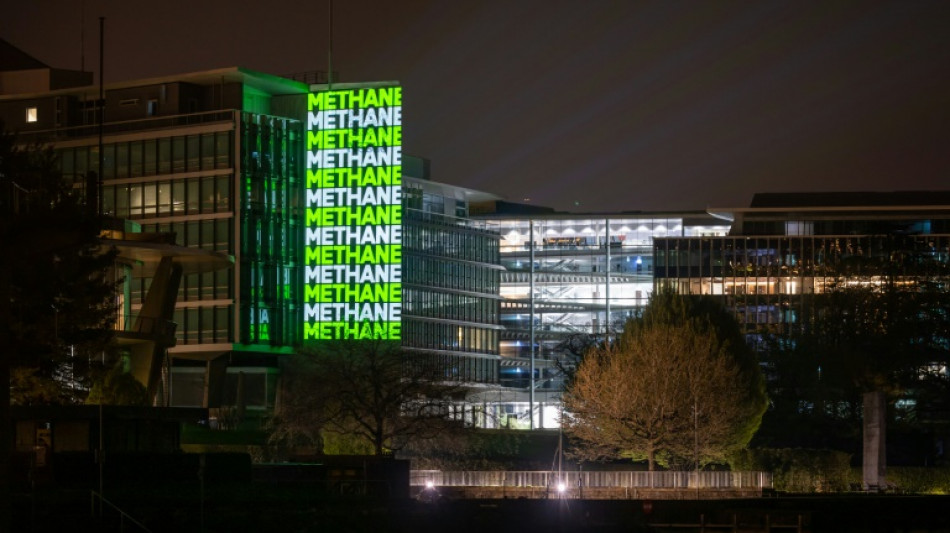
Most nations get low marks on 'net-zero' climate plans / Photo: Fabrice COFFRINI - AFP/File

 NASA scan discovers new, 'once in a century' Moon crater

 Most stocks rise as Fed hikes and indicates drive to curb inflation

 UK-Sudanese author pens book to give children 'African history of Africa'

 US Congress passes sweeping Russia sanctions bill

 US stocks fall, dollar gains after Fed lifts interest rates

 US Fed raises rates to tackle 'too high' inflation in move sure to rile Trump

 US Fed raises rates to battle inflation in move likely to rile Trump

 US House faces test on sweeping Russia sanctions bill

 British PM says to make 'difficult decisions' as inflation rises

 Global fuel price demos: a round-up

 Leverate Launches MCP for Traders to Connect AI Assistants With Trading Platforms

 MEXC Launches $1M "Discover Your Wall Street DNA" Campaign to Help Traders Find Their Market Fit

 Stocks edge higher ahead of US Fed rate call

 BASIS.pro Expands On-Chain Infrastructure with XDC Network Partnership and Zypher DAO as Auto Earn Goes Live

 Pickle-flavoured tart? AI inspires Japan's convenience stores

 EU chief hosts Canada's Carney in push to 'deepen' alliance

 Meta chief pushes back on AI slowdown calls

 US Fed to deliver rate decision with markets betting on hike

 i-payout Expands U.S. Money Transmitter Licensing Footprint and Advances European EMI Strategy

 US Senate crypto bill collapses amid partisan deadlock

 OpenAI, Anthropic and Google are working to create an AI standards body

 Protesting shepherds, farmers clash with Romanian police

 Foundation Lets Ledger Users Switch to Open Source Without Starting Over

 EU to propose curbing social media, online games for under 15s

 FX Junction Reaches 40,600 Members and 26 Million Trades

Nearly all of 35 countries accounting for more than four-fifths of global greenhouse gas emissions got low marks for their net zero plans in a peer-reviewed assessment published Thursday.
Of the four biggest carbon polluters, only the European Union's plan was deemed credible, while those of China, the United States and India were found lacking.
Most nations have set targets to eliminate their carbon footprint around mid-century, with commitments from China and India for 2060 and 2070, respectively.
The extent to which Earth remains hospitable in a warming world depends in large measure on whether these pledges are kept, but assessing their credibility has proven difficult.
Many net-zero goals lack details, and some do not even specify if they cover just CO2 or other important planet-warming gases as well, such as methane and nitrous oxide.
These uncertainties, in turn, have confounded attempts to project global temperature increases, and whether the Paris climate treaty goals of capping global warming at "well below" two degrees Celsius, and at 1.5C if possible, remains within reach.
If both short-term and long-term plans from all countries are accepted at face value, global warming could stabilise in that critical range between 1.5C and 2C.
But if only policies already in place are taken into account and more-or-less vague promises are set aside, temperatures are more likely to settle between 2.5C and 3C.
"The two outcomes could not contrast more," Joeri Rogelj, director of research at Imperial College's Grantham Institute, and a team of international scientists wrote in the journal Science.
- 'A high-risk track' -
One scenario sees climate damages capped a "potentially manageable levels," and the other "a world where climate change continues toward levels that undermine sustainable development."
Every country in the world whose greenhouse gas emissions comprise at least 0.1 percent of the global total was then given a "credibility rating" of higher, lower or much lower.
A handful of countries besides the European Union got top marks, including Britain and New Zealand.
But around 90 percent inspired lower or much lower confidence, including the US and China, which together account for more than a third of global emissions.
Most of the worlds major emerging economies -- Brazil, India, South Africa and Indonesia, for example -- got the lowest ratings, as did Gulf states Egypt and the United Arab Emirates, hosts respectively of last year's COP27 climate summit and COP28 in Dubai in December.
Among wealthy nations, only Australia was in the least credible tier.
Today, a third of the 35 nations have net zero policies enshrined in law.
"Making targets legally binding is crucial to ensure long-term plans are adopted," said co-author Robin Lamboll, from Imperial College's Centre for Environmental Policy.
"We need to see concrete legislation in order to trust that action will follow promises."
Detailed, step-by-step plans showing how emissions cuts will be distributed over time across all economic and social sectors is key, the authors said.
The researchers applied the new credibility ratings to model different scenarios for future emissions and the temperatures they will yield.
When only net-zero plans that inspired high confidence were added to policies already under way, global warming was projected to top out at 2.4C by 2100 -- still far above the Paris targets.
"The world is still on a high-risk climate track, and we are far from delivering a safe climate future," Rogelj said in a statement.
mh/cw
P.Gonzales--CPN