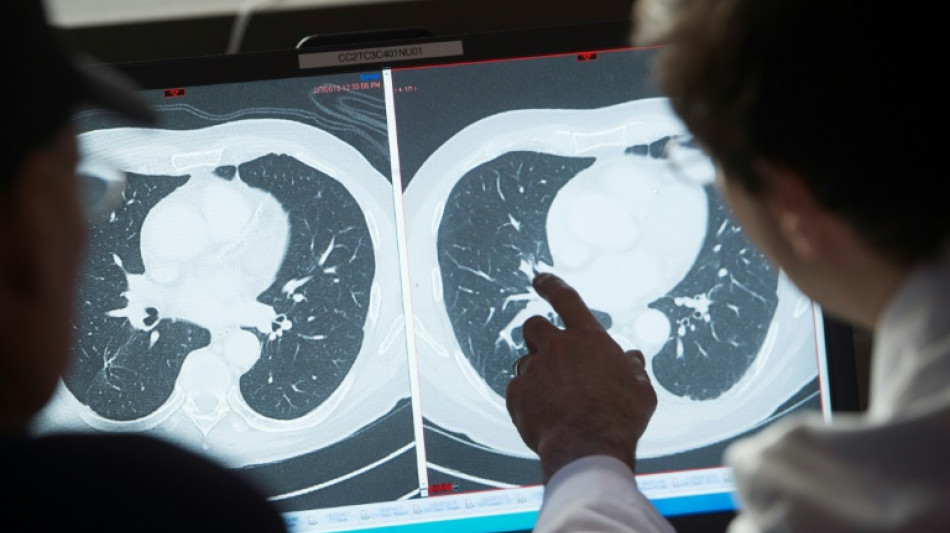
'Ray of hope': New advances in fighting a range of cancers / Photo: SAUL LOEB - AFP/File

 NASA scan discovers new, 'once in a century' Moon crater

 Most stocks rise as Fed hikes and indicates drive to curb inflation

 UK-Sudanese author pens book to give children 'African history of Africa'

 US Congress passes sweeping Russia sanctions bill

 US stocks fall, dollar gains after Fed lifts interest rates

 US Fed raises rates to tackle 'too high' inflation in move sure to rile Trump

 US Fed raises rates to battle inflation in move likely to rile Trump

 US House faces test on sweeping Russia sanctions bill

 British PM says to make 'difficult decisions' as inflation rises

 Global fuel price demos: a round-up

 Leverate Launches MCP for Traders to Connect AI Assistants With Trading Platforms

 MEXC Launches $1M "Discover Your Wall Street DNA" Campaign to Help Traders Find Their Market Fit

 Stocks edge higher ahead of US Fed rate call

 BASIS.pro Expands On-Chain Infrastructure with XDC Network Partnership and Zypher DAO as Auto Earn Goes Live

 Pickle-flavoured tart? AI inspires Japan's convenience stores

 EU chief hosts Canada's Carney in push to 'deepen' alliance

 Meta chief pushes back on AI slowdown calls

 US Fed to deliver rate decision with markets betting on hike

 i-payout Expands U.S. Money Transmitter Licensing Footprint and Advances European EMI Strategy

 US Senate crypto bill collapses amid partisan deadlock

 OpenAI, Anthropic and Google are working to create an AI standards body

 Protesting shepherds, farmers clash with Romanian police

 Foundation Lets Ledger Users Switch to Open Source Without Starting Over

 EU to propose curbing social media, online games for under 15s

 FX Junction Reaches 40,600 Members and 26 Million Trades

New advances in the fight against a range of cancers have been revealed at the annual meeting of the American Society of Clinical Oncology (ASCO), which wraps up in Chicago on Tuesday.
Here are some of the announcements that have most excited experts.
- Lung cancer -
One of the trial results that caused a stir in Chicago has raised hopes for a new weapon against lung cancer, the deadliest of all cancers.
The treatment osimertinib was shown to halve the risk of death from a certain type of lung cancer when taken daily after surgery to remove the tumour.
Developed by the pharmaceutical group AstraZeneca, the daily pill targets patients with non-small cell cancer -- by far the most common type -- as well as a mutation of their epidermal growth factor receptor, or EGFR.
Iris Pauporte, head of research at France's League Against Cancer, told AFP the advance was a "big ray of hope" for this type of cancer, for which progress has been slow.
Muriel Dahan, head of research at Unicancer, said that if the results are confirmed, it "should change" common practice in treating this kind of lung cancer.
Systematic testing for the EGFR mutation would also become necessary for lung cancer patients, she added.
- Brain cancer -
Another treatment, called vorasidenib, was found to significantly prolong the progression-free survival of patients with brain tumour glioma, according to clinical trial results.
The daily pill, developed by French pharma firm Servier, aims to block an enzyme responsible for the progression of some brain cancers, which have been particularly difficult to treat.
Patrick Therasse, Servier's vice-president of oncology research, told AFP that there "have been few therapeutic advances for brain tumours over the last 20 years".
"Thanks to our targeted treatment, patients avoided cancer progression for 27.7 months, compared to 11.1 months" for those taking a placebo, he added.
Fabrice Andre, head of research at France's Gustave Roussy cancer centre, said "precision medicine opens a door for a disease for which there was nothing until now".
"It means that science can unblock situations that were catastrophic," he told AFP.
Unicancer's Dahan said it was important to "remain cautious" but added that "this could become the new therapeutic standard -- depending on further trials".
- Breast cancer -
Preliminary trial results also released in Chicago indicated the drug ribociclib reduced the risk of breast cancer recurring by 25 percent for a large group of early-stage survivors.
The drug, developed by Swiss pharmaceutical maker Novartis, is already widely approved around the world. It was tested in combination with hormonal therapy.
ASCO expert Rita Nanda said it was a "very important and practice-changing clinical trial".
- Cervical cancer -
There was also good news for patients with early-stage cervical cancer with a low risk of progression.
There was no greater risk of the cancer returning for patients who get a simple hysterectomy, in which the uterus and cervix are removed, than a radical hysterectomy, in which the uppermost part of the vagina is also removed, according to phase three trials.
League Against Cancer's Pauporte said this was "good news," adding that "it shows that it's not just progress involving drugs that was important".
- Ovarian cancer -
A trial also presented at ASCO showed that taking the antibody treatment mirvetuximab soravtansine significantly improved the survival rate of patients with ovarian cancer, a particularly deadly form of cancer.
ASCO expert Merry Jennifer Markham said the treatment "demonstrates progress and offers hope for these patients".
- Rectal cancer -
Study results released in Chicago indicated that patients with locally advanced rectal cancer could receive chemotherapy without getting radiation therapy before undergoing surgery.
This would spare patients from the brutal side effects of radiation.
- Vaccines -
Vaccines that treat existing cancer have long been a goal of the medical community.
Preliminary studies announced at the ASCO meeting involved vaccines targeting lung cancer, head and neck cancers, brain tumour glioblastoma and the cancer-causing HPV virus.
Christophe Le Tourneau, an oncologist at France's Curie Institute which presented a study about a vaccine for a certain form of HPV, said there has been "significant technological progress" in the area recently.
"Therapeutic vaccines, we talk about them more and more, and there are more and more trials in progress," he said.
T.Morelli--CPN