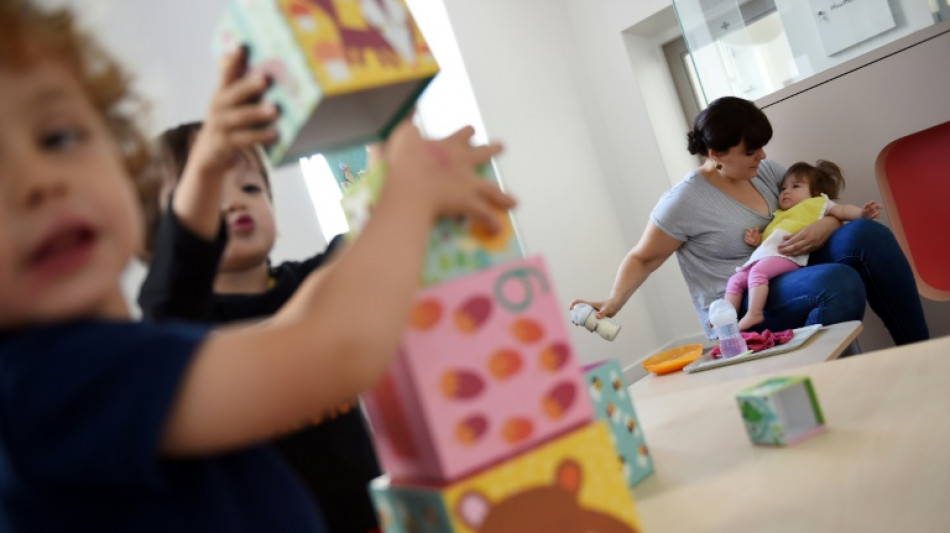
Baby boys more chatty than girls, according to large study / Photo: LOIC VENANCE - AFP/File

 NASA scan discovers new, 'once in a century' Moon crater

 Most stocks rise as Fed hikes and indicates drive to curb inflation

 UK-Sudanese author pens book to give children 'African history of Africa'

 US Congress passes sweeping Russia sanctions bill

 US stocks fall, dollar gains after Fed lifts interest rates

 US Fed raises rates to tackle 'too high' inflation in move sure to rile Trump

 US Fed raises rates to battle inflation in move likely to rile Trump

 US House faces test on sweeping Russia sanctions bill

 British PM says to make 'difficult decisions' as inflation rises

 Global fuel price demos: a round-up

 Leverate Launches MCP for Traders to Connect AI Assistants With Trading Platforms

 MEXC Launches $1M "Discover Your Wall Street DNA" Campaign to Help Traders Find Their Market Fit

 Stocks edge higher ahead of US Fed rate call

 BASIS.pro Expands On-Chain Infrastructure with XDC Network Partnership and Zypher DAO as Auto Earn Goes Live

 Pickle-flavoured tart? AI inspires Japan's convenience stores

 EU chief hosts Canada's Carney in push to 'deepen' alliance

 Meta chief pushes back on AI slowdown calls

 US Fed to deliver rate decision with markets betting on hike

 i-payout Expands U.S. Money Transmitter Licensing Footprint and Advances European EMI Strategy

 US Senate crypto bill collapses amid partisan deadlock

 OpenAI, Anthropic and Google are working to create an AI standards body

 Protesting shepherds, farmers clash with Romanian police

 Foundation Lets Ledger Users Switch to Open Source Without Starting Over

 EU to propose curbing social media, online games for under 15s

 FX Junction Reaches 40,600 Members and 26 Million Trades

Baby boys babble more than girls, according to a scientific paper out Wednesday that upends a common belief that females hold a language advantage over males early on in life.
The findings, published in iScience after the largest ever study on the subject, came as a surprise even to the paper's authors.
They say it might be the result of an important sex difference that emerged during our species' evolution.
A team led by D. Kimbrough Oller of the University of Memphis, Tennessee used an algorithm to trawl through a data set of more than 450,000 hours of non-stop audio from 5,899 infants, recorded using an iPod sized device over two years.
"This is the biggest sample for any study ever conducted on language development, as far as we know," Oller said in a statement.
While young babies don't talk, they produce pre-speech vocalizations -- squeals, growls, raspberries, and later word-like sounds such as "ba" and "ga" -- collectively called "protophones" that eventually give way to real words and sentences.
The idea that girls acquire language faster than boys has long held sway in scientific circles, and with it the assumption that baby girls vocalize more than baby boys.
However, the results showed that boys made 10 percent more utterances in the first year of life, before the girls caught up and made seven percent more sounds by the second year.
- Evolutionary theory -
The differences occurred despite the fact that adult care-givers spoke more to girls than to boys across both years.
One theory for the finding was that male infants were more vocal because they were more active in general. But the data did not support this, since higher male vocalizations gave way to females around the 16 month mark, but higher physical activity did not.
Instead, the team suggests their findings might fit an evolutionary theory which holds that infants make sounds in order to signal their wellbeing to their caregivers, who in turn invest more energy and attention in them.
Boys have higher mortality rates than girls in their first year of life, according to a broad body of research, and so it may follow that more vocal baby boys in the distant past were more likely to survive and pass on their genes.
But by the second year of life, death rates have dropped dramatically for both sexes, and "the pressure on special fitness signaling is lower for both boys and girls," said Oller.
Next, Oller plans more research on how caregivers respond to baby talk.
"We anticipate that caregivers will show discernible reactions of interest and of being charmed by the speech-like sounds, indicators that fitness-signaling by the baby elicits real feelings of fondness and willingness to invest in the well-being of infants," he said.
X.Wong--CPN