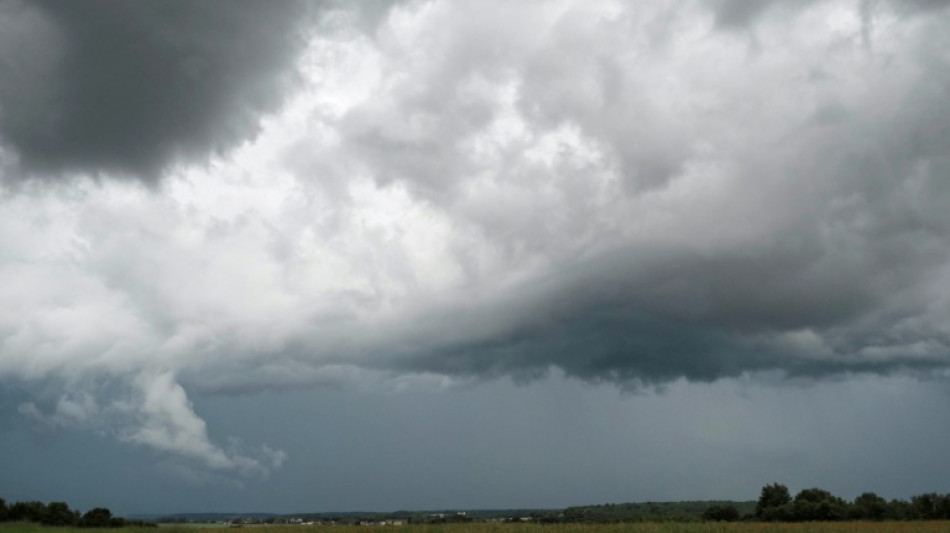
Clouds carry drug-resistant bacteria across distances: study / Photo: GUILLAUME SOUVANT - AFP/File

 Where the US-China tariff row stands ahead of White House summit

 Indonesia cash-for-photos scheme turns animal hunters into protectors

 Argentine judge orders suspension of Falklands oil project

 US Fed raises rates to tackle 'too high' inflation, irking Trump

 Turkey releases 106 protesters, jails more LGBTQ activists

 Candidate for UN chief calls for AI regulation akin to nuclear weapons

 'We're losing control,' AI pioneer Yoshua Bengio tells AFP

 IR-MED and Dice Technologies Announce collaboration to Evaluate and Advance Pressure-Injury Prevention Platform in Japan

 Watts, Pitt, Cruz to light up Spain's top film festival

 Toogood Gold's Table Mountain Sits in the Shadow of a Nevada Gold Rush

 MEXC July–August Security Report: 38.66M USDT in Risk Funds Intercepted, Futures Insurance Fund Hits 792M USDT

 Emporio Armani names Dario Vitale new creative director

 EU to ban social media for under 13s, curb access until 15

 Wildfires push endangered Sumatran elephants to brink: Indonesian NGO

 Bank of Japan set to raise rates under pressure from inflation, US

 EU chief to unveil social media, gaming curbs for under-15s

 'Resident Evil' film brings video game's ethos to the big screen

 GA-ASI Mojave First UAS To Complete Battlefield Short Field Ops

 Sanders, Bannon warn of AI dangers in rare US left-right alignment

 Empty benches as schools reopen in Venezuela's quake-hit Guaira

 Tiny English village holds 'independence' vote over asylum seeker housing

 US Treasury chief says to meet Chinese counterpart at weekend

 BingX Evolves into a Multi-Asset Trading Platform, Connecting Users to Global Opportunities

 International Trading Institute Expands Professional Trader Development Beyond the Master’s in Trading

 Lake Energy Secures $80 Million for U.S. Renewable Energy Expansion

For a team of Canadian and French researchers, dark clouds on the horizon are potentially ominous not because they signal an approaching storm -- but because they were found in a recent study to carry drug-resistant bacteria over long distances.
"These bacteria usually live on the surface of vegetation like leaves, or in soil," lead author Florent Rossi said in a telephone interview Friday.
"We found that they are carried by the wind into the atmosphere and can travel long distances -- around the world -- at high altitudes in clouds," he told AFP.
The discovery was published in last month's edition of the journal Science of The Total Environment.
The researchers from Laval University in Quebec City and Clermont Auvergne University in central France searched for antibiotic-resistant genes from bacteria found in cloud samples.
The samples were taken from an atmospheric research station perched 1,465 meters (4,806 feet) above sea level atop the Puy de Dome summit, a dormant volcano in central France between September 2019 and October 2021.
An analysis of the retrieved mist revealed that they contained between 330 to more than 30,000 bacteria per milliliter of cloud water, for an average of around 8,000 bacteria er milliliter.
They also identified 29 subtypes of antibiotic-resistant genes in the bacteria.
Drug resistance occurs when bacteria are exposed to antibiotics and develop an immunity to them over generations.
Health authorities have repeatedly warned these adaptations are becoming what the study described as a "major sanitary concern worldwide," making it harder -- in some cases impossible -- to treat certain bacterial infections as antibiotics use continues to rise in health care and agriculture.
The study offered no conclusions on the potential health effects of the spread in the atmosphere of antibiotic resistant bacteria -- estimating that only five percent to 50 percent of the organisms could be alive and potentially active.
But Rossi suggested the risks are likely low.
"The atmosphere is very stressful for bacteria, and most of those we found were environmental bacteria," which are less likely to be harmful to humans, he explained. "So people shouldn't be afraid to go for a walk in the rain."
"It's unclear if those genes would be transmitted to other bacteria," Rossi added.
Atmospheric monitoring, however, could help pinpoint the sources of drug-resistant bacteria -- similar to wastewater tests for Covid-19 and other pathogens -- "in order to limit their dispersal," he said.
P.Gonzales--CPN