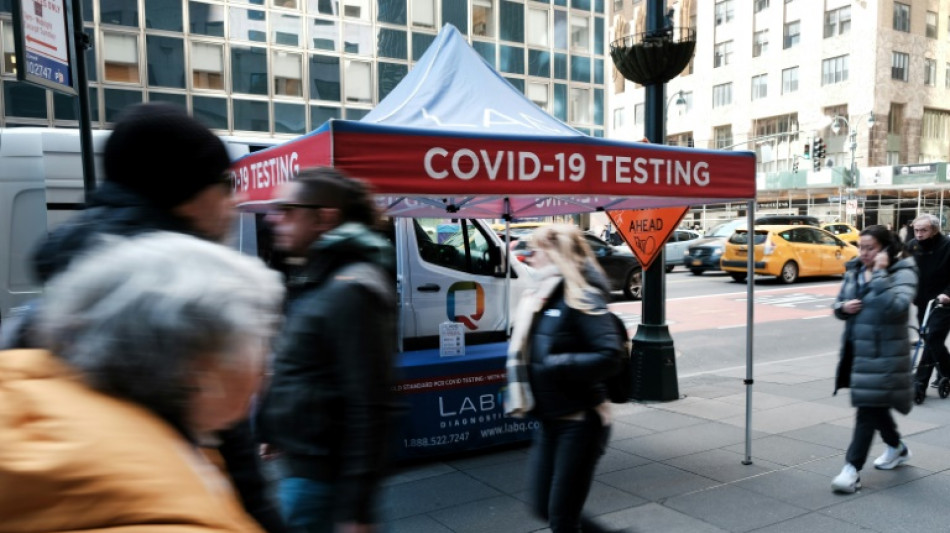
Scientists develop mobile printer for mRNA vaccine patches / Photo: SPENCER PLATT - GETTY IMAGES NORTH AMERICA/AFP

 Where the US-China tariff row stands ahead of White House summit

 Indonesia cash-for-photos scheme turns animal hunters into protectors

 Argentine judge orders suspension of Falklands oil project

 US Fed raises rates to tackle 'too high' inflation, irking Trump

 Turkey releases 106 protesters, jails more LGBTQ activists

 Candidate for UN chief calls for AI regulation akin to nuclear weapons

 'We're losing control,' AI pioneer Yoshua Bengio tells AFP

 IR-MED and Dice Technologies Announce collaboration to Evaluate and Advance Pressure-Injury Prevention Platform in Japan

 Watts, Pitt, Cruz to light up Spain's top film festival

 Toogood Gold's Table Mountain Sits in the Shadow of a Nevada Gold Rush

 MEXC July–August Security Report: 38.66M USDT in Risk Funds Intercepted, Futures Insurance Fund Hits 792M USDT

 Emporio Armani names Dario Vitale new creative director

 EU to ban social media for under 13s, curb access until 15

 Wildfires push endangered Sumatran elephants to brink: Indonesian NGO

 Bank of Japan set to raise rates under pressure from inflation, US

 EU chief to unveil social media, gaming curbs for under-15s

 'Resident Evil' film brings video game's ethos to the big screen

 GA-ASI Mojave First UAS To Complete Battlefield Short Field Ops

 Sanders, Bannon warn of AI dangers in rare US left-right alignment

 Empty benches as schools reopen in Venezuela's quake-hit Guaira

 Tiny English village holds 'independence' vote over asylum seeker housing

 US Treasury chief says to meet Chinese counterpart at weekend

 BingX Evolves into a Multi-Asset Trading Platform, Connecting Users to Global Opportunities

 International Trading Institute Expands Professional Trader Development Beyond the Master’s in Trading

 Lake Energy Secures $80 Million for U.S. Renewable Energy Expansion

Scientists said Monday they have developed the first mobile printer that can produce thumbnail-sized patches able to deliver mRNA Covid vaccines, hoping the tabletop device will help immunise people in remote regions.
While many hurdles remain and the 3D printer is likely years away from becoming available, experts hailed the "exciting" finding.
The device prints two-centimetre-wide patches which each contain hundreds of tiny needles that administer a vaccine when pressed against the skin.
These "microneedle patches" offer a range of advantages over traditional jabs in the arm, including that they can be self-administered, are relatively painless, could be more palatable to the vaccine-hesitant and can be stored at room temperature for long periods of time.
The popular mRNA Covid-19 vaccines from Pfizer and Moderna need to be refrigerated, which has caused distribution complications -- particularly in developing countries that have condemned the unequal distribution of doses during the pandemic.
The new printer was tested with the Pfizer and Moderna jabs, according to a study in the journal Nature Biotechnology, but the goal of the international team of researchers behind it is for it to be adapted to whatever vaccines are needed.
Robert Langer, co-founder of Moderna and one of the study's authors, told AFP that he hoped the printer could be used for "the next Covid, or whatever crisis occurs".
Ana Jaklenec, a study author also from the Massachusetts Institute of Technology, said the printer could be sent to areas such as refugee camps or remote villages to "quickly immunise the local population," in the event of a fresh outbreak of a disease like Ebola.
- Vacuum-sealed -
Microneedle patch vaccines are already under development for Covid and a range of other diseases, including polio, measles and rubella.
But the patches have long struggled to take off because producing them is an expensive, laborious process often involving large machines for centrifugation.
To shrink that process down, the researchers used a vacuum chamber to suck the printer "ink" into the bottom of their patch moulds, so it reaches the points of the tiny needles.
The vaccine ink is made up of lipid nanoparticles containing mRNA vaccine molecules, as well as a polymer similar to sugar water.
Once allowed to dry, the patches can be stored at room temperature for at least six months, the study found. The patches even survived a month at a balmy 37 degrees Celsius (99 Fahrenheit).
Mice which were given a vaccine patch produced a similar level of antibody response to others immunised via a traditional injection, the study said.
The printed patches are currently being tested on primates, which if successful would lead to trials on humans.
- 'A real breakthrough'? -
The printer can make 100 patches in 48 hours. But modelling suggested that -- with improvements -- it could potentially print thousands a day, the researchers said.
"And you can have more than one printer," Langer added.
Joseph DeSimone, a chemist at Stanford University not involved in the research, said that "this work is particularly exciting as it realises the ability to produce vaccines on demand".
"With the possibility of scaling up vaccine manufacturing and improved stability at higher temperatures, mobile vaccine printers can facilitate widespread access to RNA vaccines," said DeSimone, who has invented his own microneedle patches.
Antoine Flahault, director of the Institute of Global Health at the University of Geneva, said that production and access to vaccines could be "transformed through such a printer".
"It might become a real breakthrough," he told AFP, while warning that this depended on approval and mass production, which could take years.
Darrick Carter, a biochemist and CEO of US biotech firm PAI Life Sciences, was less optimistic.
He said that the field of microneedle patches had "suffered for 30 years" because no one had yet been able to scale up manufacturing in a cost-effective way.
"Until someone figures out the manufacturing scale-up issues for microneedle patches they will remain niche products," he told AFP.
D.Goldberg--CPN