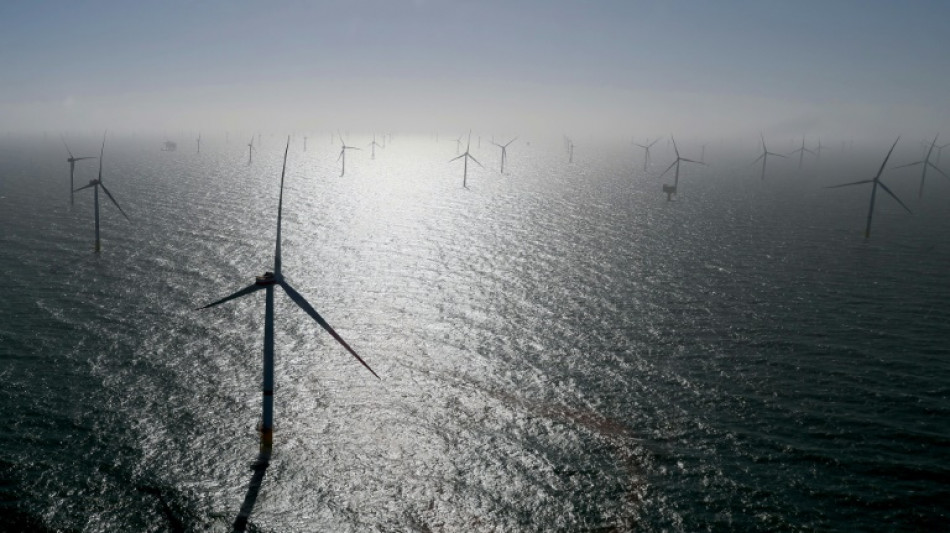
European summit looks to boost wind energy production / Photo: Christian Charisius - POOL/AFP

 Where the US-China tariff row stands ahead of White House summit

 Indonesia cash-for-photos scheme turns animal hunters into protectors

 Argentine judge orders suspension of Falklands oil project

 US Fed raises rates to tackle 'too high' inflation, irking Trump

 Turkey releases 106 protesters, jails more LGBTQ activists

 Candidate for UN chief calls for AI regulation akin to nuclear weapons

 'We're losing control,' AI pioneer Yoshua Bengio tells AFP

 IR-MED and Dice Technologies Announce collaboration to Evaluate and Advance Pressure-Injury Prevention Platform in Japan

 Watts, Pitt, Cruz to light up Spain's top film festival

 Toogood Gold's Table Mountain Sits in the Shadow of a Nevada Gold Rush

 MEXC July–August Security Report: 38.66M USDT in Risk Funds Intercepted, Futures Insurance Fund Hits 792M USDT

 Emporio Armani names Dario Vitale new creative director

 EU to ban social media for under 13s, curb access until 15

 Wildfires push endangered Sumatran elephants to brink: Indonesian NGO

 Bank of Japan set to raise rates under pressure from inflation, US

 EU chief to unveil social media, gaming curbs for under-15s

 'Resident Evil' film brings video game's ethos to the big screen

 GA-ASI Mojave First UAS To Complete Battlefield Short Field Ops

 Sanders, Bannon warn of AI dangers in rare US left-right alignment

 Empty benches as schools reopen in Venezuela's quake-hit Guaira

 Tiny English village holds 'independence' vote over asylum seeker housing

 US Treasury chief says to meet Chinese counterpart at weekend

 BingX Evolves into a Multi-Asset Trading Platform, Connecting Users to Global Opportunities

 International Trading Institute Expands Professional Trader Development Beyond the Master’s in Trading

 Lake Energy Secures $80 Million for U.S. Renewable Energy Expansion

Nine European countries held a summit on Monday aimed at scaling up wind power generation in the North Sea, spurred by the fallout of the Ukraine war and the push for renewables.
"We've seen over the past months what the impact is if you are too dependent on outsiders for the supply of energy," said Belgian Prime Minister Alexander De Croo, hosting the meeting in the coastal town of Ostend.
The leaders of EU members France, Germany, Ireland, Denmark, the Netherlands and Luxembourg, along with European Commission chief Ursula von der Leyen, attended the summit.
Norway and Britain also participated, with the latter represented by UK Energy Security Secretary Grant Shapps.
In a joint op-ed published in Politico, the leaders of the nine nations emphasised the need to build more offshore wind turbines "to reach our climate goals, and to rid ourselves of Russian gas, ensuring a more secure and independent Europe".
Several leaders pointed to the need also to ensure security of offshore wind farms and their interconnectors, in the wake of recent reports of a Russian spy ship in the North Sea and last year's sabotage of the Nord Stream gas pipelines in the Baltic Sea.
De Croo said North Sea infrastructure, including turbines and undersea cables "are prone to sabotage or to espionage" and the topic was "an extremely important one" at the summit.
The summit's collective goal, stated by all the leaders, is to boost offshore wind power generation to 120 gigawatts by 2030 -- from just 30 GW today -- and at least 300 GW by 2050.
They recognised the size of the task requires massive investment, and that standardising equipment is needed to bring down costs and timescales.
A key point, hammered by French President Emmanuel Macron, is to ensure the supply chain for the push for more North Sea wind power is anchored in Europe, rather than elsewhere, and that the jobs created are there.
"We want to secure our industrial chain, because it's important to deploy this offshore wind power but we don't want to repeat the errors we've sometimes committed in the past, of deploying equipment made on the other side of the world," he said.
The comment appeared to be directed at China, which currently dominates the supply of critical elements, such as rare earths. The European Union is seeking to shift away from that reliance on China by bolstering its own industries.
German Chancellor Olaf Scholz said the "very important" summit underscored the potential to greatly expand renewable energy from the North Sea.
- Industry criticism -
WindEurope, the federation representing Europe's wind energy industry, believes the summit's ambitions are achievable.
But it highlighted a lack of "adequate funding mechanisms" and recruitment in the sector.
The organisation says Europe needs to build the offshore infrastructure to add 20 GW in output per year, yet the sector currently has capacity for just seven GW annually, with supply chain bottlenecks for cables, substations and foundations, and in the availability of offshore wind vessels.
Investment to get Europe where it wants to be is huge: the EU has calculated the cost of reaching 300 GW in offshore energy production by 2050 at 800 billion euros ($900 billion).
Britain has the biggest fleet of offshore wind farms, 45 of them, currently producing 14 GW, with plans to expand capacity to 50 GW by 2030.
Germany's 30 wind farms produce eight GW, followed by the Netherlands with 2.8 GW and Denmark and Belgium both with 2.3 GW.
The other participating countries produce less than a gigawatt from their existing installations but share ambitions to greatly ramp up wind energy capacity.
J.Bondarev--CPN