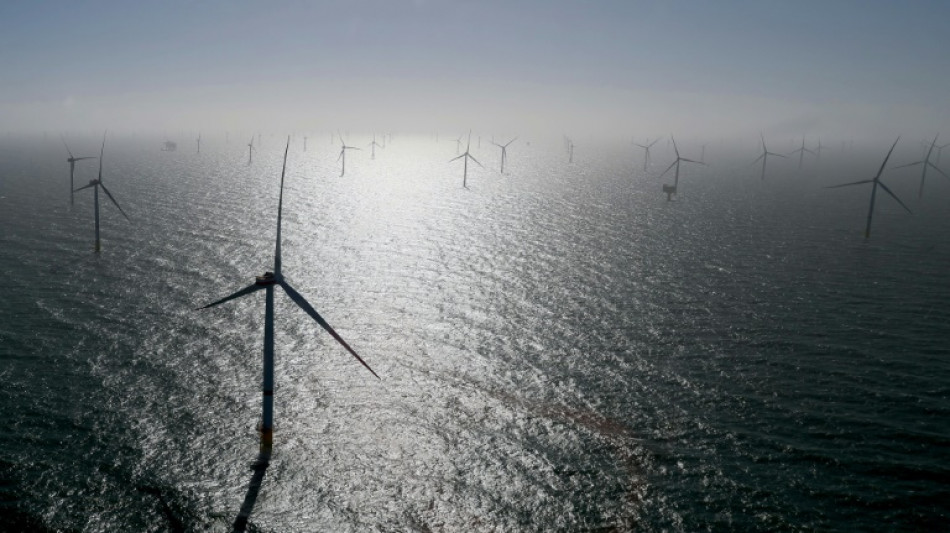
European summit to spur wind energy production in North Sea / Photo: Christian Charisius - POOL/AFP

 Where the US-China tariff row stands ahead of White House summit

 Indonesia cash-for-photos scheme turns animal hunters into protectors

 Argentine judge orders suspension of Falklands oil project

 US Fed raises rates to tackle 'too high' inflation, irking Trump

 Turkey releases 106 protesters, jails more LGBTQ activists

 Candidate for UN chief calls for AI regulation akin to nuclear weapons

 'We're losing control,' AI pioneer Yoshua Bengio tells AFP

 IR-MED and Dice Technologies Announce collaboration to Evaluate and Advance Pressure-Injury Prevention Platform in Japan

 Watts, Pitt, Cruz to light up Spain's top film festival

 Toogood Gold's Table Mountain Sits in the Shadow of a Nevada Gold Rush

 MEXC July–August Security Report: 38.66M USDT in Risk Funds Intercepted, Futures Insurance Fund Hits 792M USDT

 Emporio Armani names Dario Vitale new creative director

 EU to ban social media for under 13s, curb access until 15

 Wildfires push endangered Sumatran elephants to brink: Indonesian NGO

 Bank of Japan set to raise rates under pressure from inflation, US

 EU chief to unveil social media, gaming curbs for under-15s

 'Resident Evil' film brings video game's ethos to the big screen

 GA-ASI Mojave First UAS To Complete Battlefield Short Field Ops

 Sanders, Bannon warn of AI dangers in rare US left-right alignment

 Empty benches as schools reopen in Venezuela's quake-hit Guaira

 Tiny English village holds 'independence' vote over asylum seeker housing

 US Treasury chief says to meet Chinese counterpart at weekend

 BingX Evolves into a Multi-Asset Trading Platform, Connecting Users to Global Opportunities

 International Trading Institute Expands Professional Trader Development Beyond the Master’s in Trading

 Lake Energy Secures $80 Million for U.S. Renewable Energy Expansion

Nine European countries are holding a summit Monday aimed at scaling up wind power generation in the North Sea, spurred by the fall-out of the Ukraine war and the push for renewables.
Hosted by Belgium in the coastal town of Ostend, the meeting will gather the leaders of EU members France, Germany, Ireland, Denmark, the Netherlands and Luxembourg, with European Commission chief Ursula von der Leyen also attending.
Norway and Britain will participate, too, though French officials said the UK's energy minister would lead the delegation and not Prime Minister Rishi Sunak who could not make it.
Belgian Prime Minister Alexander De Croo said ahead of the summit that the goal was for enough North Sea wind farms to be built to produce 130 gigawatts (GW) of electricity by the end of this decade.
That capacity should more than double, to nearly 300 GW, by 2050, he said.
The North Sea summit is the second one to be held, after the four countries in the inaugural gathering last year -- Belgium, Denmark, Germany and the Netherlands -- decided it was necessary to broaden cooperation.
De Croo said developments over the past year, which saw European energy prices soar as the continent shunned Russian gas, meant energy was now, "more than ever, a geopolitical topic".
The summit was focused on "speed of execution", notably by standardising the infrastructure needed so that North Sea wind farms could be built faster and cheaper, he said.
Dozens of bosses of energy and wind turbine companies are also participating in the summit, to suggest ways the governments can boost their countries' North Sea energy production.
Britain has the biggest fleet of offshore wind farms, 45 of them producing 14 GW, with plans to expand capacity to 50 GW by 2030.
Germany is next, with 30 wind farms producing 8 GW, followed by the Netherlands with 2.8 GW and Denmark and Belgium both with 2.3 GW.
The other participating countries produce less than a gigawatt from their existing offshore wind farms but share ambitions to greatly increase energy from that source.
"For us, as with our neighbours, offshore wind energy will probably be the main source of renewable energy production between 2030 and 2050, far ahead of solar energy and land wind farms," an official at the French presidency said.
As the North Sea is relatively shallow, turbines can be installed fairly easily and in great number, the official noted, adding that France aimed to have 40 GW in offshore output by 2050.
- Financing needed -
The European Union has recently set out a goal to double the proportion of renewables in its energy mix, to 42.5 percent, notably by making it easier to get permits to install the infrastructure.
WindEurope, the federation representing Europe's wind energy industry, believes the ambitions of the Ostend summit are doable, given the technological expertise and experience of companies in the sector.
But "there is a lack of mobilisation of financing" to scale up supply chains, said Pierre Tardieu, WindEurope's chief policy officer.
The organisation says Europe needs to build the offshore infrastructure to add 20 GW in output per year, yet the sector currently has capacity for just 7 GW annually, with supply chain bottlenecks for cables, wind turbine housings and other parts.
"We're not producing enough of certain crucial elements today," Tardieu told AFP.
He said turbine-makers were operating "at a loss" because of logistical friction experienced in the wake of boosted demand after the worst of the Covid pandemic.
Recruitment in the sector was also well below where it needs to be, he said.
Investment to get Europe where it wants to be is massive: the EU has calculated the cost of getting to 300 GW in offshore energy production by 2050 at 800 million euros ($900 million).
U.Ndiaye--CPN