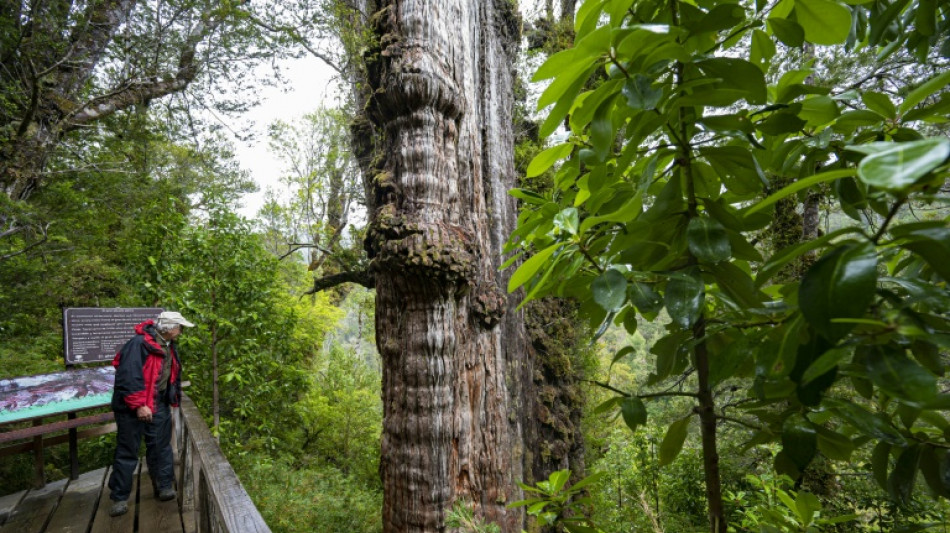
World's 'oldest' tree able to reveal planet's secrets / Photo: MARTIN BERNETTI - AFP

 Where the US-China tariff row stands ahead of White House summit

 Indonesia cash-for-photos scheme turns animal hunters into protectors

 Argentine judge orders suspension of Falklands oil project

 US Fed raises rates to tackle 'too high' inflation, irking Trump

 Turkey releases 106 protesters, jails more LGBTQ activists

 Candidate for UN chief calls for AI regulation akin to nuclear weapons

 'We're losing control,' AI pioneer Yoshua Bengio tells AFP

 IR-MED and Dice Technologies Announce collaboration to Evaluate and Advance Pressure-Injury Prevention Platform in Japan

 Watts, Pitt, Cruz to light up Spain's top film festival

 Toogood Gold's Table Mountain Sits in the Shadow of a Nevada Gold Rush

 MEXC July–August Security Report: 38.66M USDT in Risk Funds Intercepted, Futures Insurance Fund Hits 792M USDT

 Emporio Armani names Dario Vitale new creative director

 EU to ban social media for under 13s, curb access until 15

 Wildfires push endangered Sumatran elephants to brink: Indonesian NGO

 Bank of Japan set to raise rates under pressure from inflation, US

 EU chief to unveil social media, gaming curbs for under-15s

 'Resident Evil' film brings video game's ethos to the big screen

 GA-ASI Mojave First UAS To Complete Battlefield Short Field Ops

 Sanders, Bannon warn of AI dangers in rare US left-right alignment

 Empty benches as schools reopen in Venezuela's quake-hit Guaira

 Tiny English village holds 'independence' vote over asylum seeker housing

 US Treasury chief says to meet Chinese counterpart at weekend

 BingX Evolves into a Multi-Asset Trading Platform, Connecting Users to Global Opportunities

 International Trading Institute Expands Professional Trader Development Beyond the Master’s in Trading

 Lake Energy Secures $80 Million for U.S. Renewable Energy Expansion

In a forest in southern Chile, a giant tree has survived for thousands of years and is in the process of being recognized as the oldest in the world.
Known as the "Great Grandfather," the trunk of this tree measuring four meters (13 feet) in diameter and 28 meters tall is also believed to contain scientific information that could shed light on how the planet has adapted to climatic changes.
Believed to be more than 5,000 years old, it is on the brink of replacing Methuselah, a 4,850-year-old Great Basin bristlecone pine found in California in the United States, as the oldest tree on the planet.
"It's a survivor, there are no others that have had the opportunity to live so long," said Antonio Lara, a researcher at Austral University and Chile's center for climate science and resilience, who is part of the team measuring the tree's age.
The Great Grandfather lies on the edge of a ravine in a forest in the southern Los Rios region, 800 kilometers (500 miles) to the south of the capital Santiago.
It is a Fitzroya cupressoides, a type of cypress tree that is endemic to the south of the continent.
In recent years, tourists have walked an hour through the forest to the spot to be photographed beside the new "oldest tree in the world."
Due to its growing fame, the national forestry body has had to increase the number of park rangers and restrict access to protect the Great Grandfather.
By contrast, the exact location of Methuselah is kept a secret.
Also known as the Patagonian cypress, it is the largest tree species in South America.
It lives alongside other tree species, such as coigue, plum pine and tepa, Darwin's frogs, lizards, and birds such as the chucao tapaculo and Chilean hawk.
For centuries its thick trunk has been chopped down to build houses and ships, and it was heavily logged during the 19th and 20th centuries.
- Excitement in scientific community -
Park warden Anibal Henriquez discovered the tree while patrolling the forest in 1972. He died of a heart attack 16 years later while patrolling the same forest on horseback.
"He didn't want people and tourists to know (where it was) because he knew it was very valuable," said his daughter Nancy Henriquez, herself a park warden.
Henrique's nephew, Jonathan Barichivich, grew up playing amongst the Fitzroya and is now one of the scientists studying the species.
In 2020, Barichivich and Lara managed to extract a sample from the Great Grandfather using the longest manual drill that exists, but they did not reach the center.
They estimated that their sample was 2,400 years old and used a predictive model to calculate the full age of the tree.
Barichivich said that "80 percent of the possible trajectories show the tree would be 5,000 years old."
He hopes to soon publish the results.
The study has created excitement within the scientific community given that dendrochronology -- the method of dating tree rings to when they were formed -- is less accurate when it comes to older trees as many have a rotten core.
- 'Symbols of resistence' -
This is about more than just a competition to enter the record books though, as the Great Grandfather is a font of valuable information.
"There are many other reasons that give value and sense to this tree and the need to protect it," said Lara.
There are very few thousands-years-old trees on the planet.
"The ancient trees have genes and a very special history because they are symbols of resistence and adaptation. They are nature's best athletes," said Barichivich.
"They are like an open book and we are like the readers who read every one of their rings," said Carmen Gloria Rodriguez, an assistant researcher at the dendrochronology and global change laboratory at Austral University.
Those pages show dry and rainy years, depending on the width of the rings.
Fires and earthquakes are also recorded in those rings, such as the most powerful tremor in history that hit this area in 1960.
The Great Grandfather is also considered a time capsule that can offer a window into the past.
"If these trees disappear, so too will disappear an important key about how life adapts to changes on the planet," said Barichivich.
A.Leibowitz--CPN