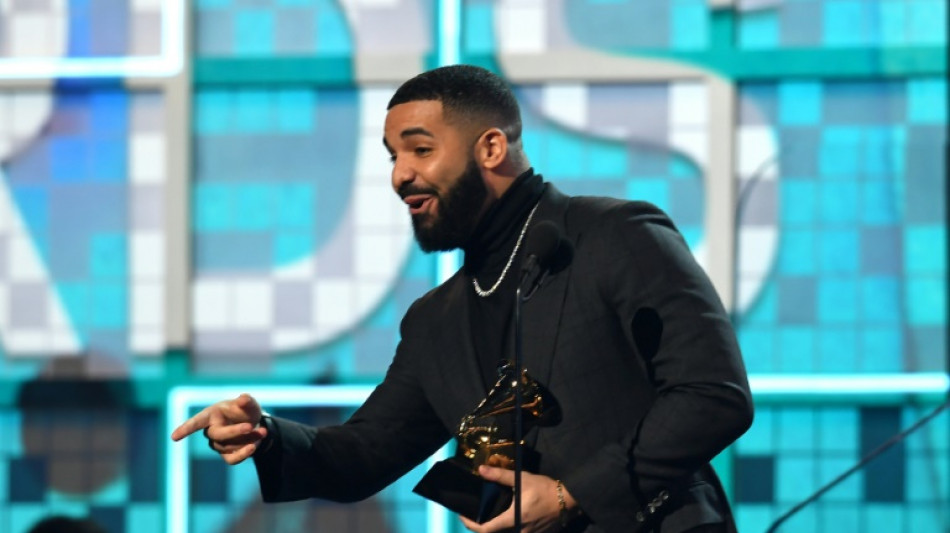
Did the AI Drake song breach copyright? / Photo: Robyn Beck - AFP

 Where the US-China tariff row stands ahead of White House summit

 Indonesia cash-for-photos scheme turns animal hunters into protectors

 Argentine judge orders suspension of Falklands oil project

 US Fed raises rates to tackle 'too high' inflation, irking Trump

 Turkey releases 106 protesters, jails more LGBTQ activists

 Candidate for UN chief calls for AI regulation akin to nuclear weapons

 'We're losing control,' AI pioneer Yoshua Bengio tells AFP

 IR-MED and Dice Technologies Announce collaboration to Evaluate and Advance Pressure-Injury Prevention Platform in Japan

 Watts, Pitt, Cruz to light up Spain's top film festival

 Toogood Gold's Table Mountain Sits in the Shadow of a Nevada Gold Rush

 MEXC July–August Security Report: 38.66M USDT in Risk Funds Intercepted, Futures Insurance Fund Hits 792M USDT

 Emporio Armani names Dario Vitale new creative director

 EU to ban social media for under 13s, curb access until 15

 Wildfires push endangered Sumatran elephants to brink: Indonesian NGO

 Bank of Japan set to raise rates under pressure from inflation, US

 EU chief to unveil social media, gaming curbs for under-15s

 'Resident Evil' film brings video game's ethos to the big screen

 GA-ASI Mojave First UAS To Complete Battlefield Short Field Ops

 Sanders, Bannon warn of AI dangers in rare US left-right alignment

 Empty benches as schools reopen in Venezuela's quake-hit Guaira

 Tiny English village holds 'independence' vote over asylum seeker housing

 US Treasury chief says to meet Chinese counterpart at weekend

 BingX Evolves into a Multi-Asset Trading Platform, Connecting Users to Global Opportunities

 International Trading Institute Expands Professional Trader Development Beyond the Master’s in Trading

 Lake Energy Secures $80 Million for U.S. Renewable Energy Expansion

A viral AI-generated song imitating Drake and The Weeknd was pulled from streaming services this week, but did it actually breach copyright as claimed by record label Universal?
Created by someone called @ghostwriter, "Heart On My Sleeve" racked up millions of listens before Universal Music Group asked for its removal from Spotify, Apple Music and other platforms.
However, Andres Guadamuz, who teaches intellectual property law at Britain's University of Sussex, is not convinced that the song breached copyright.
As similar cases look set to multiply -- with an uncanny AI replication of Liam Gallagher from Oasis causing buzz -- he spoke to AFP about some of the issues being raised.
- Did the song breach copyright?-
The underlying music on "Heart On My Sleeve" was new -- only the sound of the voice was familiar -- "and you can't copyright the sound of someone's voice," said Guadamuz.
Perhaps the furore around AI impersonators may lead to copyright being expanded to include voice -- rather than just melody, lyrics and other created elements -- "but that would be problematic," Guadamuz added.
"What you're protecting with copyright is the expression of an idea, and voice isn't really that."
He said Universal probably claimed copyright infringement because it is the simplest route to removing content, with established procedures already in place with streaming platforms.
"Most of the time, these issues are not resolved by law, but just by record companies making a stink with the platforms. It's easier for the platform just to comply," said Guadamuz.
- Were other rights breached?
An AI-generated impersonator may be breaching other laws.
If an artist has a distinctive voice or image, this is potentially protected under "publicity rights" in the United States or similar image rights in other countries.
Bette Midler won a case against Ford in 1988 for using an impersonator of her in an advert. Tom Waits won a similar case in 1993 against the Frito-Lays potato chips company.
The problem, said Guadamuz, is that enforcement of these rights is "very hit and miss" and taken much more seriously in some countries than others.
And streaming platforms currently lack straightforward mechanisms for removing content seen as breaching image rights.
- What comes next?
The big upcoming legal fight is over how AI programmes are trained.
It may be argued that inputting existing Drake and Weeknd songs to train an AI programme may be a breach of copyright -- but Guadamuz said this issue was far from settled.
"You need to copy the music in order to train the AI and so that unauthorised copying could potentially be copyright infringement," he said.
"But defendants will say it's fair use. They are using it to train a machine, teaching it to listen to music, and then removing the copies.
"Ultimately, we will have to wait and see for the case law to be decided."
But it is almost certainly too late to stem the flood.
"Bands are going to have to decide whether they want to pursue this in court, and copyright cases are expensive," said Guadamuz.
"Some artists may lean into the technology and start using it themselves -- especially if they start losing their voice."
C.Smith--CPN