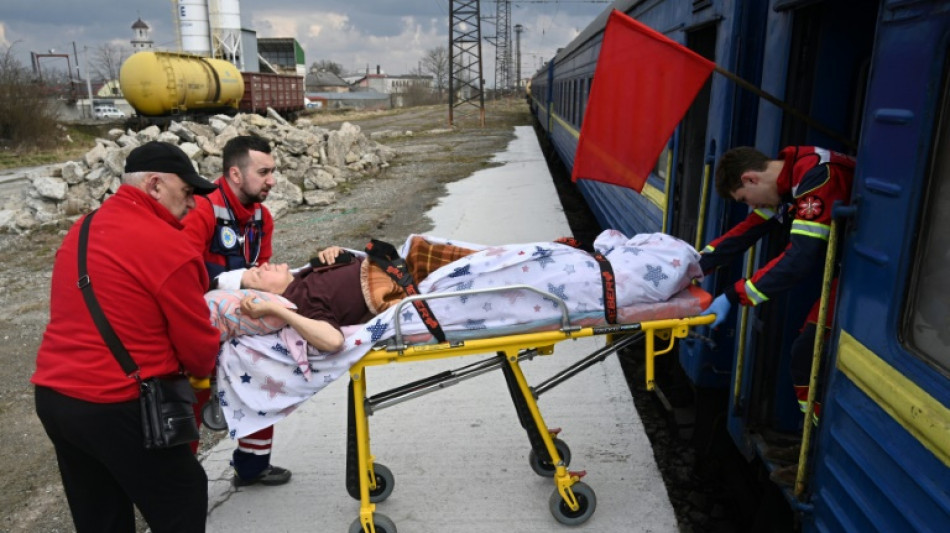
Superbugs pose 'huge challenge' in treating Ukraine war wounds / Photo: YURIY DYACHYSHYN - AFP/File

 UK-Sudanese author pens book to give children 'African history of Africa'

 US Congress passes sweeping Russia sanctions bill

 US stocks fall, dollar gains after Fed lifts interest rates

 US Fed raises rates to tackle 'too high' inflation in move sure to rile Trump

 US Fed raises rates to battle inflation in move likely to rile Trump

 US House faces test on sweeping Russia sanctions bill

 British PM says to make 'difficult decisions' as inflation rises

 Global fuel price demos: a round-up

 Leverate Launches MCP for Traders to Connect AI Assistants With Trading Platforms

 MEXC Launches $1M "Discover Your Wall Street DNA" Campaign to Help Traders Find Their Market Fit

 Stocks edge higher ahead of US Fed rate call

 BASIS.pro Expands On-Chain Infrastructure with XDC Network Partnership and Zypher DAO as Auto Earn Goes Live

 Pickle-flavoured tart? AI inspires Japan's convenience stores

 EU chief hosts Canada's Carney in push to 'deepen' alliance

 Meta chief pushes back on AI slowdown calls

 US Fed to deliver rate decision with markets betting on hike

 i-payout Expands U.S. Money Transmitter Licensing Footprint and Advances European EMI Strategy

 US Senate crypto bill collapses amid partisan deadlock

 OpenAI, Anthropic and Google are working to create an AI standards body

 Protesting shepherds, farmers clash with Romanian police

 Foundation Lets Ledger Users Switch to Open Source Without Starting Over

 EU to propose curbing social media, online games for under 15s

 FX Junction Reaches 40,600 Members and 26 Million Trades

 'We unleashed the beast': the world's fears and hopes about AI

 Hospitality leaders ask Burnham to halve VAT amid rising costs

Infections with superbugs that are resistant to most drugs have presented a "huge challenge" in treating the devastating injuries of people wounded in the war in Ukraine, doctors in Germany said on Tuesday.
Superbugs -- strains of bacteria resistant to antibiotics -- were already considered a major health problem in Ukraine before Russia invaded, and researchers have warned the conflict could make the situation worse.
Out of 47 wounded patients evacuated from Ukraine to Berlin's Charite University Hospital for treatment last year, 14 had injuries infected with multidrug-resistant bacteria, according to new research.
That number included three children and one soldier, with six suffering from gunshot wounds and the other eight injured in bomb or grenade explosions.
Andrej Trampuz, an infectious disease specialist at the hospital, told AFP the combination of the complicated, horrific wounds and superbug infections had created the "most challenging situation" he had experienced in 25 years as a doctor.
Charite doctor Maria Virginia Dos Santos said the infections came about because Ukraine war casualties "often receive suboptimal surgical and antibiotic treatment in often unsterile low resource conditions and war zone, emergency settings, sometimes for weeks or even months".
- 'Silent pandemic' -
Antimicrobial resistance (AMR), which is spurred by the massive use of antibiotics in humans and animals, has been dubbed "the silent pandemic".
Superbugs are estimated to have killed 1.27 million people in 2019, according to the World Health Organization (WHO), which has warned that the annual number could rise to 10 million by 2050.
Trampuz said drug-resistant bacteria was already "everywhere" in Ukraine before the war, adding that this was likely due to the use of antibiotics in animals.
But the addition of severe, open wounds that are not quickly treated during the war had led to more infections, he said, with the combination presenting "a huge challenge" for doctors.
He said the medical team had used several innovative ways to treat the infections, including putting antibiotics directly into the wound during surgery as well as deploying bacteriophages, which are viruses that only target bacteria.
Following treatment, 10 of the patients were discharged from hospital, with two thought to have returned to Ukraine, according to the new research presented at the European Congress of Clinical Microbiology and Infectious Diseases in Denmark's capital Copenhagen.
Two are still undergoing treatment, while two others who are no longer at the hospital have developed new acute infections, according to the research, which has not been peer-reviewed.
Despite concerns the drug-resistant superbugs could spread in Germany, Trampuz said no cases had been transmitted because the patients were isolated and treated quickly.
Trampuz called for doctors in Ukraine to receive more support and resources so patients can be more effectively treated immediately after being wounded.
Earlier this month, the WHO said it had delivered 10 bacteriological analysers and 1,200 test kits to hospitals and regional centres in Ukraine.
It said the deliveries would help decrease the use of antibiotics and provide a clearer picture of antimicrobial resistance in Ukraine.
Y.Jeong--CPN