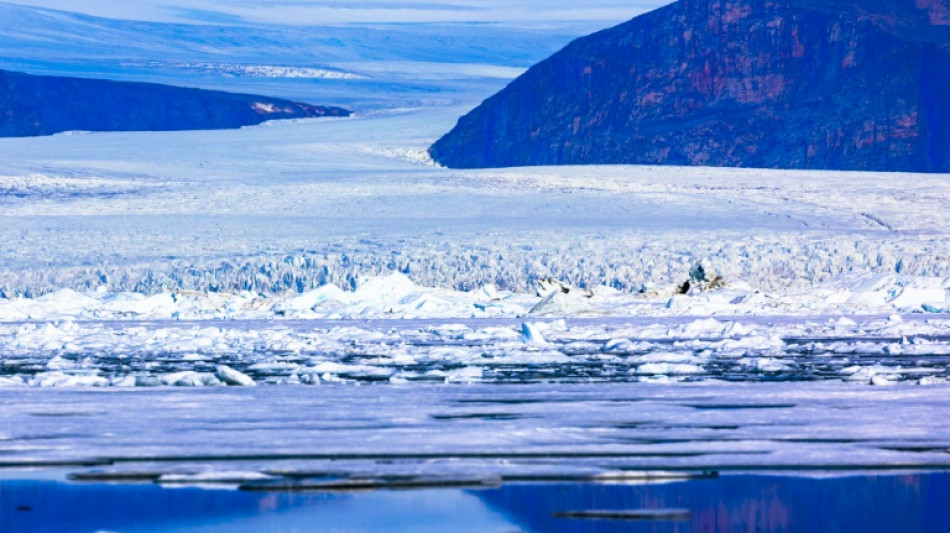
'Snowball Earth' might have been rather slushy: study / Photo: Kerem Yücel - AFP/File

 UK-Sudanese author pens book to give children 'African history of Africa'

 US Congress passes sweeping Russia sanctions bill

 US stocks fall, dollar gains after Fed lifts interest rates

 US Fed raises rates to tackle 'too high' inflation in move sure to rile Trump

 US Fed raises rates to battle inflation in move likely to rile Trump

 US House faces test on sweeping Russia sanctions bill

 British PM says to make 'difficult decisions' as inflation rises

 Global fuel price demos: a round-up

 Leverate Launches MCP for Traders to Connect AI Assistants With Trading Platforms

 MEXC Launches $1M "Discover Your Wall Street DNA" Campaign to Help Traders Find Their Market Fit

 Stocks edge higher ahead of US Fed rate call

 BASIS.pro Expands On-Chain Infrastructure with XDC Network Partnership and Zypher DAO as Auto Earn Goes Live

 Pickle-flavoured tart? AI inspires Japan's convenience stores

 EU chief hosts Canada's Carney in push to 'deepen' alliance

 Meta chief pushes back on AI slowdown calls

 US Fed to deliver rate decision with markets betting on hike

 i-payout Expands U.S. Money Transmitter Licensing Footprint and Advances European EMI Strategy

 US Senate crypto bill collapses amid partisan deadlock

 OpenAI, Anthropic and Google are working to create an AI standards body

 Protesting shepherds, farmers clash with Romanian police

 Foundation Lets Ledger Users Switch to Open Source Without Starting Over

 EU to propose curbing social media, online games for under 15s

 FX Junction Reaches 40,600 Members and 26 Million Trades

 'We unleashed the beast': the world's fears and hopes about AI

 Hospitality leaders ask Burnham to halve VAT amid rising costs

Millions of years ago, the Earth was so cold that most of its surface was covered in ice. But that hard freeze might have been slushier than once thought.
The longstanding "Snowball Earth" theory imagines our world as seen from space, a perfect sphere with ice covering land and sea alike.
It draws on clues including deposits made by glaciers near the Equator. For ice to have extended that far from the poles suggests much of our planet was once frozen.
But there has long been speculation about just how complete the cover was, with some convinced that areas of slush or open ocean remained, allowing oxygen to penetrate and creating incubators for life.
New research published Tuesday in the journal Nature Communications adds weight to that theory, and suggests these oases in the tundra might have existed much further north than previously suspected.
The evidence comes from a thin layer of black shale that would have been under the sea during the Marinoan ice age, which began around 650 million years ago.
The shale in the Nantuo Formation in southern China acts as a sort of archive for the conditions in oceans at the time.
By analysing levels of elements such as iron, and the presence of nitrogen, scientists can infer whether oxygen was penetrating the ocean and nitrogen was being produced by lifeforms.
"We found evidence of ice-free conditions at mid-northern paleolatitudes (locations before continental drift)," Huyue Song, who helped lead the research, told AFP.
"Until now, ice-free areas had been identified only in peri-equatorial regions."
Instead of a "narrow ice-free belt" across the middle of the Earth, "patchy ice-free areas may have existed much more widely," added Song, a professor at the China University of Geosciences, Wuhan.
The findings build on other research at sites ranging from Australia to Brazil that suggest life was able to cling on in pockets while most of Earth was in deep freeze.
These incubators may even have helped spur "a rapid rebound of the biosphere" at the end of the ice age, the research published Tuesday argues.
The work took four years in total, and involved collecting samples at a remote site in the Shennongjia region of Hubei province, some 500 kilometres from Song's base in Wuhan.
Song believes the findings will help scientists better understand both how our planet's climate works, and how life evolved and survived on Earth through the ages.
And while Earth's ice ages might seem like ancient history, Song argues they could have useful lessons for a planet now experiencing new severe climate change.
"It provides insight into how life survived extreme climate events -- a topic that will become of increasing relevance as modern climate change intensifies," he said.
U.Ndiaye--CPN