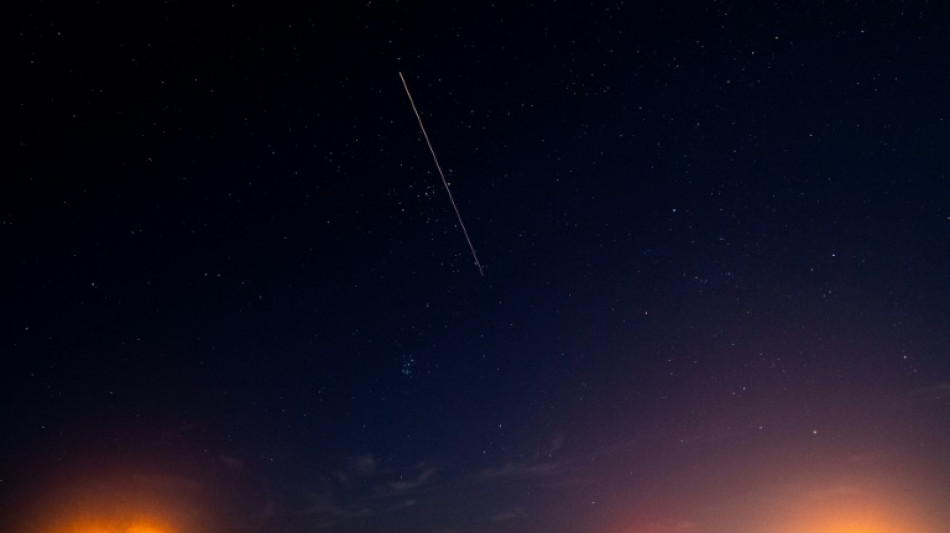
RNA base in asteroid samples suggests origins of life on Earth: study / Photo: Morgan Sette - AFP

 UK-Sudanese author pens book to give children 'African history of Africa'

 US Congress passes sweeping Russia sanctions bill

 US stocks fall, dollar gains after Fed lifts interest rates

 US Fed raises rates to tackle 'too high' inflation in move sure to rile Trump

 US Fed raises rates to battle inflation in move likely to rile Trump

 US House faces test on sweeping Russia sanctions bill

 British PM says to make 'difficult decisions' as inflation rises

 Global fuel price demos: a round-up

 Leverate Launches MCP for Traders to Connect AI Assistants With Trading Platforms

 MEXC Launches $1M "Discover Your Wall Street DNA" Campaign to Help Traders Find Their Market Fit

 Stocks edge higher ahead of US Fed rate call

 BASIS.pro Expands On-Chain Infrastructure with XDC Network Partnership and Zypher DAO as Auto Earn Goes Live

 Pickle-flavoured tart? AI inspires Japan's convenience stores

 EU chief hosts Canada's Carney in push to 'deepen' alliance

 Meta chief pushes back on AI slowdown calls

 US Fed to deliver rate decision with markets betting on hike

 i-payout Expands U.S. Money Transmitter Licensing Footprint and Advances European EMI Strategy

 US Senate crypto bill collapses amid partisan deadlock

 OpenAI, Anthropic and Google are working to create an AI standards body

 Protesting shepherds, farmers clash with Romanian police

 Foundation Lets Ledger Users Switch to Open Source Without Starting Over

 EU to propose curbing social media, online games for under 15s

 FX Junction Reaches 40,600 Members and 26 Million Trades

 'We unleashed the beast': the world's fears and hopes about AI

 Hospitality leaders ask Burnham to halve VAT amid rising costs

The black particles from an asteroid some 300 million kilometres away look unremarkable, like pieces of charcoal, but they hold a component of life itself.
Scientists have discovered the chemical compound uracil, one of the building blocks of RNA, in just 10 milligrammes of material from the asteroid Ryugu, according to new research published on Tuesday.
The finding lends weight to a longstanding theory that life on Earth may have been seeded from outer space when asteroids crashed into our planet carrying fundamental elements.
It is some of the latest research from analysis of 5.4 grams of rocks and dust gathered by the Hayabusa-2 probe from the asteroid Ryugu.
Hayabusa-2 was launched in 2014 and returned to Earth's orbit in late 2020 with a capsule containing the sample from the asteroid.
The precious cargo was divided between international research teams and has already yielded several insights, including that some of life's building blocks, amino acids, may have been formed in space.
The first drop of water discovered in a near-Earth asteroid has also been found among the samples.
The new research, published Tuesday in the journal Nature Communications, went looking for another foundation of life: the nucleobases of RNA.
While DNA, the famed double helix, functions as a genetic blueprint, single-strand RNA is an all-important messenger, converting the instructions contained in DNA for implementation.
Like DNA, it is made up of bases: adenine, guanine, cytosine, and uracil.
Scientists have previously found some or all of these bases in different asteroids that landed on Earth as meteorites. However, they could not be sure the chemicals came from outer space or were contaminated when they landed.
"Since every meteorite has landed on the surface of the Earth where microorganisms are ubiquitously present everywhere, it always makes the interpretation on the origin of such biologically important molecules in meteorites more complex," said Yasuhiro Oba, associate professor at Hokkaido University and an author of the research.
- 'Like brewing coffee' -
Testing the Ryugu samples was a multi-phase process that began by putting them in hot water, like "brewing coffee or tea", Oba said.
Acid was then applied to extract molecules that were analysed by extremely sensitive tools capable of detecting the minute quantities of uracil present.
The discovery offers "strong evidence that one of the RNA components has been provided to the Earth even before the emergence of life", Oba told AFP.
"We expect it plays a role for prebiotic evolution and possibly the emergence of the first life," he said.
RNA's other bases were not found in the sample, though Oba believes they could be present at levels too low to be detected with the method used to find uracil.
He hopes to analyse new samples collected from space in coming years, including Osiris-REx's material from the asteroid Bennu, expected to arrive this year.
Yoshinori Takano, a scientist at the Japan Agency for Marine-Earth Science and Technology and author of the Ryugu research, said he was also keenly awaiting the Martian Moons eXploration project, set to launch from Japan next year and return around 2029.
It will collect samples from Phobos, one of the moons of Mars.
"I am sure it will be very hotly watched by organic cosmochemists for the next 10 years," said Takano.
P.Kolisnyk--CPN