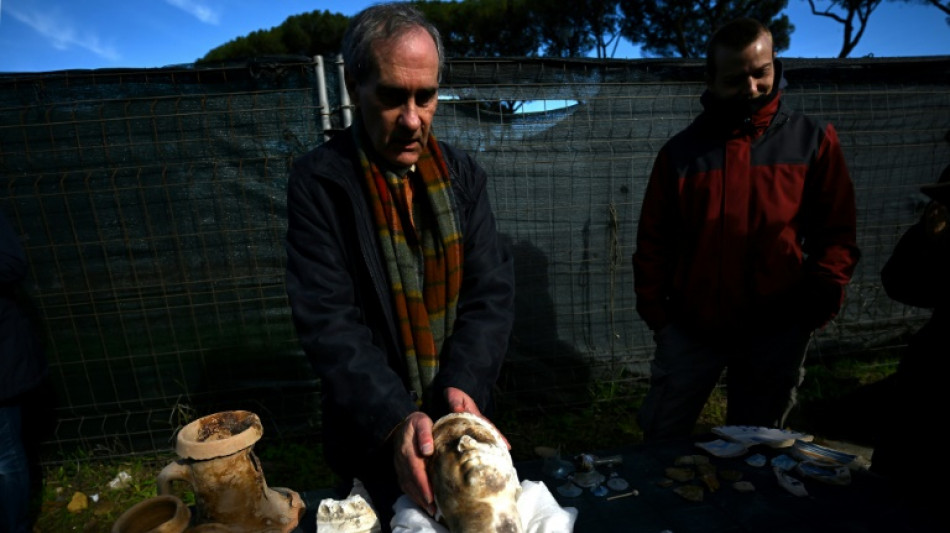
Rome archaeologists search for start of Appian Way / Photo: Filippo MONTEFORTE - AFP

 Argentine judge orders suspension of Falklands oil project

 US Fed raises rates to tackle 'too high' inflation, irking Trump

 Turkey releases 106 protesters, jails more LGBTQ activists

 Candidate for UN chief calls for AI regulation akin to nuclear weapons

 'We're losing control,' AI pioneer Yoshua Bengio tells AFP

 IR-MED and Dice Technologies Announce collaboration to Evaluate and Advance Pressure-Injury Prevention Platform in Japan

 Watts, Pitt, Cruz to light up Spain's top film festival

 Toogood Gold's Table Mountain Sits in the Shadow of a Nevada Gold Rush

 MEXC July–August Security Report: 38.66M USDT in Risk Funds Intercepted, Futures Insurance Fund Hits 792M USDT

 Emporio Armani names Dario Vitale new creative director

 EU to ban social media for under 13s, curb access until 15

 Wildfires push endangered Sumatran elephants to brink: Indonesian NGO

 Bank of Japan set to raise rates under pressure from inflation, US

 EU chief to unveil social media, gaming curbs for under-15s

 'Resident Evil' film brings video game's ethos to the big screen

 GA-ASI Mojave First UAS To Complete Battlefield Short Field Ops

 Sanders, Bannon warn of AI dangers in rare US left-right alignment

 Empty benches as schools reopen in Venezuela's quake-hit Guaira

 Tiny English village holds 'independence' vote over asylum seeker housing

 US Treasury chief says to meet Chinese counterpart at weekend

 BingX Evolves into a Multi-Asset Trading Platform, Connecting Users to Global Opportunities

 International Trading Institute Expands Professional Trader Development Beyond the Master’s in Trading

 Lake Energy Secures $80 Million for U.S. Renewable Energy Expansion

 Stocks drop, oil climbs and Treasury yields hit 19-year high

 SkySail Strategies Outperforms Wall Street's 30-Year Risk Standard With Proprietary AI Inference Model

All roads lead to Rome, as the saying goes, and the most prestigious is the Appian Way, the strategic highway for the Roman Empire now hoping to become a UNESCO World Heritage Site.
A paved road of more than 500 kilometres (310 miles) begun in 312 B.C. by Roman statesman Appius Claudius Caecus, the "Via Appia" is an archaeological treasure trove, where an ongoing excavation hopes to uncover the actual starting point of the road in Rome.
The artery leading south to the key port of Brindisi at Italy's heel provided a gateway to the eastern Mediterranean, especially Greece, and was of strategic importance for the armies and merchants of a quickly expanding Rome.
This week, archaeologists showed off progress in their attempt to dig deep enough to unearth the beginning of the road, hidden far beneath Rome's Baths of Caracalla, built some five centuries after the Appian Way.
"What we see today is the result of an excavation that began in July with the central goal of finding clues to the location of the first section of the Appian Way," said archaeologist Riccardo Santangeli Valenzani.
The first, earliest section of the road is the one that provides "the most problems regarding the precise and exact location", the professor at Roma Tre University cautioned.
Construction of the Appian Way required Herculean engineering, from the levelling of the land, building of ditches and canals and surfacing of the road with gravel and heavy stone, to the building of post offices and inns to support the thousands of soldiers and merchants headed southward.
- Digging deeper -
Wandering today along the Appian Way --- its massive blocks of paving stone still visible in sections -- is to take a trip through the past.
Imposing monuments such as the first century B.C. tomb of a consul's daughter, Cecilia Metella, sit alongside ancient catacombs and churches, crumbling tombstones of Roman families and leafy villas.
The Appian Way sheds light not only on the Roman Republic and later Roman Empire, but also on life and death in the Middle Ages with its pilgrimage shrines and crypts.
The road also provides a glimpse of modern architectural wonders, such as the sumptuous villas owned by Italy's rich and famous, including film legend Gina Lollobrigida or former premier Silvio Berlusconi.
Italy, which earlier this month presented its bid for the Appian Way to UNESCO, already has 58 sites recognised as World Heritage Sites, the most of any country.
They include entire historical city centres, such as Rome, Florence and Venice, and archaeological areas such as the ruins of Pompeii and Herculaneum.
Work to locate the starting point of the Appian Way, believed to be some eight metres under the ground, has so far been complicated by groundwater.
Nevertheless, digging in higher strata of ground has unearthed relics from different periods, including a marble bust from the second century A.D. and an early papal square coin, minted between 690 and 730.
Archaeologists have also found fragments of glass and ceramics, mosaic and bits of amphora.
So far, the excavation has reached residential or commercial structures dating from the time of Emperor Hadrian, who died in 138 A.D.
Archaeologist Daniel Manacorda said the current excavation had reached the point of "late ancient Rome, the one that began to live in the ruins of ancient Rome".
"If we could continue to dig deeper, we would find archaic Rome," he said.
Y.Uduike--CPN