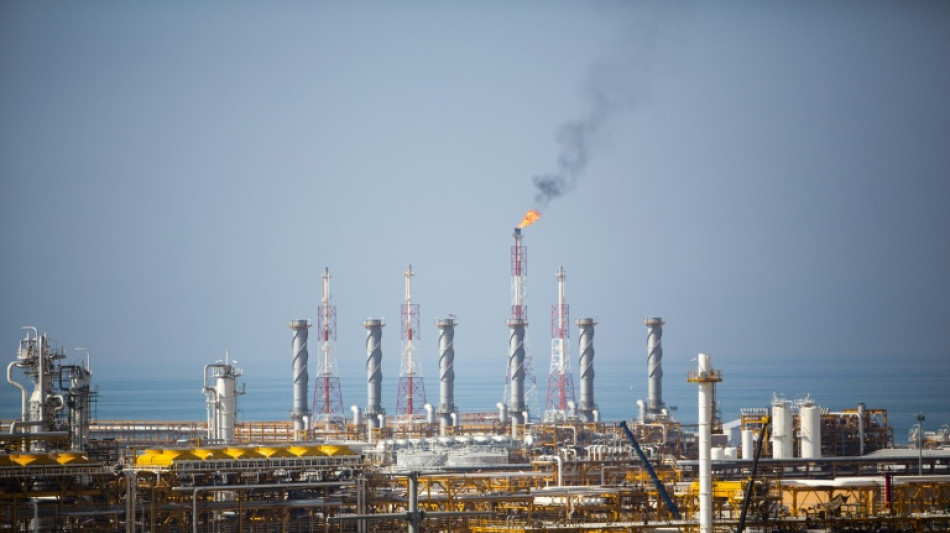
Iran targets Gulf energy sites after intel chief killed / Photo: Behrouz MEHRI - AFP/File

 Bank of Japan hikes rates to 31-year high to battle inflation

 AI doomsday warnings unlikely to slow IPOs but questions linger

 In Brazil's Amazon, the hunt for oil fuels hopes and fears

 Baby orangutans in India expose 'frightening' scale of trafficking

 Oversight Board blasts 'inadequate' Meta safeguards for AI deepfakes

 Harry makes first public appearance since return to UK

 Princess Diana's brother makes new explosive claims against Charles

 Trump admin overhauls key protection for endangered species

 Mbappe draws political fire over Ceuta t-shirt controversy

 Third malaria death in Germany from outbreak tied to Frankfurt airport

 AtlasClear Holdings Reports Preliminary Fiscal 2026 Revenue of Approximately $20.1 Million, Up 85%; Revenue Plus Interest Income of Approximately $21.9 Million

 'Another arrow to the quiver': World Bank posts record private capital mobilization

 Ireland to boycott Eurovision 2027 over Gaza

 India's Tata Sons reappoints N. Chandrasekaran as chairman

 Germany urges EU action against China to defend carmakers

 Japan eyes changing prostitution law to punish sex buyers

 Modi pitches India as global chipmaking hub

 Ukraine plans record defence spending in 2027

 NASA scan discovers new, 'once in a century' Moon crater

 Most stocks rise as Fed hikes and indicates drive to curb inflation

 UK-Sudanese author pens book to give children 'African history of Africa'

 Argentine judge orders suspension of Falklands oil project

 US Fed raises rates to tackle 'too high' inflation, irking Trump

 Turkey releases 106 protesters, jails more LGBTQ activists

 Candidate for UN chief calls for AI regulation akin to nuclear weapons

Iran launched attacks targeting oil and gas facilities around the Gulf on Wednesday, lashing out after suffering yet another blow to its leadership with Israel's killing of its intelligence chief.
The death of Esmail Khatib came hot on the heels of the killing of security chief Ali Larijani, which Iran's new supreme leader Ayatollah Mojtaba Khamenei -- who has not been seen since succeeding his slain father -- vowed to avenge.
The spate of targeted killings has wiped out many of Iran's senior leaders, although Washington's top intelligence official said the government of the Islamic republic remained intact, albeit degraded, after nearly three weeks of war.
Tehran had vowed to retaliate in kind after a strike on its enormous South Pars gas field, with Qatar's state-run energy company later saying a fire sparked by an Iranian missile attack had caused "extensive damage" at the country's main gas facility.
Saudi Arabia's defence ministry said it had thwarted drone attacks on energy infrastructure in the kingdom's east, while a fragment of an intercepted ballistic missile landed near a refinery south of Riyadh.
Iranian President Masoud Pezeshkian warned that the attack on its key energy site, the largest known gas reserve on earth, "could have uncontrollable consequences, the scope of which could engulf the entire world".
Qatar's foreign ministry said the Iranian reprisal against its own gas facility represented a "direct threat to its national security", later ordering two of Tehran's diplomats and their staff to depart over the attack.
The renewed strikes on energy targets caused a fresh surge in oil prices, already high thanks to the de facto closure of the Strait of Hormuz.
- 'Price to be paid' -
The US-Israeli campaign against Iran began with strikes that killed supreme leader Ayatollah Ali Khamenei, and has since claimed the lives of its defence minister, the head of its Basij paramilitary and the leader of the Revolutionary Guards, among others.
Israeli Defence Minister Israel Katz said his country's military had been given authorisation to continue eliminating top officials "without the need for additional approval".
"We will continue to hunt down all of the regime's senior officials," military spokesman Effie Defrin said. "The series of eliminations will not stop."
Iran's President Pezeshkian branded intelligence minister Khatib's death a "cowardly assassination" on Wednesday, the day after security chief Larijani was confirmed killed in an Israeli strike.
After crowds gathered in central Tehran for Larijani's funeral, Iran's new supreme leader Mojtaba Khamenei declared in a written message that his killers would pay.
"Every drop of spilled blood comes at a price, and the criminal murderers of these martyrs will soon have to pay it," Khamenei said.
The new leader's whereabouts remain a mystery and he has not been seen since the war began, prompting taunts from US President Donald Trump that he might not even be alive.
Larijani's funeral was held alongside those of Gholamreza Soleimani, the head of the Basij who was also killed this week, and dozens of Iranian sailors who were killed when US forces torpedoed their frigate off Sri Lanka earlier this month.
US Director of National Intelligence Tulsi Gabbard, in testimony to the Senate intelligence committee, said Iran had suffered heavy blows, but that the Islamic republic was still functioning.
The US intelligence community, she said, "assesses the regime in Iran to be intact but largely degraded".
She also undercut one of Trump's key justifications for the war by acknowledging that Iran had not been rebuilding nuclear enrichment capacities destroyed last year by the United States and Israel.
"There have been no efforts since then to try to rebuild their enrichment capability."
- Decapitation policy -
Israel has pursued what analysts have described as a policy of decapitation against Iran and the militant movements it backs in the region.
It killed Hassan Nasrallah, the longtime leader of Hezbollah, in 2024 as well Hamas's top figures since the Palestinian group's October 7, 2023 attack that sparked the Gaza war.
Despite losing key figures, the powerful Revolutionary Guards and the leadership as a whole have remained defiant.
An Iranian missile barrage killed two people near Israel's commercial hub of Tel Aviv, medics said on Wednesday, while authorities said falling munitions hit multiple sites in central Israel overnight.
Police said a cluster bomb hit a residential building in Ramat Gan, a city just outside Tel Aviv, and the roof collapsed on an elderly couple.
Iranian media, meanwhile, said Israel and the United States had launched fresh strikes across several areas of the country, including Tehran.
The war has engulfed much of the region, from Gulf nations to Iraq and nearby Lebanon, leaving hundreds dead and millions displaced.
In Lebanon, Israel struck central Beirut multiple times Wednesday, with fatalities reported.
The country was drawn into the conflict when Iran-backed Hezbollah launched rockets at Israel over Ali Khamenei's death.
A line of cars stretched as far as the eye could see along the country's southern coast as residents of affected areas fled to the ancient city of Sidon in search of safety.
Nidal Ahmad Chokr initially intended to stay put but finally decided on Tuesday to leave his village of Jibchit, as the air strikes intensified.
"Bakers died while making bread" in the village square and "municipal workers were martyred while using bulldozers", the 55-year-old said.
burs-sr/smw
H.Cho--CPN