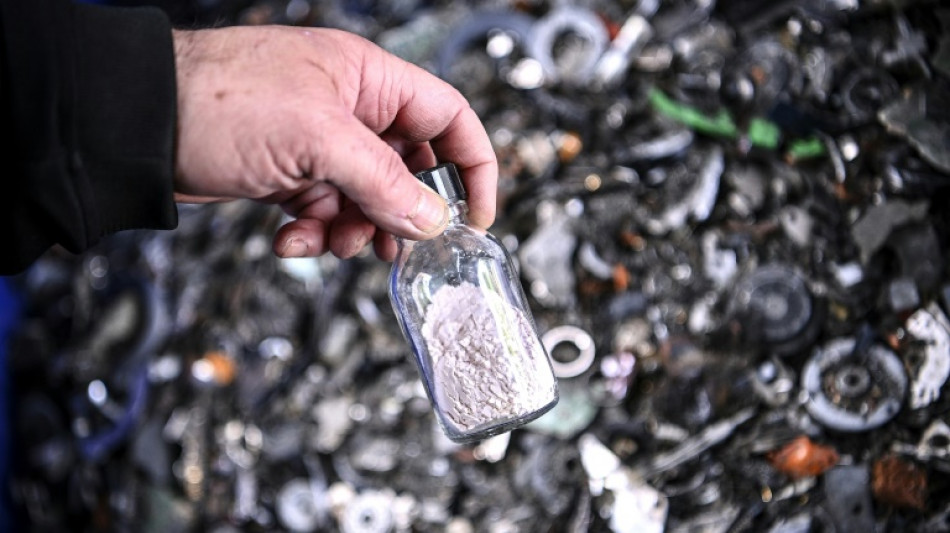
Europe's largest rare earths deposit discovered in Sweden / Photo: Christophe ARCHAMBAULT - AFP/File

 Argentine judge orders suspension of Falklands oil project

 US Fed raises rates to tackle 'too high' inflation, irking Trump

 Turkey releases 106 protesters, jails more LGBTQ activists

 Candidate for UN chief calls for AI regulation akin to nuclear weapons

 'We're losing control,' AI pioneer Yoshua Bengio tells AFP

 IR-MED and Dice Technologies Announce collaboration to Evaluate and Advance Pressure-Injury Prevention Platform in Japan

 Watts, Pitt, Cruz to light up Spain's top film festival

 Toogood Gold's Table Mountain Sits in the Shadow of a Nevada Gold Rush

 MEXC July–August Security Report: 38.66M USDT in Risk Funds Intercepted, Futures Insurance Fund Hits 792M USDT

 Emporio Armani names Dario Vitale new creative director

 EU to ban social media for under 13s, curb access until 15

 Wildfires push endangered Sumatran elephants to brink: Indonesian NGO

 Bank of Japan set to raise rates under pressure from inflation, US

 EU chief to unveil social media, gaming curbs for under-15s

 'Resident Evil' film brings video game's ethos to the big screen

 GA-ASI Mojave First UAS To Complete Battlefield Short Field Ops

 Sanders, Bannon warn of AI dangers in rare US left-right alignment

 Empty benches as schools reopen in Venezuela's quake-hit Guaira

 Tiny English village holds 'independence' vote over asylum seeker housing

 US Treasury chief says to meet Chinese counterpart at weekend

 BingX Evolves into a Multi-Asset Trading Platform, Connecting Users to Global Opportunities

 International Trading Institute Expands Professional Trader Development Beyond the Master’s in Trading

 Lake Energy Secures $80 Million for U.S. Renewable Energy Expansion

 Stocks drop, oil climbs and Treasury yields hit 19-year high

 SkySail Strategies Outperforms Wall Street's 30-Year Risk Standard With Proprietary AI Inference Model

Europe's largest known deposit of rare earth elements, essential for the manufacturing of electric vehicles, has been discovered in Sweden's far north, boosting Europe's hopes of cutting its dependence on China.
Swedish mining group LKAB said Thursday the newly-explored deposit, found right next to its iron ore mine, contained more than one million tonnes of rare earth oxides.
"This is the largest known deposit of rare earth elements in our part of the world, and it could become a significant building block for producing the critical raw materials that are absolutely crucial to enable the green transition," LKAB's chief executive Jan Mostrom said in a statement.
"We face a supply problem. Without mines, there can be no electric vehicles," Mostrom added.
While the find is believed to be the biggest in Europe, it remains small on a global scale, representing less than one percent of the 120 million tonnes estimated worldwide by the US Geological Survey.
In 2021, the European Commission said that 98 percent of the rare earths used in the EU were imported from China, prompting Brussels to urge member states to develop their own extraction capacities.
LKAB's find was presented as a delegation from the European Commission visited Sweden, which took over the rotating EU presidency at the start of the year.
"Today, the EU is way too dependent on other countries for these materials," Swedish Energy Minister Ebba Busch told a press conference, pointing specifically to Russia and China.
"This must change. We must take responsibility for the raw material supply needed for the (green) transition," she added.
- Trade not enough -
The European Union has agreed to phase out new CO2-emitting vehicles by 2035, effectively banning combustion engine cars, meaning the need for rare earth materials will only increase.
In the short term, Busch said the EU needed to "diversify" its trade.
"But in the long run, we cannot rely on trade agreements only," she said.
Mostrom said the full extent of the deposit had yet to be established.
"We are continuing to conduct exploration to see how big this is," Mostrom told AFP, adding that LKAB was also still in the process of figuring out how the new deposit could be mined.
Mostrom said it was difficult to accurately gauge the impact of the discovery on reducing Europe's dependence on Chinese imports.
But he said he was confident "it will have a huge impact."
Asked during a press conference when the deposit could actually be mined and deliver raw materials to the market, Mostrom said it would largely depend on how quickly permits could be secured.
But based on experience, it would likely be "10 to 15 years", he said.
According to LKAB, the rare earth elements found in the Per Geijer deposit occurred "in what is mainly an iron ore deposit and which may therefore be produced as by-products," creating new opportunities for potentially "competitive mining."
- From magnets to lenses -
Rare earth minerals with names like neodymium, praseodymium and dysprosium are crucial to the manufacture of magnets used in industries of the future, like wind turbines and electric cars.
They are also present in consumer goods such as smartphones, computer screens and telescopic lenses.
Others have more traditional uses, like cerium for glass polishing and lanthanum for car catalysts or optical lenses.
Sweden is one of the EU's biggest mining countries.
More than 90 percent of the EU's iron ore production comes from the Scandinavian country, which also has the bloc's largest lead and zinc production, the second largest silver production, and among the highest gold and copper production, according to the Geological Survey of Sweden.
P.Kolisnyk--CPN