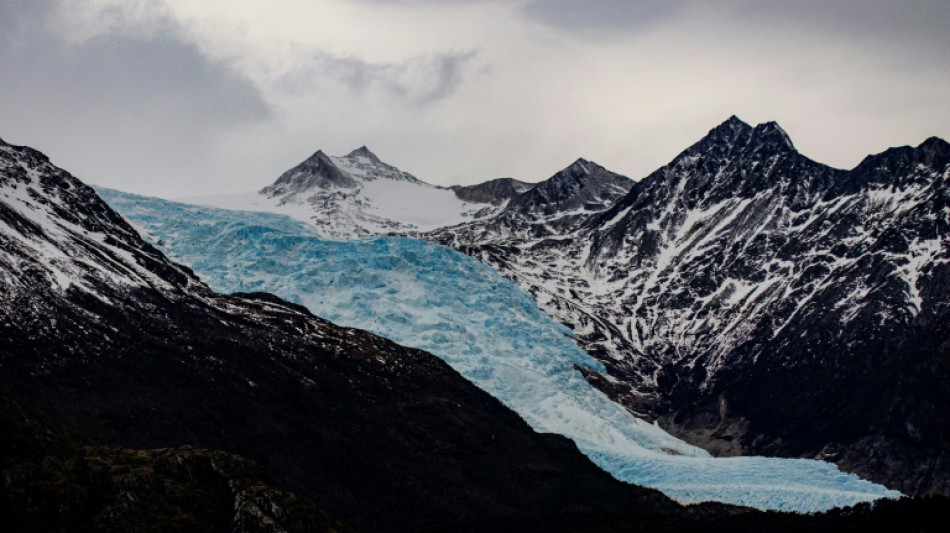
Half of world's glaciers expected to vanish by 2100: study / Photo: Alberto PEÑA - AFP/File

 Argentine judge orders suspension of Falklands oil project

 US Fed raises rates to tackle 'too high' inflation, irking Trump

 Turkey releases 106 protesters, jails more LGBTQ activists

 Candidate for UN chief calls for AI regulation akin to nuclear weapons

 'We're losing control,' AI pioneer Yoshua Bengio tells AFP

 IR-MED and Dice Technologies Announce collaboration to Evaluate and Advance Pressure-Injury Prevention Platform in Japan

 Watts, Pitt, Cruz to light up Spain's top film festival

 Toogood Gold's Table Mountain Sits in the Shadow of a Nevada Gold Rush

 MEXC July–August Security Report: 38.66M USDT in Risk Funds Intercepted, Futures Insurance Fund Hits 792M USDT

 Emporio Armani names Dario Vitale new creative director

 EU to ban social media for under 13s, curb access until 15

 Wildfires push endangered Sumatran elephants to brink: Indonesian NGO

 Bank of Japan set to raise rates under pressure from inflation, US

 EU chief to unveil social media, gaming curbs for under-15s

 'Resident Evil' film brings video game's ethos to the big screen

 GA-ASI Mojave First UAS To Complete Battlefield Short Field Ops

 Sanders, Bannon warn of AI dangers in rare US left-right alignment

 Empty benches as schools reopen in Venezuela's quake-hit Guaira

 Tiny English village holds 'independence' vote over asylum seeker housing

 US Treasury chief says to meet Chinese counterpart at weekend

 BingX Evolves into a Multi-Asset Trading Platform, Connecting Users to Global Opportunities

 International Trading Institute Expands Professional Trader Development Beyond the Master’s in Trading

 Lake Energy Secures $80 Million for U.S. Renewable Energy Expansion

 Stocks drop, oil climbs and Treasury yields hit 19-year high

 SkySail Strategies Outperforms Wall Street's 30-Year Risk Standard With Proprietary AI Inference Model

Half of the Earth's glaciers, notably smaller ones, are destined to disappear by the end of the century because of climate change, but limiting global warming could save others, according to a new study.
The findings, published in the journal Science on Thursday, provide the most comprehensive look so far at the future of the world's 215,000 glaciers.
The authors emphasized the importance of restricting greenhouse gas emissions to limit the consequences from glacier melt such as sea level rise and depletion of water resources.
To help orient policy makers, the study looked at the impact of four scenarios on glaciers, where global mean temperature change is 1.5 degrees Celsius (2.7 degrees Fahrenheit), 2.0C, 3.0C and 4.0C.
"Every degree increase produces more melt and loss," said Regine Hock of the University of Oslo and University of Alaska Fairbanks, a co-author of the study.
"But that also means if you reduce the temperature increase, you can also reduce that mass loss," Hock told AFP. "So in that sense, there is also a little bit of hope."
Even if global temperature rise is limited to 1.5C above pre-industrial levels -- the most ambitious goal of the Paris Agreement -- the researchers estimated that 49 percent of the world's glaciers would vanish by the year 2100.
That would represent about 26 percent of the world's glacier mass because the smallest glaciers would be those first impacted.
Global mean temperature is currently estimated to be increasing by 2.7C which would result in a near-complete loss of glaciers in Central Europe, Western Canada and the continental United States and New Zealand.
"Regions with relatively little ice like the European Alps, the Caucasus, the Andes, or the western US, they lose almost all the ice by the end of the century almost no matter what the emission scenario is," Hock said. "So those glaciers, they're more or less doomed."
- 'Up to the policy makers' -
Under the worst-case scenario -- global temperature rise of 4.0C -- giant glaciers such as those in Alaska would be more affected and 83 percent of glaciers would disappear by the end of the century.
Glacier loss would also exacerbate sea level rise.
"The glaciers that we are studying are only one percent of all ice on Earth," said Hock, "much less than the Greenland ice sheet and the Antarctic ice sheet.
"But they have contributed to sea level rise almost just as much as the Greenland and Antarctic ice sheet together in the last three decades," she said.
Warming of 1.5C would lead to an increase in average sea levels of nine centimeters while temperatures 4.0C higher would cause 15 centimeters of sea level rise.
"It doesn't sound very much, nine centimeters up to 15 centimeters," Hock said, "but it's not global sea level that is that much of a concern.
"It's mostly associated storm surges," she said, which have the potential to cause "a lot more damage."
The disappearance of glaciers will also have an impact on water resources because they provide freshwater for some two billion people.
"The glaciers compensate for the loss of water in summer when it's not raining much and it's hot," Hock said.
The study's projections, which are more pessimistic than those of UN climate experts, were reached through observations of the mass of each glacier through the decades and computer simulations.
Despite the alarming findings, Hock said "it is possible to reduce the mass loss by human action.
"If it happens is of course a different question," she said. "If that happens is of course up to the policy makers."
Ch.Lefebvre--CPN