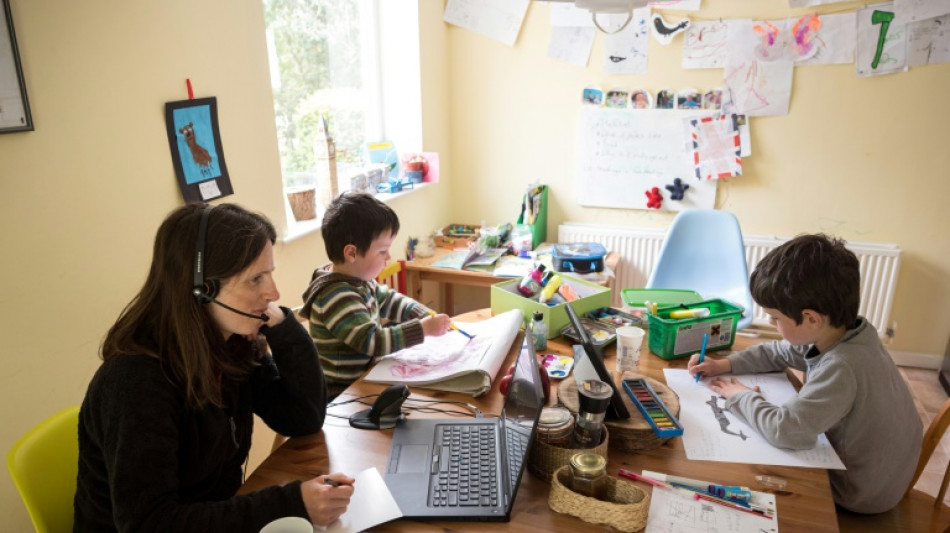
Men urged to train themselves to notice household chores: study / Photo: OLI SCARFF - AFP/File

 US Fed raises rates to tackle 'too high' inflation, irking Trump

 Turkey releases 106 protesters, jails more LGBTQ activists

 Candidate for UN chief calls for AI regulation akin to nuclear weapons

 'We're losing control,' AI pioneer Yoshua Bengio tells AFP

 IR-MED and Dice Technologies Announce collaboration to Evaluate and Advance Pressure-Injury Prevention Platform in Japan

 Watts, Pitt, Cruz to light up Spain's top film festival

 Toogood Gold's Table Mountain Sits in the Shadow of a Nevada Gold Rush

 MEXC July–August Security Report: 38.66M USDT in Risk Funds Intercepted, Futures Insurance Fund Hits 792M USDT

 Emporio Armani names Dario Vitale new creative director

 EU to ban social media for under 13s, curb access until 15

 Wildfires push endangered Sumatran elephants to brink: Indonesian NGO

 Bank of Japan set to raise rates under pressure from inflation, US

 EU chief to unveil social media, gaming curbs for under-15s

 'Resident Evil' film brings video game's ethos to the big screen

 GA-ASI Mojave First UAS To Complete Battlefield Short Field Ops

 Sanders, Bannon warn of AI dangers in rare US left-right alignment

 Empty benches as schools reopen in Venezuela's quake-hit Guaira

 Tiny English village holds 'independence' vote over asylum seeker housing

 US Treasury chief says to meet Chinese counterpart at weekend

 BingX Evolves into a Multi-Asset Trading Platform, Connecting Users to Global Opportunities

 International Trading Institute Expands Professional Trader Development Beyond the Master’s in Trading

 Lake Energy Secures $80 Million for U.S. Renewable Energy Expansion

 Stocks drop, oil climbs and Treasury yields hit 19-year high

 SkySail Strategies Outperforms Wall Street's 30-Year Risk Standard With Proprietary AI Inference Model

 Just add fish: Scientists pursue more rice, less disease in Senegal paddies

Gender imbalance in shouldering domestic work is explained by different ways in which men and women perceive chores, philosophers at Britain's Cambridge University suggest.
Women looking at an unclean surface may see something to be wiped whereas men may just observe a crumb-covered countertop, researchers argue in the journal Philosophy and Phenomenological Research.
They say data gathered during the pandemic, when both men and women spent time at the domestic coalface, throw up two important questions -- why women continue to take on most housework and why men believe it to be more equally shared than it is.
According to a survey of US households during the pandemic, 70 percent of women said they were fully or mostly responsible for housework, and 66 percent for childcare, roughly the same proportion as usual.
Tom McClelland, from Cambridge University's department of history and philosophy of science, said the fact that inequalities persisted and that many men continued to be oblivious meant that traditional explanations were not the whole story.
The researchers say "affordance theory" in which people experience objects and situations as having actions implicitly attached could explain the disparity.
According to the study, when a woman enters a kitchen, she is more likely to see dishes to be washed or a fridge to be stocked.
But the study was not about absolving men or making excuses, they said.
Perception is shaped on practice and people can train themselves into good habits, McClelland told AFP.
"If you're boiling the kettle, look to see if there are any crumbs that need wiping up. Over time you won't need the routine because the crumbs will start to grab your attention... They'll call out to be wiped up and you won't need to be so deliberate."
McClelland said the study was aimed at understanding such phenomena from an academic perspective and influencing policy areas such as paid paternal leave.
"One of the important things about parental leave is it's not just about the distribution of caring work during the early months of a child's life it's about how those early months tune you in to caring tasks in the future," he said.
"If a man has more extended parental leave, he'd be more tuned into those caring needs... and that would lead into more equitable distribution of caring and labouring in the future."
Y.Uduike--CPN