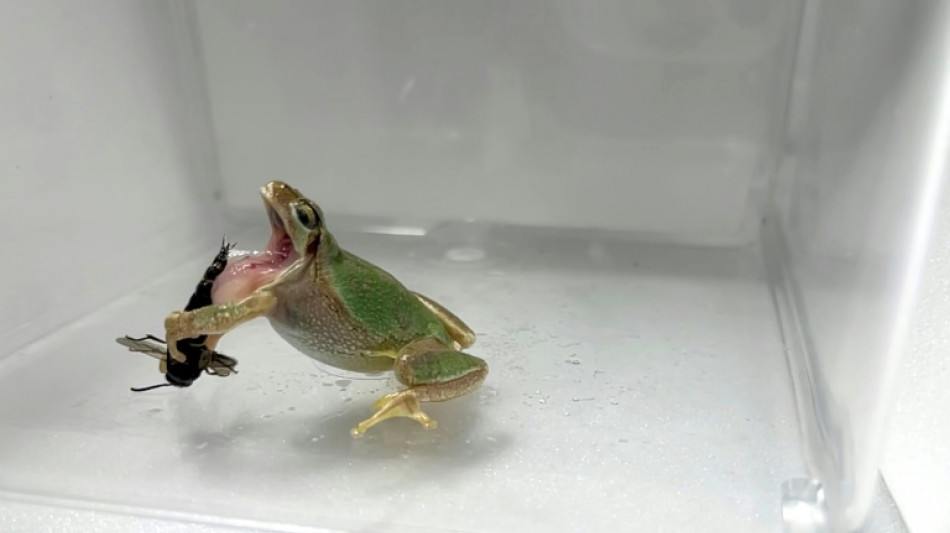
En garde! Wasps use penis spikes to ward off predators / Photo: Shinji SUGIURA - Kobe University/AFP

 US Fed raises rates to tackle 'too high' inflation, irking Trump

 Turkey releases 106 protesters, jails more LGBTQ activists

 Candidate for UN chief calls for AI regulation akin to nuclear weapons

 'We're losing control,' AI pioneer Yoshua Bengio tells AFP

 IR-MED and Dice Technologies Announce collaboration to Evaluate and Advance Pressure-Injury Prevention Platform in Japan

 Watts, Pitt, Cruz to light up Spain's top film festival

 Toogood Gold's Table Mountain Sits in the Shadow of a Nevada Gold Rush

 MEXC July–August Security Report: 38.66M USDT in Risk Funds Intercepted, Futures Insurance Fund Hits 792M USDT

 Emporio Armani names Dario Vitale new creative director

 EU to ban social media for under 13s, curb access until 15

 Wildfires push endangered Sumatran elephants to brink: Indonesian NGO

 Bank of Japan set to raise rates under pressure from inflation, US

 EU chief to unveil social media, gaming curbs for under-15s

 'Resident Evil' film brings video game's ethos to the big screen

 GA-ASI Mojave First UAS To Complete Battlefield Short Field Ops

 Sanders, Bannon warn of AI dangers in rare US left-right alignment

 Empty benches as schools reopen in Venezuela's quake-hit Guaira

 Tiny English village holds 'independence' vote over asylum seeker housing

 US Treasury chief says to meet Chinese counterpart at weekend

 BingX Evolves into a Multi-Asset Trading Platform, Connecting Users to Global Opportunities

 International Trading Institute Expands Professional Trader Development Beyond the Master’s in Trading

 Lake Energy Secures $80 Million for U.S. Renewable Energy Expansion

 Stocks drop, oil climbs and Treasury yields hit 19-year high

 SkySail Strategies Outperforms Wall Street's 30-Year Risk Standard With Proprietary AI Inference Model

 Just add fish: Scientists pursue more rice, less disease in Senegal paddies

An accidental sting has helped Japanese scientists prove some male wasps have a rather unusual predator defence weapon: penis spikes.
While wasps are known for their prickly attacks, only females have a real sting in their tails. Their male counterparts generally evade predators by mimicking the fairer sex.
Scientists had theorised that some male wasps might have other defence mechanisms, including perhaps deploying their genital spikes.
"However, the evidence was lacking," explained Shinji Sugiura, an ecologist at Japan's Kobe University.
Sugiura studies animal anti-predator defences but it was only by chance that he investigated the unusual male wasp mechanism, after his graduate student and co-author reported being stung by a mason wasp.
"I tried to be stung after hearing her experience," Sugiura told AFP.
"Because I had believed male wasps as harmless, I was very surprised to experience the pain."
Female wasps sting via an ovipositor, a tube-like protrusion that deposits eggs but can also deliver a venomous riposte.
Male wasps lack the organ but are equipped with two large spikes that sit either side of their penis.
To test the effectiveness of this defence, Sugiura's team offered up male mason wasps to two different kinds of frogs to see how the spikes were deployed.
"Male wasps were frequently observed to pierce the mouth or other parts of frogs with their genitalia while being attacked," Sugiura reported in research published Tuesday in the Current Biology journal.
The attacks are documented in a video that shows an unfortunate frog trying repeatedly to chomp down on a wasp, before using its front feet to pull the stinging insect out of its mouth.
Pond frogs happily ate all the males, as well as stinging females, but over a third of tree frogs rejected the male wasps after being stung.
When the experiment was repeated with the genital spikes removed from the wasps, the tree frogs no longer held back and ate them without hesitation.
"The difference was statistically significant. Even a small difference of survival could cause the evolution of anti-predator devices in insects," Sugiura said.
There has been little research on insect genitalia outside of its role in reproduction, according to Sugiura, though the wasp defence mechanism is not entirely without precedent.
Previous research has found, for example, that some species of hawkmoth use their genitalia to emit ultrasound that jams bat sonar.
Sugiura is no stranger to uncovering some of the weirdest ways animals evade their predators.
He has documented how some beetles can escape after being swallowed, by following the digestive tract to its logical conclusion and escaping from the anus.
And he has shown that other insects can make any unfortunate toad that has eaten them vomit them back up.
He now hopes to expand his current research to determine whether other wasp families have the same genital spike defence mechanism.
Y.Uduike--CPN