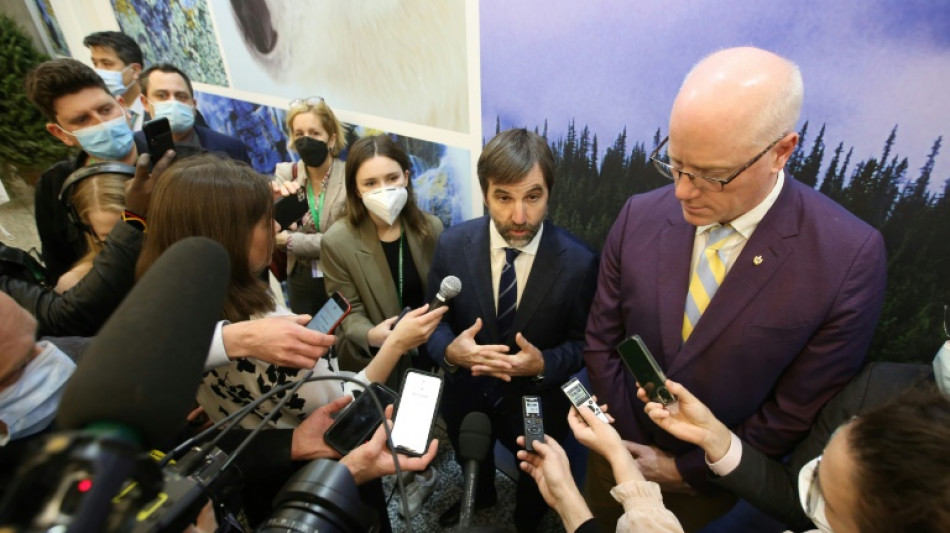
UN nature talks teeter on brink as ministers arrive for home stretch / Photo: Lars Hagberg - AFP

 US Fed raises rates to tackle 'too high' inflation, irking Trump

 Turkey releases 106 protesters, jails more LGBTQ activists

 Candidate for UN chief calls for AI regulation akin to nuclear weapons

 'We're losing control,' AI pioneer Yoshua Bengio tells AFP

 IR-MED and Dice Technologies Announce collaboration to Evaluate and Advance Pressure-Injury Prevention Platform in Japan

 Watts, Pitt, Cruz to light up Spain's top film festival

 Toogood Gold's Table Mountain Sits in the Shadow of a Nevada Gold Rush

 MEXC July–August Security Report: 38.66M USDT in Risk Funds Intercepted, Futures Insurance Fund Hits 792M USDT

 Emporio Armani names Dario Vitale new creative director

 EU to ban social media for under 13s, curb access until 15

 Wildfires push endangered Sumatran elephants to brink: Indonesian NGO

 Bank of Japan set to raise rates under pressure from inflation, US

 EU chief to unveil social media, gaming curbs for under-15s

 'Resident Evil' film brings video game's ethos to the big screen

 GA-ASI Mojave First UAS To Complete Battlefield Short Field Ops

 Sanders, Bannon warn of AI dangers in rare US left-right alignment

 Empty benches as schools reopen in Venezuela's quake-hit Guaira

 Tiny English village holds 'independence' vote over asylum seeker housing

 US Treasury chief says to meet Chinese counterpart at weekend

 BingX Evolves into a Multi-Asset Trading Platform, Connecting Users to Global Opportunities

 International Trading Institute Expands Professional Trader Development Beyond the Master’s in Trading

 Lake Energy Secures $80 Million for U.S. Renewable Energy Expansion

 Stocks drop, oil climbs and Treasury yields hit 19-year high

 SkySail Strategies Outperforms Wall Street's 30-Year Risk Standard With Proprietary AI Inference Model

 Just add fish: Scientists pursue more rice, less disease in Senegal paddies
Hopes of sealing a historic "peace pact with nature" at a United Nations biodiversity summit will soon rest on the world's environment ministers, arriving in Montreal for the final phase of talks beginning Thursday.
Stark divisions remain to be bridged, foremost among them the subject of how much developed countries will pay the developing to help them save ecosystems, and whether there should be a new, dedicated fund for this purpose.
At stake is the future of the planet and whether humanity can roll back habitat destruction, pollution and the climate crisis, which are threatening an estimated million species with extinction.
The draft agreement contains more than 20 targets, including a cornerstone pledge to protect 30 percent of the world's land and seas by 2030, eliminate harmful fishing and agriculture subsidies, tackle invasive species and reduce pesticides.
"I hope what we would have at the end of this... is a Paris moment," said Zakri Abdul Hamid, science advisor for the Campaign for Nature, referencing the landmark climate accord that agreed to hold long-term warming to 1.5 degrees Celsius.
"Decades of study have also clarified what the world must do," he added.
In the absence of heads of state and government, more than a hundred ministers will have to drag the text, three years in the making, over the finish line.
But its success still hangs in the balance after disagreements over the thorny issue of biodiversity financing led to a walkout by negotiators from developing nations overnight Tuesday and a temporary pause in talks.
- New fund sought -
The Global South, home to most of the world's biological diversity, wants a new global biodiversity fund (GBF), something rich countries oppose -- proposing instead making existing financial mechanisms more accessible.
This debate mirrors a similar disagreement during recent UN climate talks in Egypt on creating a "loss and damages" fund for the most climate-vulnerable nations -- though that demand was eventually met.
Dozens of nations, including Brazil, India, Indonesia and many African countries are also seeking funding of $100 billion yearly, or one percent of global GDP, until 2030.
Current financial flows from high-income countries to lower income ones are in the order of $10 billion per year.
A crisis meeting of heads of delegations, organized on Wednesday by China, which is chairing the meeting, brought negotiators back to the table following the breakdown.
A Western negotiator who declined to be named told AFP: "The African group wants to reach an agreement with money in front, other developing countries too, but Brazil is using the financial question to derail the process."
The source said the Brazilian delegation is still following the policies of outgoing far-right president Jair Bolsonaro, who is very close to the agricultural industry, which is hostile to reducing pesticide use.
Nevertheless, developing countries are angered by what they see as a lack of ambition.
"This has led to the negotiations now being on the edge of a full breakdown," said Innocent Maloba of WWF International.
Beyond the moral implications, there is the question of self-interest: $44 trillion of economic value generation -- more than half the world's total GDP -- is dependent on nature and its services.
The summit has failed to garner the same level of attention as the UN climate meeting held in Egypt in November, which brought together more than a hundred world leaders.
This meeting is being held in Canada after China declined to host because of its strict Covid rules, and Canada's Prime Minister Justin Trudeau has been the only leader in attendance.
X.Wong--CPN