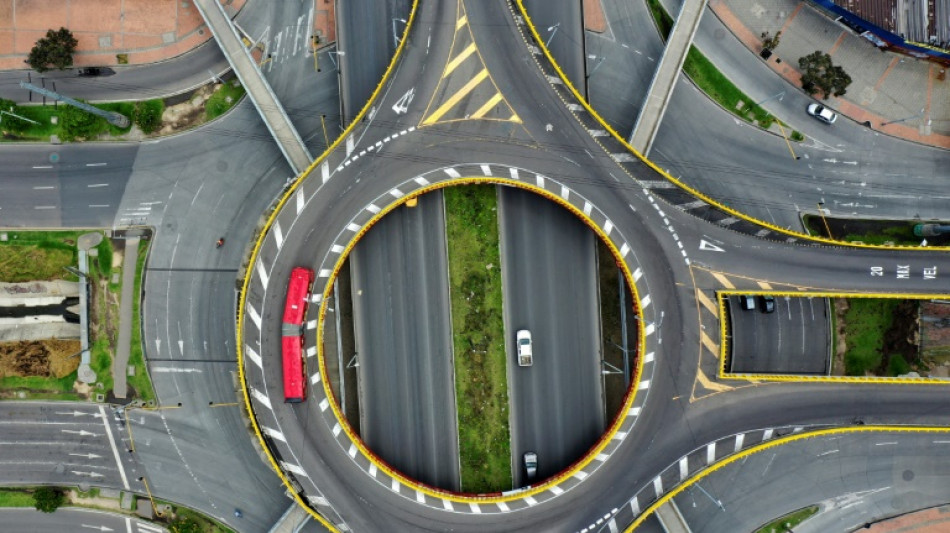
Study explains surprise surge in methane during pandemic lockdown / Photo: Raul ARBOLEDA - AFP/File

 US Fed raises rates to tackle 'too high' inflation, irking Trump

 Turkey releases 106 protesters, jails more LGBTQ activists

 Candidate for UN chief calls for AI regulation akin to nuclear weapons

 'We're losing control,' AI pioneer Yoshua Bengio tells AFP

 IR-MED and Dice Technologies Announce collaboration to Evaluate and Advance Pressure-Injury Prevention Platform in Japan

 Watts, Pitt, Cruz to light up Spain's top film festival

 Toogood Gold's Table Mountain Sits in the Shadow of a Nevada Gold Rush

 MEXC July–August Security Report: 38.66M USDT in Risk Funds Intercepted, Futures Insurance Fund Hits 792M USDT

 Emporio Armani names Dario Vitale new creative director

 EU to ban social media for under 13s, curb access until 15

 Wildfires push endangered Sumatran elephants to brink: Indonesian NGO

 Bank of Japan set to raise rates under pressure from inflation, US

 EU chief to unveil social media, gaming curbs for under-15s

 'Resident Evil' film brings video game's ethos to the big screen

 GA-ASI Mojave First UAS To Complete Battlefield Short Field Ops

 Sanders, Bannon warn of AI dangers in rare US left-right alignment

 Empty benches as schools reopen in Venezuela's quake-hit Guaira

 Tiny English village holds 'independence' vote over asylum seeker housing

 US Treasury chief says to meet Chinese counterpart at weekend

 BingX Evolves into a Multi-Asset Trading Platform, Connecting Users to Global Opportunities

 International Trading Institute Expands Professional Trader Development Beyond the Master’s in Trading

 Lake Energy Secures $80 Million for U.S. Renewable Energy Expansion

 Stocks drop, oil climbs and Treasury yields hit 19-year high

 SkySail Strategies Outperforms Wall Street's 30-Year Risk Standard With Proprietary AI Inference Model

 Just add fish: Scientists pursue more rice, less disease in Senegal paddies

A mysterious surge in planet-heating atmospheric methane in 2020 despite Covid lockdowns that reduced many human-caused sources can be explained by a greater release from nature and, surprisingly, reduced air pollution, scientists said Wednesday.
Methane stays in the atmosphere only a fraction as long as carbon dioxide, but is far more efficient at trapping heat and is responsible for roughly 30 percent of the global rise in temperatures to date.
Released from the oil and gas, waste and agriculture sectors, as well as through biological processes in wetlands, the powerful greenhouse gas is a key target for efforts to curb global warming.
But a new study published in the journal Nature suggests that cutting methane may be even more of a challenge -- and more urgent -- than is currently understood.
Researchers in China, France, the US and Norway found that efforts to reduce CO2 emissions and air pollution will affect the atmospheric process that scrubs methane from the air. That means the planet-heating gas will linger longer and accumulate faster.
If the world is to meet the challenge of keeping warming to under 2 degrees Celsius since the pre-industrial era, "we will have to act even more quickly and even more strongly to reduce methane", said Philippe Ciais who co-led the research at France's Laboratory for the Sciences of Climate and Environment (LSCE).
The researchers focused on the mystery of the concentrations of methane in the atmosphere in 2020, which had their biggest increase on record even as Covid-19 lockdowns saw carbon dioxide emissions fall.
- 'Bad news' -
What they found is potentially two pieces of "bad news" for climate change, said co-author Marielle Saunois of (LSCE).
Firstly, they looked at inventories to assess fossil fuel and agricultural methane emissions and found that human sources of methane did indeed fall slightly in 2020.
Then they used ecosystem models to estimate that warmer and wetter conditions over parts of the northern hemisphere caused a surge in emissions from wetlands.
That confirms other research and is worrying because the more methane released, the more warming, potentially creating a feedback loop largely outside of human control.
But that is only half of the story, the researchers found.
Researchers also looked at changes in atmospheric chemistry, because this provides a "sink" for methane, effectively cleaning it out of the air in a relatively short period by converting it to water and CO2 when it reacts with the hydroxyl radical (OH).
These hydroxyl radicals are present in tiny quantities and have a lifetime of less than a second, but they remove about 85 percent of methane from the atmosphere.
They are the "Pac-Man of the atmosphere", said Ciais: "As soon as they see something they eat it and then disappear."
- 'Dramatic' -
The researchers simulated changes in OH using human sources of carbon monoxide, hydrocarbons and nitrogen oxide emissions that altogether affect the production and loss of hydroxyl radicals in the atmosphere.
They found that OH concentrations decreased by around 1.6 percent in 2020 from the year before, largely because of a fall in nitrogen oxide (NOx) emissions caused by the Covid lockdowns. Nitrogen oxide is emitted into the air primarily from burning fuel.
A 20 percent reduction in NOx could increase methane twice as fast, Cias told a press briefing, adding: "This has surprised us greatly."
The researchers said their study helps to solve the riddle of the rise in methane in the atmosphere in 2020.
But they acknowledged that more work would have to be done to answer the next mystery: why the rise in methane concentrations hit a new record in 2021.
Ciais said lower nitrogen oxide emissions from transport in the United States and India, as well as continued low levels of air travel due to the pandemic may have played a part.
Euan Nisbet, a professor of Earth Sciences at Royal Holloway University who was not involved in the research, said the jump in methane in 2020 was a "major shock".
"Even more worrying is the rise in methane in 2021 -- this was after the major Coronavirus shutdowns when the economy was recovering," he told AFP.
"As yet we don't have detailed studies but something very dramatic seems to be going on."
A.Mykhailo--CPN