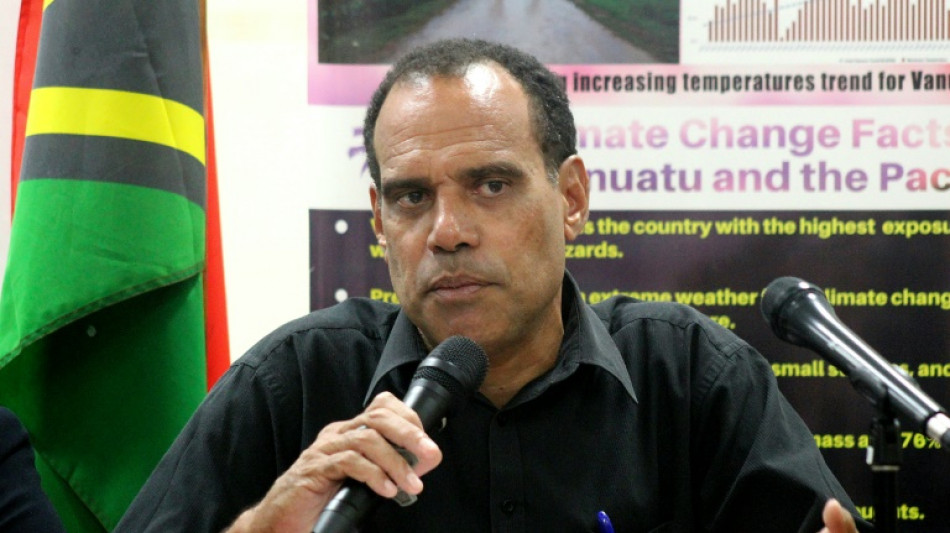
Climate 'tragedy': Vanuatu to relocate 'dozens' of villages / Photo: Hilaire Bule - AFP

 US Fed raises rates to tackle 'too high' inflation, irking Trump

 Turkey releases 106 protesters, jails more LGBTQ activists

 Candidate for UN chief calls for AI regulation akin to nuclear weapons

 'We're losing control,' AI pioneer Yoshua Bengio tells AFP

 IR-MED and Dice Technologies Announce collaboration to Evaluate and Advance Pressure-Injury Prevention Platform in Japan

 Watts, Pitt, Cruz to light up Spain's top film festival

 Toogood Gold's Table Mountain Sits in the Shadow of a Nevada Gold Rush

 MEXC July–August Security Report: 38.66M USDT in Risk Funds Intercepted, Futures Insurance Fund Hits 792M USDT

 Emporio Armani names Dario Vitale new creative director

 EU to ban social media for under 13s, curb access until 15

 Wildfires push endangered Sumatran elephants to brink: Indonesian NGO

 Bank of Japan set to raise rates under pressure from inflation, US

 EU chief to unveil social media, gaming curbs for under-15s

 'Resident Evil' film brings video game's ethos to the big screen

 GA-ASI Mojave First UAS To Complete Battlefield Short Field Ops

 Sanders, Bannon warn of AI dangers in rare US left-right alignment

 Empty benches as schools reopen in Venezuela's quake-hit Guaira

 Tiny English village holds 'independence' vote over asylum seeker housing

 US Treasury chief says to meet Chinese counterpart at weekend

 BingX Evolves into a Multi-Asset Trading Platform, Connecting Users to Global Opportunities

 International Trading Institute Expands Professional Trader Development Beyond the Master’s in Trading

 Lake Energy Secures $80 Million for U.S. Renewable Energy Expansion

 Stocks drop, oil climbs and Treasury yields hit 19-year high

 SkySail Strategies Outperforms Wall Street's 30-Year Risk Standard With Proprietary AI Inference Model

 Just add fish: Scientists pursue more rice, less disease in Senegal paddies

Vanuatu is drawing up plans to relocate "dozens" of villages within the next two years, as they come under threat from rising seas, the Pacific nation's climate chief told AFP Thursday.
Climate Change Minister Ralph Regenvanu said dealing with the impact of global warming was a major challenge facing Vanuatu's 300,000 inhabitants who live on a chain of islands strung out between Australia and Fiji.
Regenvanu said the response would inevitably involve relocating long-established communities from coastal areas, where climate change is pushing sea levels higher and fuelling more extreme storms.
He said Vanuatu's government has identified "dozens" of villages in "at-risk areas" to be relocated "within the next 24 months" while other settlements have also been earmarked to move in the longer term.
"Climate displacement of populations is the main feature of our future. We have to be ready for it and plan for it now," said Regenvanu, who took over his ministerial portfolio after a snap election in October.
"It's going to be a huge challenge and a huge tragedy for many people who would have to leave their ancestral land to move to other places, but that's the reality."
Low-lying Pacific island nations, like Vanuatu, are already experiencing the impact of climate change.
Half of Vanuatu's population was affected when Cyclone Pam battered the capital Port Vila in 2015, killing a dozen people, destroying crops and leaving thousands homeless.
Vanuatu is ranked as one of the countries most susceptible to natural disasters like earthquakes, storm damage, flooding and tsunamis, according to the annual World Risk Report.
Other Pacific nations are also looking to move under-threat communities, including Fiji where dozens of villages have been earmarked for relocation owing to the impacts of the climate crisis.
Scientists predict sea levels in the Pacific will rise between 25–58 centimetres (9-22 inches) by the middle of the century.
That is a devastating prospect for Vanuatu, where around 60 percent of the population live within a kilometre of the coast.
- 'All sorts of threats' -
Regenvanu wants coastal defences strengthened.
"Our greatest challenge right now on Vanuatu is basically keeping our populations safe," he said.
"We're finding more and more that our people are subject to all sorts of threats from volcanoes, flooding, cyclones and so on.
"So we have to engage now in moving populations and building resilient infrastructure so that our people are safer in the coming years."
Vanuatu already has experience of moving its people.
In 2005, it was one of the first Pacific nations to move an entire community on the northern island of Tegua from a flood-prone coastal area to higher ground.
And in 2017, all 11,000 people living on Ambae, an island in the country’s north, were ferried by a rag-tag armada of boats to other isles after the Manaro Voui volcano erupted, raining down rock and ash on villagers.
In May, Vanuatu's parliament declared a climate change emergency and its government is seeking to speed up global action by leading efforts to take the matter to the Hague-based International Court of Justice.
Regenvanu attended the UN's COP27 summit in Sharm el-Sheikh last month, where a landmark deal was struck to help vulnerable countries cope with climate change by providing a "loss and damage" fund.
The nations attending COP27 repeated a commitment to limit global warming to 1.5 degrees Celsius (34.7 degrees Fahrenheit) from pre-industrial levels, but Regenvanu said the pledges did not go far enough.
"Basically, there's not enough commitment to reducing emissions," he said.
"And so we're going to see temperatures increase beyond 1.5 degrees which we know will be disastrous for the Pacific -- we have to focus on adaptation and particularly loss and damage."
T.Morelli--CPN