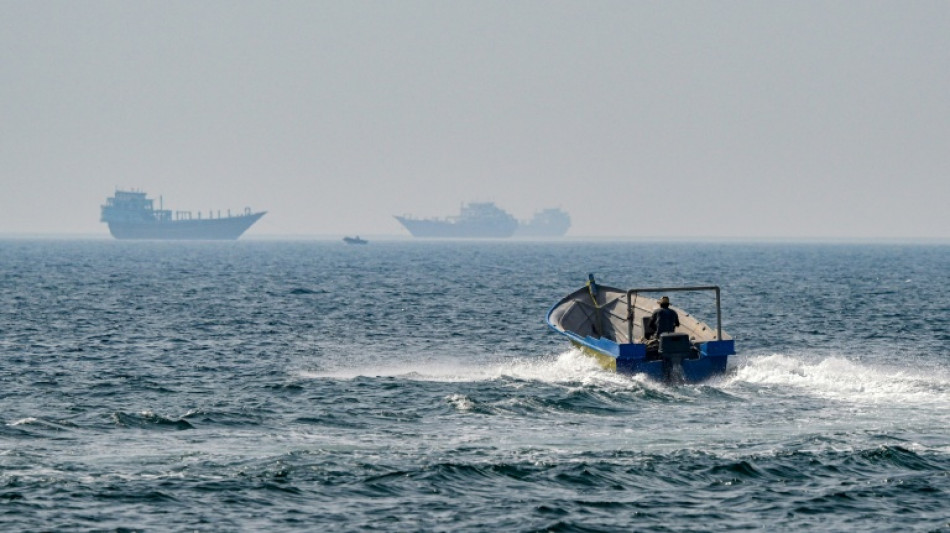
Hormuz shipping muted as US blockade takes hold: tracking data / Photo: Giuseppe CACACE - AFP/File

 Princess Diana's brother makes new explosive claims against Charles

 Trump admin overhauls key protection for endangered species

 Mbappe draws political fire over Ceuta t-shirt controversy

 Third malaria death in Germany from outbreak tied to Frankfurt airport

 AtlasClear Holdings Reports Preliminary Fiscal 2026 Revenue of Approximately $20.1 Million, Up 85%; Revenue Plus Interest Income of Approximately $21.9 Million

 'Another arrow to the quiver': World Bank posts record private capital mobilization

 Ireland to boycott Eurovision 2027 over Gaza

 India's Tata Sons reappoints N. Chandrasekaran as chairman

 Germany urges EU action against China to defend carmakers

 Japan eyes changing prostitution law to punish sex buyers

 Modi pitches India as global chipmaking hub

 Ukraine plans record defence spending in 2027

 NASA scan discovers new, 'once in a century' Moon crater

 Most stocks rise as Fed hikes and indicates drive to curb inflation

 UK-Sudanese author pens book to give children 'African history of Africa'

 Argentine judge orders suspension of Falklands oil project

 US Fed raises rates to tackle 'too high' inflation, irking Trump

 Turkey releases 106 protesters, jails more LGBTQ activists

 Candidate for UN chief calls for AI regulation akin to nuclear weapons

 'We're losing control,' AI pioneer Yoshua Bengio tells AFP

 IR-MED and Dice Technologies Announce collaboration to Evaluate and Advance Pressure-Injury Prevention Platform in Japan

 Watts, Pitt, Cruz to light up Spain's top film festival

 Toogood Gold's Table Mountain Sits in the Shadow of a Nevada Gold Rush

 MEXC July–August Security Report: 38.66M USDT in Risk Funds Intercepted, Futures Insurance Fund Hits 792M USDT

 Emporio Armani names Dario Vitale new creative director

A trickle of ships crossed the Strait of Hormuz Tuesday and Wednesday as a US blockade appeared to further curb traffic in the trade route already paralysed by Iranian forces, marine tracking data showed.
The crucial waterway normally sees about a fifth of global crude oil and liquefied natural gas (LNG) pass through it, but traffic has been almost halted since the US and Israeli strikes on Iran sparked the war on February 28.
Here are the latest developments in the strait, using maritime data from ship tracking firm Kpler unless stated otherwise:
- US blockade enforced -
The US military said the blockade of vessels either departing or destined for Iranian ports had been fully implemented during the first 48 hours.
"No vessels have made it past U.S. forces. Additionally, 9 vessels have complied with direction from U.S. forces to turn around and return toward an Iranian port or coastal area," regional command CENTCOM said on X.
It posted photos and audio of its warships and operations in the area, saying more than 10,000 personnel were deployed for the blockade "against vessels of all nations entering or departing Iranian ports and coastal areas".
- Ships turn around -
Sanctioned Chinese tanker Rich Starry, laden with methanol from Iran, crossed the Strait on Tuesday but U-turned and was close to Iran's Qeshm island on Wednesday evening.
The Iranian-flagged container ship Golbon, sanctioned by the US, made it through the strait overnight but ground to a halt as it approached Pakistan and was last detected close to the Iranian port of Chabahar.
The Kashan, another Iranian-flagged container ship, appeared to have made it out of the Gulf of Oman on its way to India, but made an abrupt U-turn at around 1300 GMT and headed back towards the strait.
- Tankers enter Gulf -
Petrochemical tankers G Summer, Alicia and Agios Fanourios I, all sanctioned by the US for transporting Iranian products, passed westwards through the strait towards the Gulf using the so-called "toll" route set up by Iran, although all listed their destination as Iraq.
Bulk carrier Christianna and sanctioned tanker Elpis both passed eastwards through the strait away from the Gulf, having left Iranian ports, but later appeared to be stopped close to the UAE.
The only vessel destined for an Iranian port that has made it westwards through the strait is the Rosalina, which is laden with corn, according to Kpler.
The US has said that humanitarian shipments would be exempt from the blockade, according to news reports.
Another vessel, Seachampion, left the strait in the opposite direction having delivered soy beans to Iran, and was heading to Oman.
- Massive slowdown -
Just 388 commodity carriers have passed through the Strait of Hormuz between March 1 and April 15, 255 of them oil and gas tankers, and most were heading east away from the Gulf, Kpler data showed.
Only 16 commodity vessels have made the crossing since the US blockade came into force on Monday.
- Vessels stuck -
Around 670 commodity vessels sent signals from west of the strait on Tuesday, having apparently been stuck there since the end of February, according to data from maritime companies collated by Bloomberg.
Of those, 332 were oil or gas tankers.
More than 55 very large crude carriers are stuck in the Gulf -- including nine owned by Japanese companies and several owned by companies from China, Greece and South Korea, according to Bloomberg data and other maritime companies.
- Dozens of vessels targeted -
No new attacks on ships have been reported since the start of a ceasefire in the US-Israeli war with Iran last week.
Some 30 commercial ships, including 13 tankers, have been attacked or reported incidents in the region since March 1, according to the IMO, the UK Maritime Trade Operations Centre and Vanguard Tech.
J.Bondarev--CPN