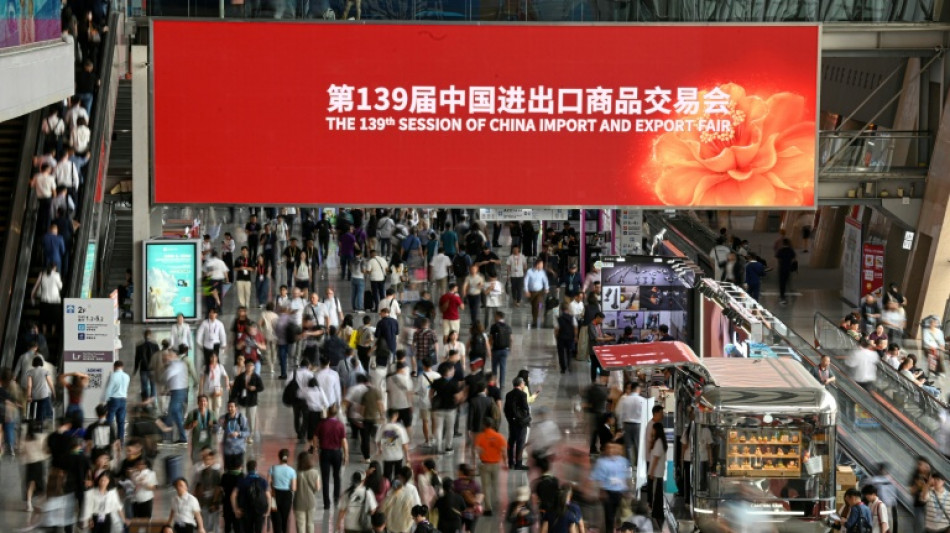
Chinese suppliers, Mideast importers fret about war fallout on trade / Photo: Jade GAO - AFP

 Princess Diana's brother makes new explosive claims against Charles

 Trump admin overhauls key protection for endangered species

 Mbappe draws political fire over Ceuta t-shirt controversy

 Third malaria death in Germany from outbreak tied to Frankfurt airport

 AtlasClear Holdings Reports Preliminary Fiscal 2026 Revenue of Approximately $20.1 Million, Up 85%; Revenue Plus Interest Income of Approximately $21.9 Million

 'Another arrow to the quiver': World Bank posts record private capital mobilization

 Ireland to boycott Eurovision 2027 over Gaza

 India's Tata Sons reappoints N. Chandrasekaran as chairman

 Germany urges EU action against China to defend carmakers

 Japan eyes changing prostitution law to punish sex buyers

 Modi pitches India as global chipmaking hub

 Ukraine plans record defence spending in 2027

 NASA scan discovers new, 'once in a century' Moon crater

 Most stocks rise as Fed hikes and indicates drive to curb inflation

 UK-Sudanese author pens book to give children 'African history of Africa'

 Argentine judge orders suspension of Falklands oil project

 US Fed raises rates to tackle 'too high' inflation, irking Trump

 Turkey releases 106 protesters, jails more LGBTQ activists

 Candidate for UN chief calls for AI regulation akin to nuclear weapons

 'We're losing control,' AI pioneer Yoshua Bengio tells AFP

 IR-MED and Dice Technologies Announce collaboration to Evaluate and Advance Pressure-Injury Prevention Platform in Japan

 Watts, Pitt, Cruz to light up Spain's top film festival

 Toogood Gold's Table Mountain Sits in the Shadow of a Nevada Gold Rush

 MEXC July–August Security Report: 38.66M USDT in Risk Funds Intercepted, Futures Insurance Fund Hits 792M USDT

 Emporio Armani names Dario Vitale new creative director

Suppliers and buyers at a trade show in southern China were cautious on Wednesday as they weighed costs for ice cream machines, home appliances and cars that have risen since the start of the Middle East war.
Chinese exporters and Middle Eastern buyers at the opening day of the Canton Fair -- one of the largest trade shows in the world -- gloomily told AFP that the Iran war has pummelled orders and led to price hikes.
The fair gives foreign buyers a chance to meet face-to-face with Chinese manufacturers and assess their products up close, establishing new supply agreements and shoring up old contacts.
But standing by a row of deep fryers and ovens, kitchenware company sales manager Li Jin told AFP that some customers in the Middle East "dare not place orders" while shipments still have not reached others.
Many cargo vessels that would normally pass through the Strait of Hormuz en route to the Middle East have been floating in limbo since Tehran effectively closed the vital waterway in response to US and Israeli strikes on Iran that began February 28.
Washington announced its own blockade of Iranian ports on Sunday after peace talks with Tehran failed, dashing hopes for an imminent reopening of the trade route.
Fresh orders from Middle East customers have dried up, said Li, whose company usually exports 20 to 30 percent of its products to the region.
"If it weren't for the war, we would have had a steady stream of new orders coming in," Li said.
The rising cost of raw materials has also pushed the company to hike prices to make up for thinner profit margins, she added.
- More safety, more business -
Customers remain in a "wait-and-see" mode, said Zora Wang, a sales manager at a company selling factory machinery.
"Even though they are sending out inquiries, their actual intent to purchase in the near term is not very strong," Wang told AFP.
But Wang said many of her clients work with freight forwarders -- third-party logistics and transportation agents -- to use other shipping channels or overland routes to ensure shipments still reach them in the Middle East.
Ahmad Alibasha, a Syrian general manager at a Chinese trading company, said Middle East customers "just don't want to order right now", with purchases from the region plummeting more than 50 percent since the conflict began.
"We will prefer the calm and the quiet and the safety, because more safety means more business," Alibasha told AFP, hopeful business would pick up if the war ends.
US President Donald Trump told The New York Post on Tuesday a new round of talks with Tehran could take place in Pakistan "over the next two days", while a fragile ceasefire between Washington and Tehran holds.
In the meantime, Chinese car exporters in a sleek showroom told AFP that the conflict has caused them to pivot operations to other regions, including South America and Africa.
- Shipment headache -
This year's Canton Fair, which is held twice a year in the Chinese manufacturing hub of Guangdong province -- is featuring a record 32,000 enterprises, state media said Wednesday.
Buyers, including those from the Middle East, packed into the sprawling exhibition centre to scout new suppliers.
Abdallah Mebarkia, a Saudi Arabian business owner, scoured the cavernous halls for televisions, washing machines and household appliances to sell to distributors in his country.
The Middle East war has had a "heavy impact" on his business, he told AFP, calling his shipment costs -- now up 50 to 70 percent -- a big "headache".
Shipping prices have risen as vessels stay put in the Gulf for fear of attack if they set sail, while others take long and costly alternative routes to avoid the Strait of Hormuz.
About a fifth of the world's oil and natural gas normally pass through the strait, with its closure pushing up the price of shipping fuel.
"A lot of delays" have also been caused by the Hormuz blockade, Mebarkia said, with some of his goods still stuck in the key waterway.
Jordanian business owner Asad Mohammad Abbas Asaad, who was inspecting drink dispensers and blenders at his supplier's booth, bemoaned the higher shipping costs which have doubled the import price of a container of those goods.
Buyers at the Canton Fair all expressed hopes that the war would end soon and reduce both trade turbulence and the wider instability in the region.
"We always hope for peace," Asaad said.
D.Philippon--CPN