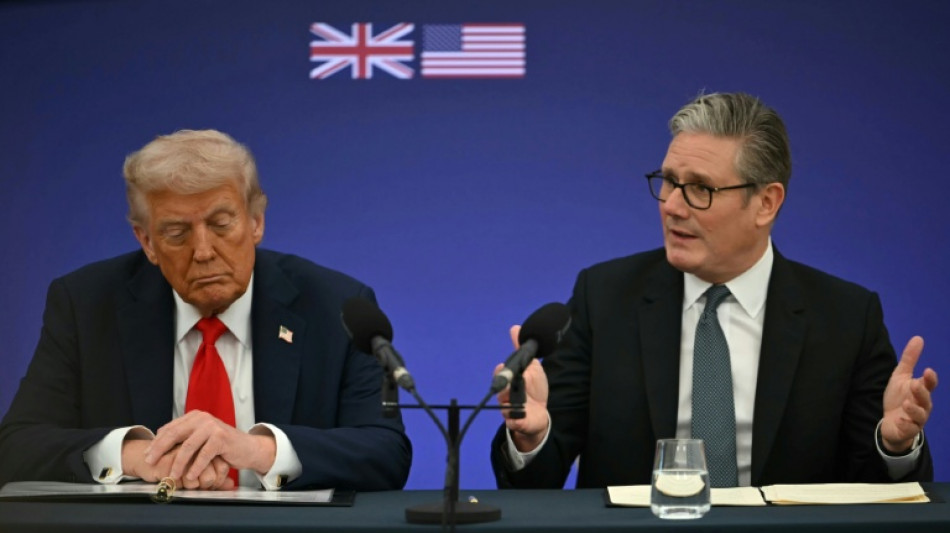
Starmer says 'won't yield' to Trump's Mideast war threats / Photo: ANDREW CABALLERO-REYNOLDS - AFP/File

 Princess Diana's brother makes new explosive claims against Charles

 Trump admin overhauls key protection for endangered species

 Mbappe draws political fire over Ceuta t-shirt controversy

 Third malaria death in Germany from outbreak tied to Frankfurt airport

 AtlasClear Holdings Reports Preliminary Fiscal 2026 Revenue of Approximately $20.1 Million, Up 85%; Revenue Plus Interest Income of Approximately $21.9 Million

 'Another arrow to the quiver': World Bank posts record private capital mobilization

 Ireland to boycott Eurovision 2027 over Gaza

 India's Tata Sons reappoints N. Chandrasekaran as chairman

 Germany urges EU action against China to defend carmakers

 Japan eyes changing prostitution law to punish sex buyers

 Modi pitches India as global chipmaking hub

 Ukraine plans record defence spending in 2027

 NASA scan discovers new, 'once in a century' Moon crater

 Most stocks rise as Fed hikes and indicates drive to curb inflation

 UK-Sudanese author pens book to give children 'African history of Africa'

 Argentine judge orders suspension of Falklands oil project

 US Fed raises rates to tackle 'too high' inflation, irking Trump

 Turkey releases 106 protesters, jails more LGBTQ activists

 Candidate for UN chief calls for AI regulation akin to nuclear weapons

 'We're losing control,' AI pioneer Yoshua Bengio tells AFP

 IR-MED and Dice Technologies Announce collaboration to Evaluate and Advance Pressure-Injury Prevention Platform in Japan

 Watts, Pitt, Cruz to light up Spain's top film festival

 Toogood Gold's Table Mountain Sits in the Shadow of a Nevada Gold Rush

 MEXC July–August Security Report: 38.66M USDT in Risk Funds Intercepted, Futures Insurance Fund Hits 792M USDT

 Emporio Armani names Dario Vitale new creative director

British Prime Minister Keir Starmer on Wednesday said he would not "yield" to pressure to join the Iran war after US President Donald Trump threatened to scrap a UK trade deal.
"We're not going to get dragged into this war. It is not our war," Starmer told parliament.
"I'm not going to change my mind. I'm not going to yield. It is not in our national interest to join this war," the Labour leader added.
In a phone interview with Sky News, Trump threatened to alter an agreement struck with Britain that limits the impact of his US tariffs blitz.
Trump, who has repeatedly slammed Starmer's policies, said strains in the relationship with the NATO ally would "not at all" negatively affect King Charles III's state visit to the United States this month.
In reference to the royal trip, Starmer told parliament that the two nations' "long standing bonds... are far greater than anyone who occupies any particular office at any particular time".
London and Washington concluded a trade agreement last year capping US tariffs at 10 percent on most British manufactured goods.
In return, the UK agreed to open its markets further to American ethanol and beef, sparking concerns in the country.
At the time, it was an advantageous agreement for London, which benefited from the lowest tariffs granted by the US.
This advantage has, however, been weakened since the US Supreme Court struck down some tariffs and Washington retaliated by imposing a temporary 10-percent tariff on almost all of its imports pending a new tariff regime by July.
- No 'exit plan' -
While Trump praised his good relationship with Starmer at the time of the agreement, ties have since deteriorated, particularly over the war in the Middle East.
Starmer angered Trump by refusing to allow British bases to be used for the US's initial strikes on Iran last month.
He later agreed to a US request to use two British military bases for a "specific and limited defensive purpose".
"It's a relationship where when we asked them for help, they were not there," Trump told Sky News.
"When we needed them, they were not there. When we didn't need them, they were not there. They still aren't there," he insisted.
Starmer's Labour government, which has sought to build bridges with Trump since his return to the White House in January 2025, has recently hardened its rhetoric toward its historic ally.
Finance Minister Rachel Reeves on Tuesday hit out at the "folly" of Trump launching a war with Iran "without a clear exit plan".
Starmer told parliament on Monday that Trump was wrong to threaten to destroy Iranian "civilisation", while on Sunday Health Minister Wes Streeting criticised Trump's language as "incendiary, provocative, outrageous".
Against this backdrop, Reeves was to see US Treasury Secretary Scott Bessent in Washington on Wednesday as part of an International Monetary Fund meeting to detail the economic impact of the conflict.
A.Leibowitz--CPN