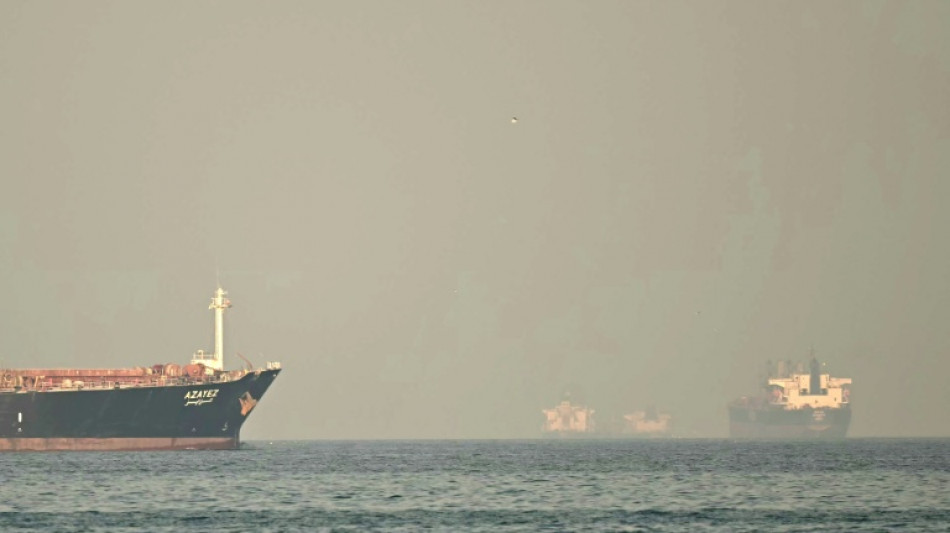
Italy, Germany and France offer help with Hormuz only after ceasefire / Photo: Giuseppe CACACE - AFP/File

 Bank of Japan hikes rates to 31-year high to battle inflation

 AI doomsday warnings unlikely to slow IPOs but questions linger

 In Brazil's Amazon, the hunt for oil fuels hopes and fears

 Baby orangutans in India expose 'frightening' scale of trafficking

 Oversight Board blasts 'inadequate' Meta safeguards for AI deepfakes

 Harry makes first public appearance since return to UK

 Princess Diana's brother makes new explosive claims against Charles

 Trump admin overhauls key protection for endangered species

 Mbappe draws political fire over Ceuta t-shirt controversy

 Third malaria death in Germany from outbreak tied to Frankfurt airport

 AtlasClear Holdings Reports Preliminary Fiscal 2026 Revenue of Approximately $20.1 Million, Up 85%; Revenue Plus Interest Income of Approximately $21.9 Million

 'Another arrow to the quiver': World Bank posts record private capital mobilization

 Ireland to boycott Eurovision 2027 over Gaza

 India's Tata Sons reappoints N. Chandrasekaran as chairman

 Germany urges EU action against China to defend carmakers

 Japan eyes changing prostitution law to punish sex buyers

 Modi pitches India as global chipmaking hub

 Ukraine plans record defence spending in 2027

 NASA scan discovers new, 'once in a century' Moon crater

 Most stocks rise as Fed hikes and indicates drive to curb inflation

 UK-Sudanese author pens book to give children 'African history of Africa'

 Argentine judge orders suspension of Falklands oil project

 US Fed raises rates to tackle 'too high' inflation, irking Trump

 Turkey releases 106 protesters, jails more LGBTQ activists

 Candidate for UN chief calls for AI regulation akin to nuclear weapons

Six major international powers said Thursday they were ready "to contribute to" ensuring safe passage through the Strait of Hormuz, though three stressed that any initiative would take place post-ceasefire.
Britain, France, Germany, Italy, Japan and the Netherlands said Thursday they were ready "to contribute to appropriate efforts to ensure safe passage through the Strait of Hormuz".
The grouping said they "welcome the commitment of nations who are engaging in preparatory planning", as they condemned "in the strongest terms recent attacks by Iran on unarmed commercial vessels in the Gulf".
But Italy, Germany and France made clear later Thursday that they were not talking about any immediate military help, but rather a potential multilateral initiative after a ceasefire.
The declaration came as an effective Iranian blockade of the strait has paralysed commercial shipping through the crucial maritime chokepoint, which in peacetime sees a fifth of global crude oil and liquefied natural gas pass through it.
The war, which erupted on February 28 when the United States and Israel began bombing Iran, has led Tehran to retaliate with strikes across the Gulf region.
Twenty-three commercial vessels, including 10 tankers, have reported incidents or having been attacked.
The situation has left around 20,000 seafarers stranded on approximately 3,200 vessels west of the strait, according to the International Maritime Organization.
"We express our deep concern about the escalating conflict," the allies' joint statement said.
"We call on Iran to cease immediately its threats, laying of mines, drone and missile attacks and other attempts to block the Strait to commercial shipping," it added.
"Freedom of navigation is a fundamental principle of international law, including under the United Nations Convention on the Law of the Sea.
"The effects of Iran's actions will be felt by people in all parts of the world, especially the most vulnerable."
- Not a 'war mission' -
US President Donald Trump has urged other world powers, and NATO, to help reopen the Hormuz Strait to commercial shipping.
But they have rebuffed his call in the short term while insisting they were open to discussions and planning.
Italy's Defence Minister Guido Crosetto said the statement by the six countries should not be seen as a "war mission".
"No entry into Hormuz without a truce and a comprehensive multilateral initiative", for which "it is right and appropriate for the United Nations to provide the legal framework", he said in a statement.
And in Berlin, Defence Minister Boris Pistorius said that any German military involvement "would depend on the situation after a ceasefire... and whether we could participate within the framework of an international mandate".
Military involvement would also require approval by the German parliament, he added.
French President Emmanuel Macron told reporters his country planned to sound out permanent members of the UN Security Council on the possibilty of establishing a UN framework for future plans -- once the ongoing exchange of fire had ended -- to secure navigation in the Strait of Hormuz.
"We have initiated an exploratory process, and we will see in the coming days whether it stands a chance of succeeding," he said in Brussels following a European summit that took place on Thursday.
A UK defence official told reporters at a briefing Wednesday that "the level of threat is such that I don't see many nations being willing to put warships into the middle of that threat right now".
The defence official noted London has sent a "small number" of additional military "planners" to US Central Command to "help with the planning and option development for... whatever comes next in the Strait of Hormuz might look like".
D.Goldberg--CPN