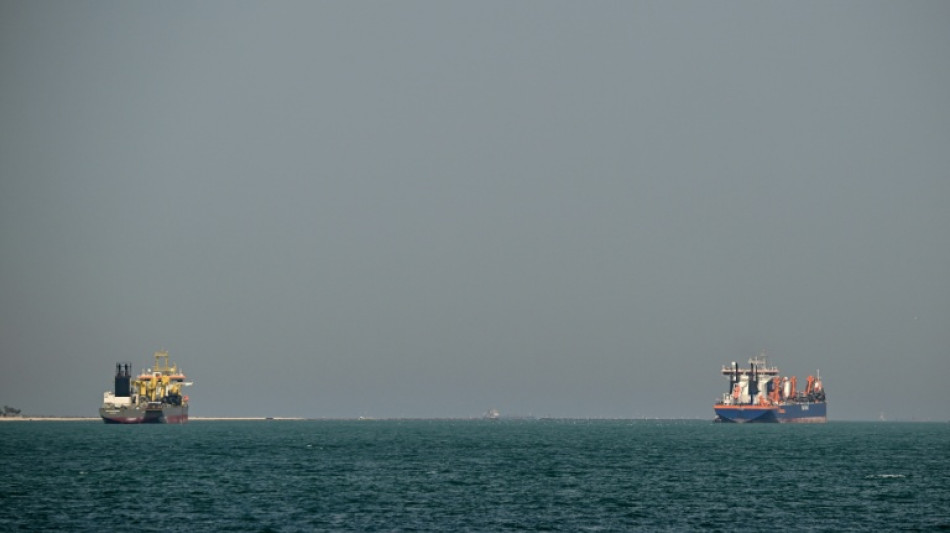
What cargo ships are passing Hormuz strait? / Photo: - - AFP/File

 Bank of Japan hikes rates to 31-year high to battle inflation

 AI doomsday warnings unlikely to slow IPOs but questions linger

 In Brazil's Amazon, the hunt for oil fuels hopes and fears

 Baby orangutans in India expose 'frightening' scale of trafficking

 Oversight Board blasts 'inadequate' Meta safeguards for AI deepfakes

 Harry makes first public appearance since return to UK

 Princess Diana's brother makes new explosive claims against Charles

 Trump admin overhauls key protection for endangered species

 Mbappe draws political fire over Ceuta t-shirt controversy

 Third malaria death in Germany from outbreak tied to Frankfurt airport

 AtlasClear Holdings Reports Preliminary Fiscal 2026 Revenue of Approximately $20.1 Million, Up 85%; Revenue Plus Interest Income of Approximately $21.9 Million

 'Another arrow to the quiver': World Bank posts record private capital mobilization

 Ireland to boycott Eurovision 2027 over Gaza

 India's Tata Sons reappoints N. Chandrasekaran as chairman

 Germany urges EU action against China to defend carmakers

 Japan eyes changing prostitution law to punish sex buyers

 Modi pitches India as global chipmaking hub

 Ukraine plans record defence spending in 2027

 NASA scan discovers new, 'once in a century' Moon crater

 Most stocks rise as Fed hikes and indicates drive to curb inflation

 UK-Sudanese author pens book to give children 'African history of Africa'

 Argentine judge orders suspension of Falklands oil project

 US Fed raises rates to tackle 'too high' inflation, irking Trump

 Turkey releases 106 protesters, jails more LGBTQ activists

 Candidate for UN chief calls for AI regulation akin to nuclear weapons

Just a trickle of cargo ships and tankers -- most of them Iranian -- have made it through the Strait of Hormuz since Iranian forces blocked the crucial trade route in the Middle East war.
Here are facts and figures about vessels that have passed through the 167-kilometre (104-mile) long strait since the war broke out with US-Israeli strikes on Iran on February 28.
- 95% shipping drop -
From March 1 to 19, commodities carriers made just 114 crossings, according to analytics firm Kpler -- a decrease of 95 percent from peacetime.
Of these, 69 crossings were by oil tankers and more than half were loaded, Kpler data showed, with most travelling east out of the strait.
Traffic "is being led mostly by bulk carriers, tankers and container ships," said Richard Meade, editor of leading shipping intelligence journal Lloyd's List, in a briefing on Thursday.
"But we have seen a bit of an uptick in gas carriers moving over the last week."
- Iranian, Greek, Chinese ships -
Most of the ships passing the strait are owned or flagged in Iran, said Bridget Diakun, an analyst at data company Lloyd's List Intelligence.
After that, Greek ships accounted for 18 percent of crossings and Chinese ones 10 percent in recent days, she said.
"Although Iran is continuing to control the Strait and exit its own oil, everything else is largely still at a standstill," said Meade.
- 35 sanctioned ships -
Overall since the war started, around a third of the ships transiting the strait were under US, EU or UK sanctions, according to an AFP analysis of passage data.
Of the oil and gas tankers, more than half were under sanctions.
Since March 16 "anything heading westbound has been shadow fleet, gas carriers or tankers... they absolutely dominate the traffic going through," Diakun told the Lloyds briefing.
- Oil to China -
Commodities analysts at JPMorgan bank said in a report released Monday that most of the oil passing through the strait was headed for Asia, principally China.
Data in the report indicated it was receiving more than a million barrels day from Hormuz -- far below the pre-war level of nearly five million.
Cichen Shen, Asia Pacific editor at Lloyd's List, said there were indications online that Chinese authorities were working on "some sort of exit plan" for their big tankers stuck in the region.
- 1.3 mn barrels of Iran oil -
The JPMorgan analysts said overall 98 percent of the observable oil traffic through the strait was Iranian, averaging 1.3 million barrels a day "in early March".
A fifth of the world's oil and liquefied natural gas passes through the strait in peacetime.
- Indian, Pakistani ships -
"There are indications that some ships are transiting under Iranian 'approval', with some vessels following a route through the Strait closer to the Iranian coastline than normal," including Indian and Pakistani vessels, marine consultancy Clarksons said in a note.
Meade of Lloyds List added: "Several governments, including China, but (also) India, Pakistan, Iraq, Malaysia, they're all in direct talks with Tehran, coordinating vessel transits" with Iran's Revolutionary Guards.
- Alternative routes surge -
Shipping companies are carving out other ways to get their cargos through the region. Major shipping firm CMA CGM said it was moving freight across Gulf countries by rail and road to avoid the strait.
"Gulf maritime traffic patterns indicate early signs of global rebalancing," said marine intelligence group Windward in a report.
In recent days transit volumes through the Bab el-Mandeb strait off east Africa surged 280 percent, and 70 percent through the Suez Canal, it said, indicating that "shipping is adapting through alternative corridors."
D.Goldberg--CPN