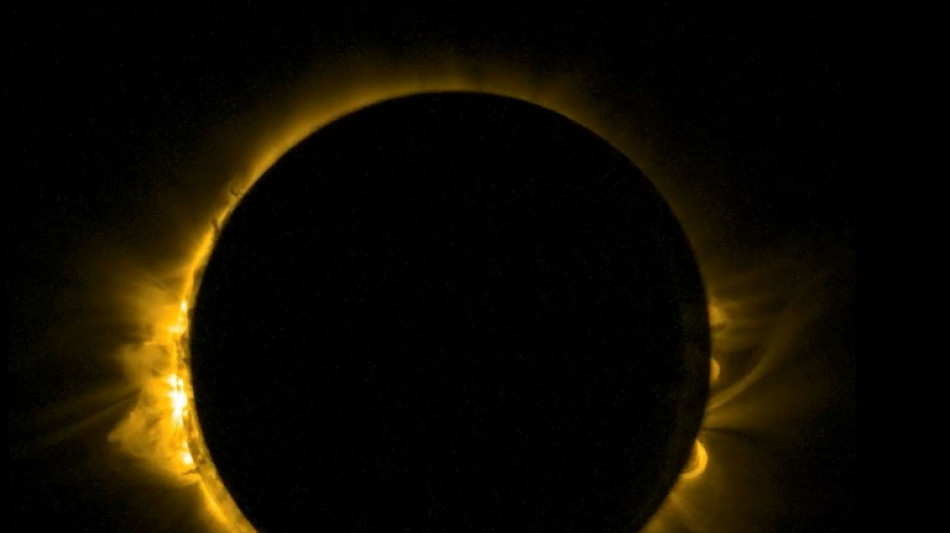
'Miracle': Europe reconnects with lost spacecraft / Photo: Proba-2 minisatellite - ESA/AFP/File

 Watts, Pitt, Cruz to light up Spain's top film festival

 Toogood Gold's Table Mountain Sits in the Shadow of a Nevada Gold Rush

 MEXC July–August Security Report: 38.66M USDT in Risk Funds Intercepted, Futures Insurance Fund Hits 792M USDT

 Emporio Armani names Dario Vitale new creative director

 EU to ban social media for under 13s, curb access until 15

 Wildfires push endangered Sumatran elephants to brink: Indonesian NGO

 Bank of Japan set to raise rates under pressure from inflation, US

 EU chief to unveil social media, gaming curbs for under-15s

 'Resident Evil' film brings video game's ethos to the big screen

 i-payout Expands U.S. Money Transmitter Licensing Footprint and Advances European EMI Strategy

 US Senate crypto bill collapses amid partisan deadlock

 OpenAI, Anthropic and Google are working to create an AI standards body

 Protesting shepherds, farmers clash with Romanian police

 Foundation Lets Ledger Users Switch to Open Source Without Starting Over

 EU to propose curbing social media, online games for under 15s

 FX Junction Reaches 40,600 Members and 26 Million Trades

 'We unleashed the beast': the world's fears and hopes about AI

 Hospitality leaders ask Burnham to halve VAT amid rising costs

 Worcestershire invited to nominate groups for 2027 King’s volunteer award

 Berlin's run-down public spaces at heart of election campaign

 'Widow's Bay' and 'The Pitt' win big at Emmy Awards

 Most markets drop as oil extends gains ahead of expected US rate hike

 Sri Lanka's famed beach shack battles demolition

 Vserv targets ₹1,000 crore revenue by 2030 through AI expansion

 India prohibits bank fees on UPI payments up to ₹2,000

The European Space Agency announced Thursday it has re-established communication with a spacecraft that is part of its Proba-3 mission, after losing contact with the satellite a month ago.
Proba-3, which launched on a two-year mission in 2024, uses two spacecraft flying in precise formation to simulate a solar eclipse more than 60,00 kilometres (37,000 miles) above Earth.
Scientists have used this delicate dance to get a rare glimpse of the Sun's little-known outer atmosphere, which is called the corona.
One satellite has a 1.4-metre (five-foot) shield that plays the role of the Moon in blocking the Sun's light, while the other observes the corona from the shadow.
However something happened to the second spacecraft, which has the crucial coronagraph instrument, on February 14.
A chain reaction led to the spacecraft losing its orientation, causing its solar panel to face away from the Sun, draining the batteries.
The spacecraft then entered survival mode -- it has been silently floating through space since.
However overnight "some miracle happened because we reconnected with the spacecraft," ESA director Josef Aschbacher said on Thursday.
The other spacecraft -- the one with the shield -- had been "following and observing" its lost twin, he told a press conference held after an ESA Council meeting.
The lost spacecraft had been "tumbling" when an ESA team in Spain "saw that some sunlight is actually hitting the solar panels," Aschbacher explained.
They seized the chance, using this small amount of power to re-establish a connection.
The spacecraft's solar panel is now facing the Sun, allowing it to charge its batteries.
Next ESA experts will switch the instruments back on and carry out tests to find out how much damage has been done.
"Hearing back from the coronagraph is amazing news, and a great relief!" Proba-3 mission manager Damien Galano said in a statement.
The Sun's corona, which is several million kilometres thick, still remains little understood. Invisible to the naked eye and telescopes, it is normally hidden by the bright light coming from the Sun.
Y.Ibrahim--CPN