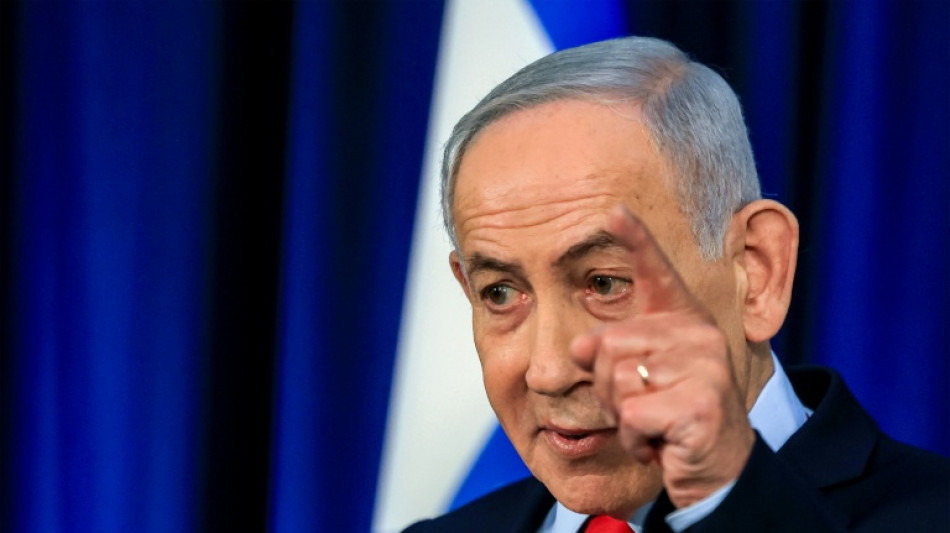
Netanyahu says Iran decimated as Tehran warns of 'zero restraint' in energy attacks / Photo: Ronen Zvulun - POOL/AFP

 Bank of Japan hikes rates to 31-year high to battle inflation

 AI doomsday warnings unlikely to slow IPOs but questions linger

 In Brazil's Amazon, the hunt for oil fuels hopes and fears

 Baby orangutans in India expose 'frightening' scale of trafficking

 Oversight Board blasts 'inadequate' Meta safeguards for AI deepfakes

 Harry makes first public appearance since return to UK

 Princess Diana's brother makes new explosive claims against Charles

 Trump admin overhauls key protection for endangered species

 Mbappe draws political fire over Ceuta t-shirt controversy

 Third malaria death in Germany from outbreak tied to Frankfurt airport

 AtlasClear Holdings Reports Preliminary Fiscal 2026 Revenue of Approximately $20.1 Million, Up 85%; Revenue Plus Interest Income of Approximately $21.9 Million

 'Another arrow to the quiver': World Bank posts record private capital mobilization

 Ireland to boycott Eurovision 2027 over Gaza

 India's Tata Sons reappoints N. Chandrasekaran as chairman

 Germany urges EU action against China to defend carmakers

 Japan eyes changing prostitution law to punish sex buyers

 Modi pitches India as global chipmaking hub

 Ukraine plans record defence spending in 2027

 NASA scan discovers new, 'once in a century' Moon crater

 Most stocks rise as Fed hikes and indicates drive to curb inflation

 UK-Sudanese author pens book to give children 'African history of Africa'

 Argentine judge orders suspension of Falklands oil project

 US Fed raises rates to tackle 'too high' inflation, irking Trump

 Turkey releases 106 protesters, jails more LGBTQ activists

 Candidate for UN chief calls for AI regulation akin to nuclear weapons

Prime Minister Benjamin Netanyahu said Thursday that Israel's military attacks had "decimated" Iran and that the Middle East war could finish sooner than expected, even as the Islamic republic kept up attacks on Gulf oil and gas targets that have jolted global markets.
Nearly four weeks into the Middle East war launched by Israel and the United States, Netanyahu said he was no longer sure who runs Iran and that it was now unable to enrich uranium or build ballistic missiles.
"We are winning and Iran is being decimated," Netanyahu told a press conference at which he hailed his cooperation with US President Donald Trump.
"I also see this war ending a lot faster than people think," he added.
"We're seeing cracks, and we're trying to propagate them as fast as we can, not only in the top command, we're seeing cracks in the field," he said.
"We are taking action to destroy the industries that make it possible to build missiles. Iran no longer has the capacity to enrich uranium and manufacture ballistic missiles," Netanyahu added.
His comments came after the United States said there was no deadline to end the war that the two countries launched on February 28.
While Israel and the US expressed confidence in their war efforts, energy markets were left reeling by Iranian attacks on the world's largest liquefied natural gas plant in Qatar and refineries in Saudi Arabia and Kuwait.
Oil markets have already been shaken by Iran's chokehold on the strategic Strait of Hormuz.
But the benchmark Brent surged six percent to $119 a barrel before falling back to $110, while European gas prices rose nearly a third, after Iranian missiles hit Qatar's huge Ras Laffan natural gas complex in retaliation for Israel's air raid on the South Pars gas field on Wednesday.
The latest attack on Ras Laffan caused "extensive damage", that QatarEngery said could cost it $20 billion a year in lost revenue and take five years to repair.
Iran also struck elsewhere in the region, with a drone crashing into the Samref refinery in Saudi Arabia's Red Sea port of Yanbu, the Saudi defence ministry said.
The Saudi government said it reserved the "right to take military actions" in response.
In Kuwait, drone attacks sparked fires at the Mina Abdullah and Mina Al-Ahmadi refineries, which have a combined capacity of 800,000 barrels per day.
And in Israel an oil refinery in the port of Haifa was hit on Thursday. Media showed images of black smoke rising from the complex.
- 'Zero restraint' -
Trump indicated he did not know in advance about Israel's raid on South Pars, which supplies about 70 percent of Iran's domestic needs. But he said he had told Netanyahu not to hit Iranian gas fields again.
"We get along great. It's coordinated, but on occasion, he'll do something" that the United States opposes, Trump said.
Netanyahu insisted Israel "acted alone" with the strike, while saying no "two leaders have been as coordinated as President Trump and I. He's the leader."
Trump warned earlier that the United States would "blow up" South Pars if Tehran did not stop attacking Qatar. But he said Thursday there was no current plan to send troops into Iran.
Iran responded to the threats with defiance. The military's Khatam Al-Anbiya operational command vowed the "complete destruction" of Gulf energy infrastructure if the Israeli attack was repeated, according to a statement carried by Fars news agency.
Foreign Minister Abbas Araghchi said on social media there would be "ZERO restraint" if Iran's infrastructure was hit again.
- 'Safe passage' sought -
Amid growing concern over the economic fallout from the conflict, Britain, France, Germany, Italy, Japan and the Netherlands said they would "contribute to appropriate efforts to ensure safe passage through the Strait of Hormuz". But they gave few details.
Rome and Berlin later insisted any action would only happen if there was a ceasefire in the war.
French President Emmanuel Macron condemned the "reckless escalation" in attacks and called for "direct talks between the Americans and Iranians on this matter".
UK Prime Minister Keir Starmer's office warned that "attacks on critical infrastructure risked pushing the region further into crisis", after talks with Macron and NATO chief Mark Rutte.
India and China also expressed new concern about their supplies which flow through the Hormuz strait.
US Defense Secretary Pete Hegseth said there is no time frame for ending the war, but that "we're very much on track" and Trump would choose when to end fighting.
"It will be at the president's choosing, ultimately, where we say, 'Hey, we've achieved what we need to,'" he told a Washington news conference.
Commentators said the energy attacks showed gaps between the United States and Israel over war tactics.
"The conflict is drifting into a war of attrition -- with no clear signs of regime collapse in Iran," said Danny Citrinowicz, a senior fellow at Israel's Institute for National Security Studies, on X.
The attacks "underscored just how unstructured this campaign has become -- lacking strategic clarity, long-term planning, and a defined end state".
US media said the administration could seek more than $200 billion in additional war funding from Congress.
"I think that number could move. Obviously it takes money to kill bad guys," Hegseth commented.
burs-tw/dcp
A.Mykhailo--CPN