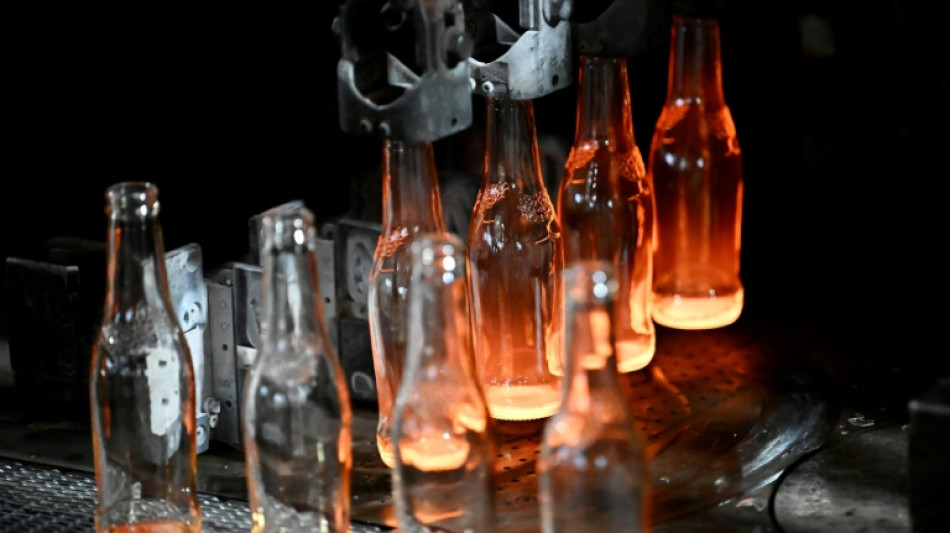
UK manufacturers struggle under sky-high energy bills / Photo: Paul ELLIS - AFP

 Saudi-led coalition says Houthis fired ballistic missile at Riyadh

 Cuba works to restore power after another blackout

 Brigitte Bardot widower slams sale of star's belongings

 Indonesia accepts Malaysia's help to tackle wildfires

 Nvidia, OpenAI CEOs to attend Xi dinner at White House

 Cuba hit with seventh major blackout of the year

 Nigeria miners struggled to breathe in cell before 37 died: survivors

 Warren Buffett steps down as Berkshire Hathaway chairman

 Isolated Syrian-Druze city blames Damascus for shortages

 Kerry James Marshall: American 'blackness' painter celebrated in Europe

 Infantino 'must go', says German FA vice-president

 Japan's busiest rail station tests robot bins

 Backpackers fret over Australian visa crackdown

 Bank of Japan hikes rates to 31-year high to battle inflation

 AI doomsday warnings unlikely to slow IPOs but questions linger

 In Brazil's Amazon, the hunt for oil fuels hopes and fears

 Baby orangutans in India expose 'frightening' scale of trafficking

 Oversight Board blasts 'inadequate' Meta safeguards for AI deepfakes

 Harry makes first public appearance since return to UK

 Princess Diana's brother makes new explosive claims against Charles

 Trump admin overhauls key protection for endangered species

 Mbappe draws political fire over Ceuta t-shirt controversy

 Third malaria death in Germany from outbreak tied to Frankfurt airport

 AtlasClear Holdings Reports Preliminary Fiscal 2026 Revenue of Approximately $20.1 Million, Up 85%; Revenue Plus Interest Income of Approximately $21.9 Million

 'Another arrow to the quiver': World Bank posts record private capital mobilization

Molten glass drops through chutes before being blown into bottles at manufacturer Encirc's northwest England plant, where intensive operations are under strain from exorbitant energy prices weighing on Britain's heavy industry.
"We're paying a lot more energy costs than our European competitors," said Oliver Harry, head of corporate affairs at Encirc, which makes over a third of the UK's glass bottles.
Britain has some of the highest energy prices in Europe, driven by its reliance on natural gas and the costs of transitioning to renewables, which are passed on to bills.
The country's industrial electricity prices were also the steepest in Europe in 2024, according to the latest annual government data.
Standing in the intense heat of the factory's two huge furnaces, Harry warned: "We're already seeing an increase in imports into the UK as customers turn to cheap, more unsustainable glass producers", notably from China and Turkey.
- More action needed -
Across energy-intensive industries -- from steel and chemicals to glass and cement -- companies are warning that government support does not go far enough to keep them competitive.
The government said it will increase discounts on electricity network charges to 90 percent from April, which will save around 500 of the UK's biggest energy users a cumulative £420 million ($570 million) per year in electricity bills.
"Lowering bills is central to every decision we make," a government spokesperson told AFP.
But the steel sector, already weakened by the closure of traditional coal-fired blast furnaces, argues that more action is needed.
"The industry still faces industrial power prices almost 40 percent higher than in France and Germany," Gareth Stace, director general of the steel union, UK Steel, told AFP.
The union has called for stronger protections similar to those in France, Italy, Spain and the UAE to shield heavy industry from high wholesale power costs.
- Decarbonisation -
Electricity is so expensive in the UK largely because more than a quarter of its power still comes from gas, which surged in price after Russia's 2022 invasion of Ukraine.
While wholesale prices have since fallen, they remain elevated.
Under the liberalised electricity market, the last power station switched on to meet demand sets the price for all generators, and in the UK, that station is usually gas-powered.
"In France, nuclear sets the price fairly often and nuclear is cheaper ... so it's not always the same expensive gas that sets the price," Sam Frankhauser, professor of economics and climate change policy at Oxford University, told AFP.
In other countries "there's moments in the day where somebody cheaper sets the price and in the UK, those moments don't exist" as it is almost always a natural gas plant setting the price, he added.
At Encirc's Elton factory, where bottles clatter along the conveyor belts to be filled and labelled, executives say energy prices are inseparable from the push to decarbonise.
By the end of the decade, "we're going to be producing glass bottles that are 80 percent reduced carbon," said Harry.
"The UK managed to decarbonise the grid phenomenally because of the exit of coal," said Gregor Singer, professor at the London School of Economics.
"It's really unfortunate that this gas price shock came now, exactly at that point where you sort of exited coal but you don't quite have enough renewables yet."
"In the medium to long run... it's almost guaranteed that prices are coming down," he said.
H.Meyer--CPN