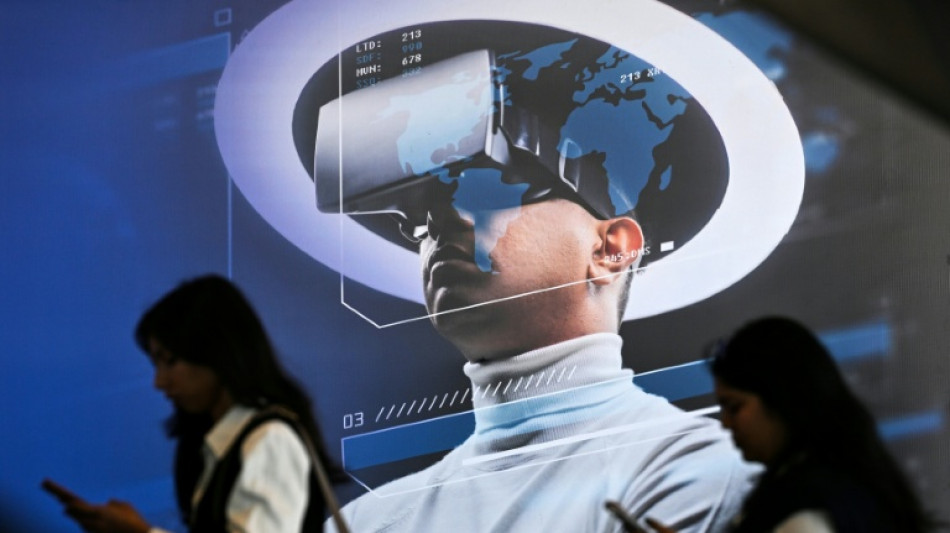
AI 'arms race' risks human extinction, warns top computing expert / Photo: Arun SANKAR - AFP

 Saudi-led coalition says Houthis fired ballistic missile at Riyadh
 Cuba works to restore power after another blackout

 Brigitte Bardot widower slams sale of star's belongings

 Indonesia accepts Malaysia's help to tackle wildfires

 Nvidia, OpenAI CEOs to attend Xi dinner at White House

 Cuba hit with seventh major blackout of the year

 Nigeria miners struggled to breathe in cell before 37 died: survivors

 Warren Buffett steps down as Berkshire Hathaway chairman

 Isolated Syrian-Druze city blames Damascus for shortages

 Kerry James Marshall: American 'blackness' painter celebrated in Europe

 Infantino 'must go', says German FA vice-president

 Japan's busiest rail station tests robot bins

 Backpackers fret over Australian visa crackdown

 Bank of Japan hikes rates to 31-year high to battle inflation

 AI doomsday warnings unlikely to slow IPOs but questions linger

 In Brazil's Amazon, the hunt for oil fuels hopes and fears

 Baby orangutans in India expose 'frightening' scale of trafficking

 Oversight Board blasts 'inadequate' Meta safeguards for AI deepfakes

 Harry makes first public appearance since return to UK

 Princess Diana's brother makes new explosive claims against Charles

 Trump admin overhauls key protection for endangered species

 Mbappe draws political fire over Ceuta t-shirt controversy

 Third malaria death in Germany from outbreak tied to Frankfurt airport

 AtlasClear Holdings Reports Preliminary Fiscal 2026 Revenue of Approximately $20.1 Million, Up 85%; Revenue Plus Interest Income of Approximately $21.9 Million

 'Another arrow to the quiver': World Bank posts record private capital mobilization

Tech CEOs are locked in an artificial intelligence "arms race" that risks wiping out humanity, top computer science researcher Stuart Russell told AFP on Tuesday, calling for governments to pull the brakes.
Russell, a professor at the University of California, Berkeley, said the heads of the world's biggest AI companies understand the dangers posed by super-intelligent systems that could one day overpower humans.
To him, the onus to save the species rests on world leaders who can take collective action.
"For governments to allow private entities to essentially play Russian roulette with every human being on earth is, in my view, a total dereliction of duty," said Russell, a prominent voice on AI safety.
Countries and companies are spending hundreds of billions of dollars on building energy-hungry data centres to train and run generative AI tools.
The rapidly developing technology promises benefits such as drug discovery, but could also lead to job losses, and facilitate surveillance and online abuse among other threats.
Alongside that is the risk of "AI systems themselves taking control and human civilisation being collatoral damage in that process", Russell said in an interview at the AI Impact Summit in New Delhi.
"Each of the CEOs of the main AI companies, I believe, wants to disarm" but cannot do so "unilaterally" as they would be fired by investors, he said.
"Some of them have said it in public and some of the told me it privately," he added, noting that even Sam Altman, head of ChatGPT maker OpenAI, has said on-record that AI could lead to human extinction.
OpenAI and rival US startup Anthropic have seen public resignations of staff who have spoken out about their ethical concerns.
Anthropic also warned last week that its latest chatbot models could be nudged towards "knowingly supporting -- in small ways -- efforts toward chemical weapon development and other heinous crimes".
- Human 'imitators' -
International gatherings such as this week's AI summit provide an opportunity for regulation, although its three previous editions have only resulted in voluntary agreements from tech companies.
"It really helps if each of the governments understand this issue. And so that's why I'm here," Russell said.
India is hoping the five-day AI summit, attended by tech bosses and dozens of high-level national delegations, will help it power ahead in the sector.
Indian IT minister Ashwini Vaishnaw said Tuesday that the country expects more than $200 billion in AI investments over the next two years, including roughly $90 billion already committed.
Meanwhile fears that AI assistant tools could lead to mass redundancies in India's larges customer service and tech support sectors has caused shares in the country's outsourcing firms to plunge in recent days.
These kind of back-end jobs in India are ripe for replacement with AI, Russell said.
"We are creating human imitators. And so of course, the natural application for that type of system is replacing humans."
Russell is sensing a burgeoning backlash against AI, "particularly among younger people".
"They actually are pushing back against the dehumanising aspects of AI," he said.
"When you're taking over all cognitive functions -- the ability to answer a question, to make a decision, to make a plan... you are turning someone into less than a human being. The young people do not want that."
A.Leibowitz--CPN