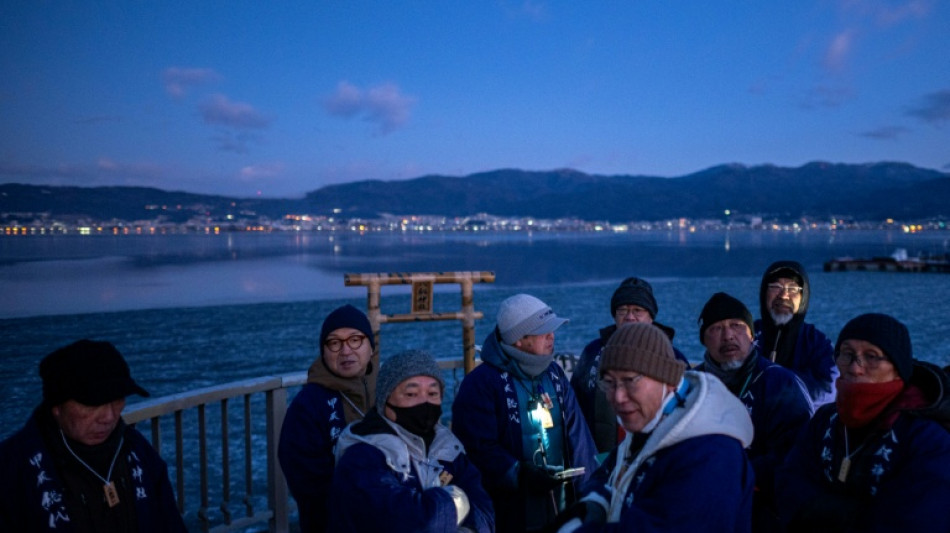
Japan's 'godless' lake warns of creeping climate change / Photo: Philip FONG - AFP

 US House faces test on sweeping Russia sanctions bill

 British PM says to make 'difficult decisions' as inflation rises

 Global fuel price demos: a round-up

 Leverate Launches MCP for Traders to Connect AI Assistants With Trading Platforms

 MEXC Launches $1M "Discover Your Wall Street DNA" Campaign to Help Traders Find Their Market Fit

 Stocks edge higher ahead of US Fed rate call

 BASIS.pro Expands On-Chain Infrastructure with XDC Network Partnership and Zypher DAO as Auto Earn Goes Live

 Pickle-flavoured tart? AI inspires Japan's convenience stores

 EU chief hosts Canada's Carney in push to 'deepen' alliance

 Meta chief pushes back on AI slowdown calls

 US Fed to deliver rate decision with markets betting on hike

 Sanders, Bannon warn of AI dangers in rare US left-right alignment

 Empty benches as schools reopen in Venezuela's quake-hit Guaira

 Tiny English village holds 'independence' vote over asylum seeker housing

 US Treasury chief says to meet Chinese counterpart at weekend

 BingX Evolves into a Multi-Asset Trading Platform, Connecting Users to Global Opportunities

 International Trading Institute Expands Professional Trader Development Beyond the Master’s in Trading

 Lake Energy Secures $80 Million for U.S. Renewable Energy Expansion

 Stocks drop, oil climbs and Treasury yields hit 19-year high

 SkySail Strategies Outperforms Wall Street's 30-Year Risk Standard With Proprietary AI Inference Model

 Just add fish: Scientists pursue more rice, less disease in Senegal paddies

 Belgium completes outer structure of offshore energy island

 China retail sales growth weakens further in August

 In Kashmir, lake weeds mix with traditional art

 'Widow's Bay' and 'The Pitt' take key Emmy awards

The Japanese priest and his parishioners gathered before dawn, hoping that climate change had not robbed them of the chance to experience an increasingly rare communion with the sacred.
The few dozen men, most in their sixties, were headed to Nagano's Lake Suwa in search of a phenomenon called "God's Crossing" that has gone from reliable to elusive in recent decades.
Known as "miwatari" in Japanese, it occurs when a crack opens up in the frozen lake surface, allowing shards of thinner ice to break through and form a ridge where local deities are believed to cross.
For centuries, the priest of the nearby Yatsurugi Shrine has led an annual watch for the crossing, contributing to a unique record of a changing climate.
This year's watch began on January 5, with Kiyoshi Miyasaka -- a priest in Japan's Shinto religion -- leading the flock.
One man carried a worn flag, another a giant axe. All wore jackets bearing the shrine's crest.
They set out with hope, despite a seven-year stretch in which the God's Crossing has not appeared once.
"This is the start of the decisive 30 days," Miyasaka told them.
But as they neared the water, dark and choppy in the pre-dawn light, Miyasaka's staple smile disappeared.
"How pitiful," he said, lowering a thermometer into the water.
Miyasaka's predecessors noted when the entire lake surface froze, and when the miwatari appeared.
More recently, priests have added temperature readings and ice thickness.
Consecutive records date all the way back to 1443, though the shrine's priests only took over the job in 1683.
"The chronicle shows data taken at a single location over hundreds of years, and thanks to it, we can now see what the climate was like centuries ago," said Naoko Hasegawa, a geographer at Tokyo's Ochanomizu University.
"We find no other meteorological archive comparable to it," she told AFP.
"Global researchers who study climate history see it as a very valuable set of observation records."
- 'A warning from nature' -
The God's Crossing has not appeared since 2018, an absence that both scientists and believers attribute to climate change.
"We are seeing the signs of climate change in many places of the world, and Lake Suwa is no exception," Miyasaka told AFP.
"Nature doesn't lie."
Traditionally, the ice ridges were believed to represent the path of a god crossing the lake to visit his goddess wife.
Scientists explain them a little differently.
They appear if the lake surface freezes entirely, which requires several days below minus 10C.
The ice lid contracts and expands with temperature fluctuations between night and day, opening cracks that fill with shards of newly frozen lake water.
They crash against each other, producing a distinctive roaring sound, and sometimes rise to eye level.
Takehiko Mikami, who has studied the phenomenon with Hasegawa, remembers seeing it in 1998.
"The surface froze completely to about 15 centimetres (six inches) thick. We could walk all the way across the lake to the other shore," said the professor emeritus at Tokyo Metropolitan University.
His research shows the crossing appeared almost every winter until the 1980s, but since then morning temperatures have often failed to fall enough for the lake to freeze over.
"This is a warning from nature," said Mikami.
- 'Open sea' -
For a time, this year's season brought hope.
On January 26, after weeks of frigid dawn observations, Miyasaka and his flock recorded a full freeze, smiling in delight as a chunk of ice was carved for the priest to measure.
But the surface melted days later before the God's Crossing could appear.
On February 4, Miyasaka once again declared an "open sea" or "ake no umi", meaning little chance one would appear before spring.
It marks eight years without a sighting, tying the longest "godless" period on record, in the early 16th century.
But Mikami doubts the documentation of that time, and suspects we might now be living through the longest absence.
What is certain is that full freezes of the lake surface are now the exception rather than the rule, as they were for centuries.
When the crossing appears, Yatsurugi's priest holds a Shinto ritual on the ice, something Miyasaka has been able to do just 11 times in over four decades in the job.
But he treasures the tradition, and the record he is leaving behind.
"We will report it was a season of 'open sea', passing on the message to people 100 years from now," he said.
For Mikami, the god's long absence is a warning that "global warming is accelerating".
"If the trend continues, I am afraid we will never see the miwatari phenomenon again."
Y.Ponomarenko--CPN