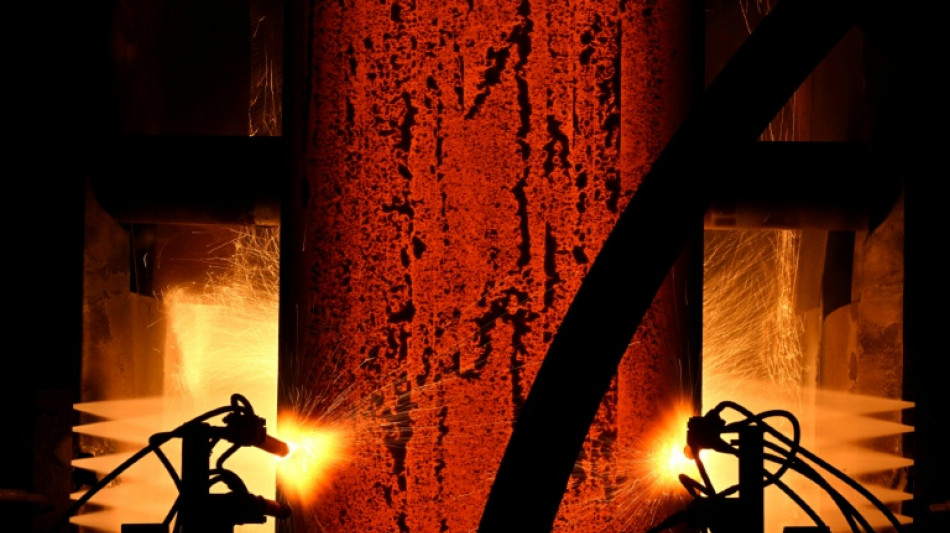
'Made in Europe' or 'Made with Europe'? Buy European push splits bloc / Photo: Ina FASSBENDER - AFP/File

 Saudi-led coalition says Houthis fired ballistic missile at Riyadh
 Cuba works to restore power after another blackout
 Brigitte Bardot widower slams sale of star's belongings
 Indonesia accepts Malaysia's help to tackle wildfires

 Nvidia, OpenAI CEOs to attend Xi dinner at White House

 Cuba hit with seventh major blackout of the year
 Nigeria miners struggled to breathe in cell before 37 died: survivors

 Warren Buffett steps down as Berkshire Hathaway chairman

 Isolated Syrian-Druze city blames Damascus for shortages

 Kerry James Marshall: American 'blackness' painter celebrated in Europe

 Infantino 'must go', says German FA vice-president

 Japan's busiest rail station tests robot bins

 Backpackers fret over Australian visa crackdown

 Bank of Japan hikes rates to 31-year high to battle inflation

 AI doomsday warnings unlikely to slow IPOs but questions linger

 In Brazil's Amazon, the hunt for oil fuels hopes and fears

 Baby orangutans in India expose 'frightening' scale of trafficking

 Oversight Board blasts 'inadequate' Meta safeguards for AI deepfakes

 Harry makes first public appearance since return to UK

 Princess Diana's brother makes new explosive claims against Charles

 Trump admin overhauls key protection for endangered species

 Mbappe draws political fire over Ceuta t-shirt controversy

 Third malaria death in Germany from outbreak tied to Frankfurt airport

 AtlasClear Holdings Reports Preliminary Fiscal 2026 Revenue of Approximately $20.1 Million, Up 85%; Revenue Plus Interest Income of Approximately $21.9 Million

 'Another arrow to the quiver': World Bank posts record private capital mobilization

Everyone in Europe agrees the EU needs to rescue its industry but the bloc is split over how far it should push a 'Buy European' approach in order to do so.
The European Commission, the EU's executive arm, will next week propose new rules that are expected to include a requirement for companies in strategic sectors to produce in Europe if they want to receive public money.
But the definition of "European preference" has triggered debate, with calls especially from France for more "Made in Europe", while other EU states such as Germany call for "Made with Europe".
- Protecting Europe or European protectionism? -
French President Emmanuel Macron insisted the new rules would be about "protecting our industry" without "being protectionist", by defending "certain strategic sectors, such as cleantech, chemicals, steel, cars or defence".
Otherwise, he warned, "Europeans will be swept aside".
But other EU countries, which are proponents of free trade, oppose the plans.
Swedish Prime Minister Ulf Kristersson said Europe should compete based on quality and innovation, not because it wanted to protect European markets.
"We do not want to protect European businesses that are basically not competitive," Kristersson told the Financial Times newspaper last week.
But EU leaders during talks Thursday appeared to reach a consensus on the issue, pushing for the measure in certain specific sectors since they say Europe faces unfair competition from China and other countries.
"We are in favour of open markets," German Finance Minister Lars Klingbeil said Monday. "But I also want to be very clear: if China changes the rules of the game, if we are confronted with overcapacity, subsidies, and the fact that markets in Europe are flooded, then Europe must defend itself."
- In Europe or with Europe? -
Supporters want "Made in Europe" to be strictly defined, and only for industrial goods made from components manufactured in the European Economic Area, made of the EU's 27 states as well as Iceland, Liechtenstein and Norway.
Critics say this definition would be too restrictive and instead call for a more flexible measure, like Germany's Merz, who calls for "Made with Europe" not "Made in Europe".
They also argue it would be difficult to apply in practice and risks destabilising European supply chains.
"Typically, even a vehicle assembled in Europe incorporates hundreds of specialised components sourced from all over the world. Many critical inputs cannot be competitively produced at scale in Europe," Japanese carmaker Honda said.
Britain and Turkey, for whom the EU is an important trading partner, have also privately expressed concern to Brussels about keeping their countries out.
Some EU capitals are worried about potential retaliatory measures from supplier countries, which would drag Europe into showdowns at a moment when it needs to strengthen its exports.
- What will the rules look like? -
The EU executive insists it has balanced the need to be open and protect firms.
The measure will be "targeted in three ways", said the office of EU industry chief Stephane Sejourne -- who is spearheading the push.
It will affect:
-- a limited number of critical components
-- a limited number of strategic sectors
-- only when public funding is involved.
The final proposal, which will be announced on February 25, could end up only touching a handful of sectors: the auto industry and those playing an essential role in the green transition and confronted by what the EU says unfair Chinese competition, such as solar panels, wind turbines and batteries.
Sejourne's office insisted companies producing in the EU would be considered European and there will be "reciprocal commitments" with trusted partners.
A draft document seen by AFP says products made in countries outside the EU with rules similar to the bloc will be treated like those made in Europe.
Non-EU countries however remain watchful until the real proposal lands.
For example, there are still many unknowns including what the percentages of European or equivalent components will be required from manufacturers if they wish to continue accessing public money.
M.P.Jacobs--CPN