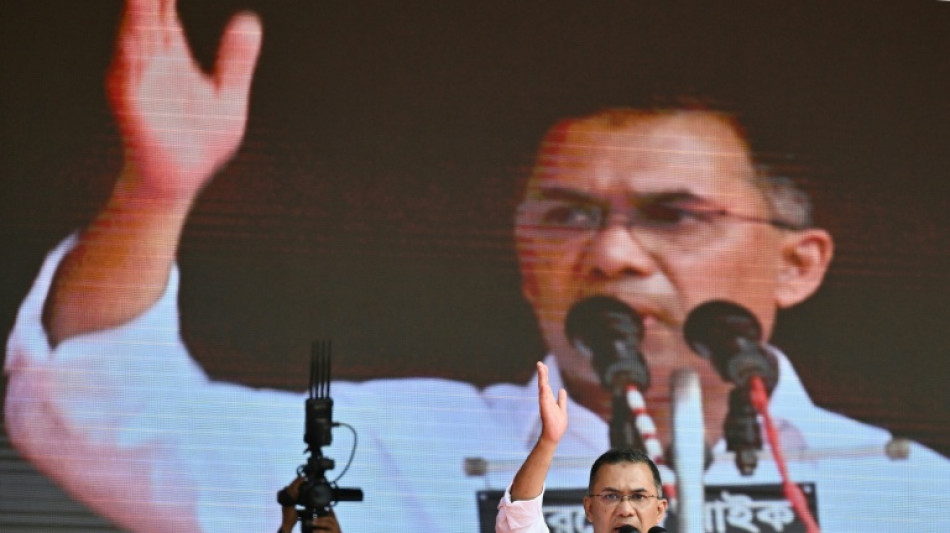
Bangladesh's new PM, political heir Tarique Rahman / Photo: MUNIR UZ ZAMAN - AFP

 US House faces test on sweeping Russia sanctions bill

 British PM says to make 'difficult decisions' as inflation rises

 Global fuel price demos: a round-up

 Leverate Launches MCP for Traders to Connect AI Assistants With Trading Platforms

 MEXC Launches $1M "Discover Your Wall Street DNA" Campaign to Help Traders Find Their Market Fit

 Stocks edge higher ahead of US Fed rate call

 BASIS.pro Expands On-Chain Infrastructure with XDC Network Partnership and Zypher DAO as Auto Earn Goes Live

 Pickle-flavoured tart? AI inspires Japan's convenience stores

 EU chief hosts Canada's Carney in push to 'deepen' alliance

 Meta chief pushes back on AI slowdown calls

 US Fed to deliver rate decision with markets betting on hike

 Sanders, Bannon warn of AI dangers in rare US left-right alignment

 Empty benches as schools reopen in Venezuela's quake-hit Guaira

 Tiny English village holds 'independence' vote over asylum seeker housing

 US Treasury chief says to meet Chinese counterpart at weekend

 BingX Evolves into a Multi-Asset Trading Platform, Connecting Users to Global Opportunities

 International Trading Institute Expands Professional Trader Development Beyond the Master’s in Trading

 Lake Energy Secures $80 Million for U.S. Renewable Energy Expansion

 Stocks drop, oil climbs and Treasury yields hit 19-year high

 SkySail Strategies Outperforms Wall Street's 30-Year Risk Standard With Proprietary AI Inference Model

 Just add fish: Scientists pursue more rice, less disease in Senegal paddies

 Belgium completes outer structure of offshore energy island

 China retail sales growth weakens further in August
 In Kashmir, lake weeds mix with traditional art

 'Widow's Bay' and 'The Pitt' take key Emmy awards

Long overshadowed by his parents and heir to one of Bangladesh's most powerful political dynasties, the country's new Prime Minister Tarique Rahman has finally stepped into the spotlight.
At 60, the leader of the Bangladesh Nationalist Party (BNP) takes charge of the South Asian nation of 170 million, driven by what he calls an ambition to "do better".
A year and a half after the deadly uprising that toppled previous prime minister Sheikh Hasina's iron-fisted rule, the BNP won a "sweeping victory" in parliamentary elections on February 12.
He was sworn in on Tuesday, leading a more than two-thirds majority in parliament.
"This victory belongs to people who aspire to and have sacrificed for democracy," he said in a speech.
His rise marks a remarkable turnaround for a man who only returned to Bangladesh in December after 17 years in exile in Britain, far from Dhaka's political storms.
Widely known as Tarique Zia, he carries a political name that has shaped every stage of his life.
He was 15 when his father, president Ziaur Rahman, was assassinated in 1981.
Tarique's mother, Khaleda Zia -- a three-time prime minister and a towering figure in Bangladeshi politics for decades -- died aged 80 in December, just days after his return home.
- 'My country' -
Rahman, speaking to AFP just before the vote, vowed to build on their legacy.
"They are them, I am me," he said from his office, beneath gold-framed portraits of his late parents. "I will try to do better than them."
He described the "mixed feelings" that overwhelmed him when he arrived home in December -- the joy of returning, swiftly eclipsed by grief at his mother's death.
Instead of celebrating, however, he had to bid farewell to his ailing mother, who had long been in intensive care.
"When you come home after so long, any son wants to hug his mother," he said. "I didn't have that chance."
Within days of landing in Dhaka, the still grieving heir assumed leadership of the BNP.
- 'Unnerves many' -
Born when the country was still East Pakistan, he was briefly detained as a child during the 1971 independence war.
His party hails him as "one of the youngest prisoners of war".
His father, Ziaur Rahman, an army commander, gained influence months after a 1975 coup when founding leader Sheikh Mujibur Rahman -- Sheikh Hasina's father -- was murdered.
It entrenched a rivalry between the two families that would define the country's politics for decades. Ziaur Rahman himself was killed in 1981.
Rahman grew up in his mother's political orbit as she went on to become the country's first female prime minister, alternating power with Hasina in a long and bitter duel.
"In her seats, I used to go and I used to campaign," Rahman said. "So this is how slowly and gradually I started getting involved in the politics."
But his career has also been shadowed by allegations of corruption and abuse of power.
A 2006 US embassy cable said he "inspires few but unnerves many".
Other cables labelled him a "symbol of kleptocratic government and violent politics" and accused him of being "phenomenally corrupt".
Arrested on corruption charges in 2007, Rahman says he was tortured in custody.
He fled to London the following year, where he faced multiple cases in absentia. He denied all charges and dismissed them as politically motivated.
But he also told AFP he offered an apology.
"If there are any mistakes which were unwanted, we are sorry for that," he told AFP.
After Hasina's fall, Rahman was acquitted of the most serious charge against him -- a life sentence handed down in absentia for a 2004 grenade attack on a Hasina rally -- which he had always denied.
Married to a cardiologist and father to a daughter, a lawyer, he led a quiet life in Britain.
That changed with his dramatic return in December, accompanied by his fluffy ginger cat, Zebu, images of which went viral on Bangladeshi social media.
He admits the task ahead is now "immense", rebuilding a country he says was "destroyed" by the former government.
D.Philippon--CPN