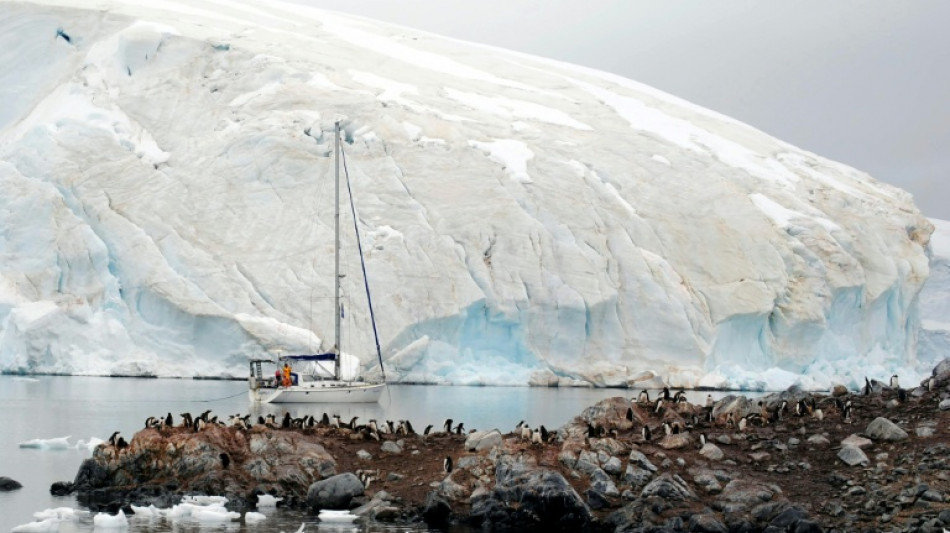
Bird flu ravaging Antarctic wildlife, scientist warns / Photo: Handout - Chilean Antarctic Institute/AFP

 Saudi-led coalition says Houthis fired ballistic missile at Riyadh

 Cuba works to restore power after another blackout

 Brigitte Bardot widower slams sale of star's belongings

 Indonesia accepts Malaysia's help to tackle wildfires

 Nvidia, OpenAI CEOs to attend Xi dinner at White House

 Cuba hit with seventh major blackout of the year

 Nigeria miners struggled to breathe in cell before 37 died: survivors

 Warren Buffett steps down as Berkshire Hathaway chairman

 Isolated Syrian-Druze city blames Damascus for shortages

 Kerry James Marshall: American 'blackness' painter celebrated in Europe

 Infantino 'must go', says German FA vice-president

 Japan's busiest rail station tests robot bins

 Backpackers fret over Australian visa crackdown

 Bank of Japan hikes rates to 31-year high to battle inflation

 AI doomsday warnings unlikely to slow IPOs but questions linger

 In Brazil's Amazon, the hunt for oil fuels hopes and fears

 Baby orangutans in India expose 'frightening' scale of trafficking

 Oversight Board blasts 'inadequate' Meta safeguards for AI deepfakes

 Harry makes first public appearance since return to UK

 Princess Diana's brother makes new explosive claims against Charles

 Trump admin overhauls key protection for endangered species

 Mbappe draws political fire over Ceuta t-shirt controversy

 Third malaria death in Germany from outbreak tied to Frankfurt airport

 AtlasClear Holdings Reports Preliminary Fiscal 2026 Revenue of Approximately $20.1 Million, Up 85%; Revenue Plus Interest Income of Approximately $21.9 Million

 'Another arrow to the quiver': World Bank posts record private capital mobilization

Scientists are sounding the alarm over the spread of bird flu across Antarctica, with a leading Chilean researcher telling AFP Tuesday of an observed strain "capable of killing 100 percent" of infected fauna.
Researchers have been warning in recent years of bird flu's spread on the icy continent, which hosts temporary teams of scientists but no permanent residents.
But a particularly dangerous strain of the disease was detected in April 2024 by Chilean researcher Victor Neira and his team in five skuas, a type of polar seabird.
Since then, the virus has spread to other species, with cases detected along 900 kilometers (560 miles) of coastline studied by scientists.
In a recent expedition to Antarctica, new cases were discovered in Antarctic cormorants, kelp gulls, Adelie and gentoo penguins, and Antarctic fur seals, Neira told AFP.
"The virus has completely spread throughout the Antarctic region where we have the capacity to go and study," said Neira, a scientist at the University of Chile and the Chilean Antarctic Institute (INACH).
"This disease is capable of killing 100 percent of the birds in short periods of time," he said.
"For example, in one or two days it can kill 90 percent or 100 percent of the animals in a given area."
Antarctic species are often small in total population, underscoring the risk of outbreaks.
Animals such as Antarctic cormorants and skuas number around 20,000 in total.
A global wave of bird flu has affected birds and mammals around the world since 2021, spread via bird migration.
In 2023, it killed thousands of Humboldt penguins in Chile.
C.Smith--CPN