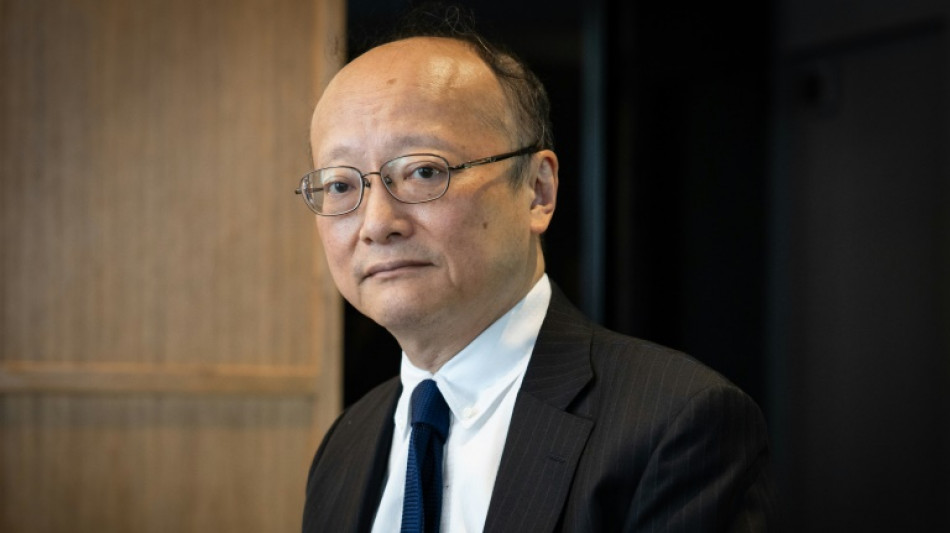
ADB acting on US concerns over China, bank chief tells AFP / Photo: Thibaud MORITZ - AFP

 Jay-Z rape accuser says she made 'false accusations'

 Trump's photo of Xi greeting carries signs of AI

 First US trial against TikTok to open Monday

 French literary prize removes novel from longlist after AI claims
 Trump accuser E. Jean Carroll finally has her damages
 Heavy fighting, internet disruption as Ethiopia conflict rages

 Asian markets mixed after oil gains

 UN approves resolution on dealing with rising sea levels

 Global stocks mostly fall as oil prices and bond yields rise

 Starbucks to close 250 more cafes in North America

 Stocks fall as oil prices rise and bonds back under pressure

 Top ECB official to resign to take up IMF role

 Eviction of pensioner puts Spain housing crisis in spotlight
 Average EU diesel price hits record 2.23 euros a litre: AFP analysis

 Whitetip Investments Marks 10 Years of Regulation, Transparency & Responsible Trading

 Stocks fall, oil prices rise as global bonds under pressure
 Hungary detects invasive spotted lanternfly for first time in EU

 Forex Expo Dubai 2026 Breaks Guinness World Record Again With 23,816 Attendees

 Asian markets fall on US-China jitters as leaders meet
 As Moscow steps up attacks, Kyiv residents brace for harsh winter

 Markets mixed as China's Xi arrives for US talks

 Archaeological 'breakthrough' could confirm origins of Paris

 Australian PM says OpenAI hacked government health website

 Rio breaks record for rainiest September amid powerful El Nino
 Mandela Digital Extends Early Access Programme to 11 February 2027 Following Strong Response

The Asian Development Bank was trying "very hard" to accommodate US concerns over lending to China, the bank's president told AFP, including by slashing loans to the world's second-largest economy.
Global development institutions are in Spain this week for a UN summit on financial aid for the world's poorest overshadowed by Washington's gutting of poverty and climate change programs.
The United States is a major donor to multilateral banks like the ABD, but Washington's future commitment to development lenders has been in doubt since the election of President Donald Trump.
In April, US Treasury Secretary Scott Bessent urged ADB President Masato Kanda "to take concrete steps" to end loans to rival China.
Kanda said lending to Beijing was "radically decreasing" and had already halved from $2 billion in 2020 to $1 billion in 2024.
"We are already on... a declining trajectory," the Japanese head of the Manila-based lender told AFP in an interview in Paris on Friday.
"Probably -- I can't promise -- but probably this declining trajectory will be continued, and someday may be zero," he added, stressing that such a decision would ultimately be decided by the bank's shareholders and board of directors.
Kanda said US demands that ADB curtail financing for China were hardly new and probably "one of the very few agendas across the aisle in the US Congress".
"Even under the Biden administration, it was the same request," Kanda said, referring to the last administration under President Joe Biden.
The United States and Japan are the largest shareholders of ADB, which helps bankroll projects in the Asia-Pacific region that lift living standards and promote economic growth.
China, India and Australia are also significant members.
- 'Universal' challenge -
Kanda said ADB's efforts to raise lending without asking more of taxpayers in donor countries "was very much appreciated by the United States and others".
"I try very hard to accommodate the issues of the United States," he said.
Kanda is among thousands this week attending the International Conference on Financing for Development in Seville, the biggest event in a decade on the crisis-hit aid sector.
The United States in snubbing the UN-sponsored conference, underlining the erosion of global cooperation on combating hunger, disease and climate change.
Trump's cuts have come under particular scrutiny but Germany, Britain and France have also slashed foreign aid while boosting spending in areas such as defence.
With budgets in doubt, multilateral development banks have come under particular pressure to step up financing for projects that tackle global warming and prepare poorer countries for climate disaster.
Last year, rich countries committed $300 billion annually by 2035 for climate finance in the developing world -- well short of the $1.3 trillion that experts say is needed.
Last year, the ADB committed to channelling half its annual lending to climate-related projects by 2030 and Kanda said it was likely this would grow in time.
The bank was navigating a level of global uncertainty not seen in many decades but it was critical to consider the most vulnerable on the rocky road ahead, he added.
"This is not just a short-term phenomenon of one country, but it is rather universal," he said.
"This is a really difficult situation. And as long as we don't improve the root cause of this situation -- for instance, a more fair society -- it will not be so easy."
O.Ignatyev--CPN