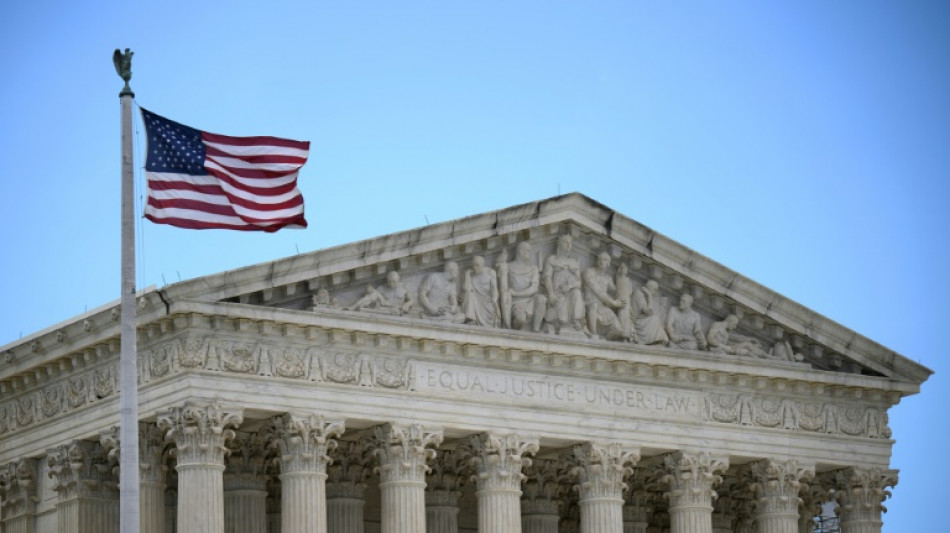
US Supreme Court upholds Texas age-check for porn sites / Photo: Drew ANGERER - AFP

 Jay-Z rape accuser says she made 'false accusations'

 Trump's photo of Xi greeting carries signs of AI

 First US trial against TikTok to open Monday

 French literary prize removes novel from longlist after AI claims

 Trump accuser E. Jean Carroll finally has her damages

 Heavy fighting, internet disruption as Ethiopia conflict rages

 Asian markets mixed after oil gains

 UN approves resolution on dealing with rising sea levels

 Global stocks mostly fall as oil prices and bond yields rise

 Starbucks to close 250 more cafes in North America

 Stocks fall as oil prices rise and bonds back under pressure

 Top ECB official to resign to take up IMF role

 Eviction of pensioner puts Spain housing crisis in spotlight

 Average EU diesel price hits record 2.23 euros a litre: AFP analysis

 Whitetip Investments Marks 10 Years of Regulation, Transparency & Responsible Trading

 Stocks fall, oil prices rise as global bonds under pressure

 Hungary detects invasive spotted lanternfly for first time in EU

 Forex Expo Dubai 2026 Breaks Guinness World Record Again With 23,816 Attendees

 Asian markets fall on US-China jitters as leaders meet

 As Moscow steps up attacks, Kyiv residents brace for harsh winter

 Markets mixed as China's Xi arrives for US talks

 Archaeological 'breakthrough' could confirm origins of Paris

 Australian PM says OpenAI hacked government health website

 Rio breaks record for rainiest September amid powerful El Nino

 Mandela Digital Extends Early Access Programme to 11 February 2027 Following Strong Response

The US Supreme Court on Friday upheld a Texas law requiring pornographic websites to verify visitors' ages, rejecting arguments that this violates free speech and boosting efforts to protect children from online sexual content.
The court's decision will impact a raft of similar laws nationwide and could set the direction for internet speech regulation as concerns about the impact of digital life on society grow.
Texas is one of about 20 US states to institute checks that porn viewers are over 18, which critics argue violate First Amendment free speech rights.
Other countries such as France, Britain and Germany also enforce age-related access restrictions to adult websites, while companies like Meta are lobbying Washington lawmakers for age-based verification to be carried out by smartphone giants Apple and Google on their app stores.
The Texas law was passed in 2023 by the state's Republican-majority legislature but was initially blocked after a challenge by an adult entertainment industry trade association.
A federal district court sided with the trade group, the Free Speech Coalition, saying the law restricted adults' access to constitutionally protected content.
But a conservative-dominated appeals court upheld the age verification requirement, prompting the pornography trade group to take its case to the Supreme Court, where conservatives have a 6-3 supermajority.
Under the law, companies that fail to properly verify users' ages face fines up to $10,000 per day and up to $250,000 if a child is exposed to pornographic content as a result.
To protect privacy, the websites aren't allowed to retain any identifying information obtained from users when verifying ages, and doing so could cost companies $10,000 daily in fines.
During arguments in January before the Supreme Court, a lawyer representing the Free Speech Coalition said the law was "overly burdensome" and that its goal could be accomplished using content filtering programs.
But Justice Amy Coney Barrett, the mother of seven children, took issue with the efficacy of content filtering, saying that from personal experience as a parent, such programs were difficult to maintain across the many types of devices used by kids.
Barrett also asked the lawyer to explain why requesting age verification online is any different than doing so at a movie theater that displays pornographic movies.
The lawyer for the Free Speech Coalition -- which includes the popular website Pornhub that has blocked all access in some states with age verification laws -- said online verification was different as it leaves a "permanent record" that could be a target for hackers.
During the court's hearing of the case in January, Chief Justice John Roberts and Justice Clarence Thomas, both Republican appointees, seemed to suggest that advances in technology might justify reviewing online free speech cases.
In 1997, the Supreme Court struck down, in an overwhelming 7-2 decision, a federal online age-verification law in what became a landmark free speech case that set a major precedent for the internet age.
S.F.Lacroix--CPN