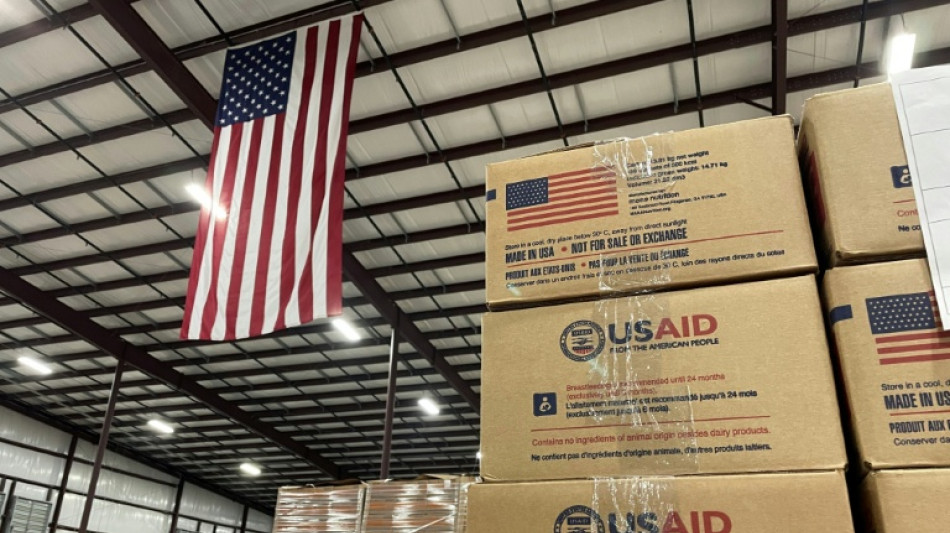
UN conference seeks foreign aid rally as Trump cuts bite / Photo: John Falchetto - AFP

 Jay-Z rape accuser says she made 'false accusations'

 Trump's photo of Xi greeting carries signs of AI

 First US trial against TikTok to open Monday

 French literary prize removes novel from longlist after AI claims
 Trump accuser E. Jean Carroll finally has her damages
 Heavy fighting, internet disruption as Ethiopia conflict rages

 Asian markets mixed after oil gains

 UN approves resolution on dealing with rising sea levels
 Global stocks mostly fall as oil prices and bond yields rise
 Starbucks to close 250 more cafes in North America

 Stocks fall as oil prices rise and bonds back under pressure

 Top ECB official to resign to take up IMF role

 Eviction of pensioner puts Spain housing crisis in spotlight
 Average EU diesel price hits record 2.23 euros a litre: AFP analysis

 Whitetip Investments Marks 10 Years of Regulation, Transparency & Responsible Trading

 Stocks fall, oil prices rise as global bonds under pressure
 Hungary detects invasive spotted lanternfly for first time in EU
 Forex Expo Dubai 2026 Breaks Guinness World Record Again With 23,816 Attendees

 Asian markets fall on US-China jitters as leaders meet
 As Moscow steps up attacks, Kyiv residents brace for harsh winter
 Markets mixed as China's Xi arrives for US talks
 Archaeological 'breakthrough' could confirm origins of Paris

 Australian PM says OpenAI hacked government health website

 Rio breaks record for rainiest September amid powerful El Nino
 Mandela Digital Extends Early Access Programme to 11 February 2027 Following Strong Response

Spain will host a UN conference next week seeking fresh backing for development aid as swingeing cuts led by US President Donald Trump and global turmoil hinder progress on fighting poverty, hunger and climate change.
French President Emmanuel Macron, South Africa's Cyril Ramaphosa and Daniel Noboa of Ecuador will headline the around 70 heads of state and government in the southern city of Seville from June 30 to July 3.
But a US snub at the Fourth International Conference on Financing for Development underlines the challenges of corralling international support for the sector.
Joining the leaders are UN chief Antonio Guterres, more than 4,000 representatives from businesses, civil society and financial institutions, including World Bank head Ajay Banga.
Such development-focused gatherings are rare -- and the urgency is high as the world's wealthiest countries tighten their purse strings and development goals set for 2030 slip from reach.
Guterres has estimated the funding gap for aid at $4 trillion per year.
Trump's evisceration of funding for USAID -- by far the world's top foreign aid contributor -- has dealt a hammer blow to humanitarian campaigns.
Britain, France, Germany, the Netherlands and Belgium are among the other rich nations that have announced recent aid cuts as economic and security priorities shift and national budgets are squeezed.
From fighting AIDS in southern Africa to educating displaced Rohingya children in Bangladesh, the retreat is having an instant impact.
The UN refugee agency has announced it will slash 3,500 jobs as funds dried up, affecting tens of millions of the world's most vulnerable citizens.
International cooperation is already under increasing strain during devastating conflicts in the Middle East and Ukraine, while Trump's unpredictable tariff war plunges global trade into disarray.
- Debt burden -
Reforming international finance and alleviating the huge debt burden under which low-income countries sag are key points for discussion.
The budgets of many developing nations are constrained by servicing debt, which surged after the Covid-19 pandemic, curbing critical investment in health, education and infrastructure.
According to a recent report commissioned by the late Pope Francis and coordinated by Nobel laureate economist Joseph Stiglitz, 3.3 billion people live in countries that fork out more on interest payments than on health.
Critics have singled out US-based bulwarks of the post-World War II international financial system, the World Bank and the International Monetary Fund, for reform.
Seville represents "a unique opportunity to reform an international financial system that is outdated, dysfunctional and unfair", Guterres said.
At a preparatory meeting at UN headquarters in New York in June, countries except the United States unanimously agreed a text to be adopted in Seville.
The document reaffirms commitment to achieving the 2030 UN sustainable development goals on eliminating poverty, hunger and promoting gender equality.
It focuses on reforming tax systems, notably by improving the Global South's representation within international financial institutions.
The text also calls on development banks to triple their lending capacity, urges lenders to ensure predictable finance for essential social spending and for more cooperation against tax evasion.
The United States said it opposed initiatives that encroach on national sovereignty, interfere with international financial institutions and include "sex-based preferences".
- Lack of ambition? -
While the European Union celebrated achieving a consensus, NGOs have criticised the commitment for lacking ambition.
For Mariana Paoli, global advocacy lead at Christian Aid, the text "weakens key commitments on debt and fossil fuel subsidies -- despite urgent calls from the Global South".
"Shielded by US obstructionism, the Global North continues to block reform. This isn't leadership -- it's denial."
Previous failures by rich countries to keep their promises have eroded trust.
After promising to deliver $100 billion of climate finance a year to poorer nations by 2020, they only hit the target in 2022.
Acrimonious negotiations at last year's UN climate summit in Azerbaijan ended with rich countries pledging $300 billion in annual climate finance by 2035, decried as too low by activists and developing nations.
Independent experts have estimated the needs upwards of $1 trillion per year.
Spain will be the first developed country to host the UN development finance conference. The inaugural edition took place in Mexico in 2002, followed by Qatar in 2008 and Ethiopia in 2015.
P.Gonzales--CPN