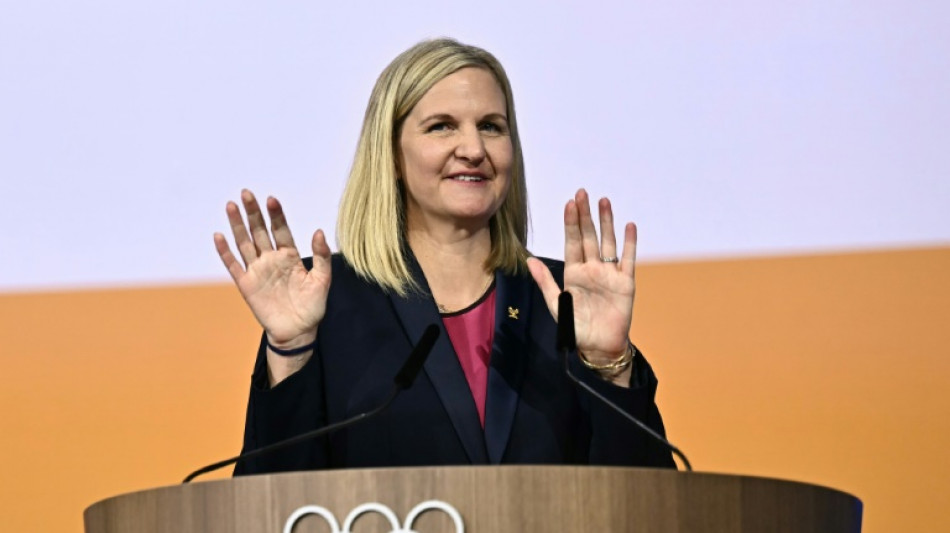
As sports embrace gender tests, Coventry and IOC may follow / Photo: Fabrice COFFRINI - AFP

 Jay-Z rape accuser says she made 'false accusations'

 Trump's photo of Xi greeting carries signs of AI

 First US trial against TikTok to open Monday

 French literary prize removes novel from longlist after AI claims

 Trump accuser E. Jean Carroll finally has her damages

 Heavy fighting, internet disruption as Ethiopia conflict rages

 Asian markets mixed after oil gains

 UN approves resolution on dealing with rising sea levels
 Global stocks mostly fall as oil prices and bond yields rise

 Starbucks to close 250 more cafes in North America

 Stocks fall as oil prices rise and bonds back under pressure

 Top ECB official to resign to take up IMF role

 Eviction of pensioner puts Spain housing crisis in spotlight
 Average EU diesel price hits record 2.23 euros a litre: AFP analysis

 Whitetip Investments Marks 10 Years of Regulation, Transparency & Responsible Trading

 Stocks fall, oil prices rise as global bonds under pressure
 Hungary detects invasive spotted lanternfly for first time in EU

 Forex Expo Dubai 2026 Breaks Guinness World Record Again With 23,816 Attendees

 Asian markets fall on US-China jitters as leaders meet

 As Moscow steps up attacks, Kyiv residents brace for harsh winter
 Markets mixed as China's Xi arrives for US talks
 Archaeological 'breakthrough' could confirm origins of Paris

 Australian PM says OpenAI hacked government health website

 Rio breaks record for rainiest September amid powerful El Nino

 Mandela Digital Extends Early Access Programme to 11 February 2027 Following Strong Response

As the gender furore that engulfed boxing at the 2024 Paris Olympics rumbles on, the International Olympic Committee (IOC) is weighing reintroducing testing, while several sports have already embraced testing for male chromosomes.
Such testing has its critics and the Olympics have already tried it once only to abandon it in 1996.
Incoming president Kirsty Coventry, who will become the first woman to lead the Olympic movement when she starts her term on Monday, signalled a change of direction on this politically inflammatory and scientifically complex issue when she was elected in March.
"We will protect the female category and female athletes," said Coventry, a Zimbabwean swimmer who won seven Olympic medals.
At recent Games, the IOC has left responsibility for setting and enforcing gender rules to the international federations who run their sports.
"I want the IOC to take a little bit more of a leading role," Coventry said, adding that she planned to create "a task force."
Even before Coventry begins her consultations, World Athletics and World Boxing have adopted chromosomal testing -- generally a cheek swab. World Aquatics in 2023 adopted a policy that foresees such testing.
Their rules make participation in women's competition conditional on the absence of Y chromosome genetic material -- known as the SRY gene, an indicator of masculinity.
- 'Non-invasive' -
Only "XX athletes", as World Athletics calls them, can compete. Both transgender women and those who have always been considered female but have XY chromosomes -- a form of "differences in sex development" (DSD) -- are excluded.
On the surface, chromosomal screening simplifies access to women's competition, which has long been the subject of varied regulations and scientific and ethical debates.
Last October, the United Nations Special Rapporteur on Violence against Women and Girls, Reem Alsalem, told the UN General Assembly that such tests were "reliable and non-invasive."
The gender debate reignited in June around Paris Olympic boxing champion Imane Khelif.
The Algerian was at the centre of a violent controversy over her gender last summer stoked by Donald Trump, Italian Prime Minister Giorgia Meloni, and Harry Potter author J.K. Rowling.
World Boxing, which is taking over running Olympic boxing in Los Angeles in 2028, ordered Khelif to undergo testing before a competition in the Netherlands in early June. She skipped the event.
During the Paris Games, the International Boxing Association, which was booted out of the Olympics by the IOC in 2019, accused Khelif, raised as a girl, of carrying XY chromosomes.
Chromosomal screening attracts criticism, notably from the World Medical Association and human rights organisations.
- 'Highly invasive' -
"It is far from being scientifically accurate as a performance indicator, while being very harmful to the athletes affected," Madeleine Pape, a sociologist of gender in sport at the University of Lausanne, told AFP.
While World Athletics and World Aquatics both say transgender women have a muscular advantage, Pape, who ran the 800m for Australia at the 2008 Beijing Olympics, disagrees.
She said there is a lack of research proving that transgender athletes or those with or one of the many forms of DSD gain a "disproportionate advantage" over XX competitors.
Explaining performance is so complex that this uncertainty applies to "all athletes," said Pape.
She also said it was possible to have an XY chromosome while being "totally or partially insensitive to testosterone," as was the case with Spanish hurdler Maria Jose Martinez-Patino, who after missing out on the 1988 Olympics was the first woman to successfully challenge the femininity tests in court.
Aware of these limitations, World Boxing and World Athletics are proposing additional steps after SRY screening which could include anatomical examination.
"Chromosomal tests seem very simple, very clean, but there is a lot of complexity behind them: potentially a highly invasive and non-standardised gynaecological examination, or expensive genetic sequencing that is inaccessible in many countries," said Pape.
Ultimately, the future of such tests could be decided in the courts.
The European Court of Human Rights is expected to rule on July 10, for a second time, on the case of DSD athlete Caster Semenya, the double Olympic 800m champion.
The South African was barred from competing under an earlier version of the World Athletics rules. In 2023, the court ruled that her rights had been infringed but that decision did not force WA to reinstate her.
Ng.A.Adebayo--CPN