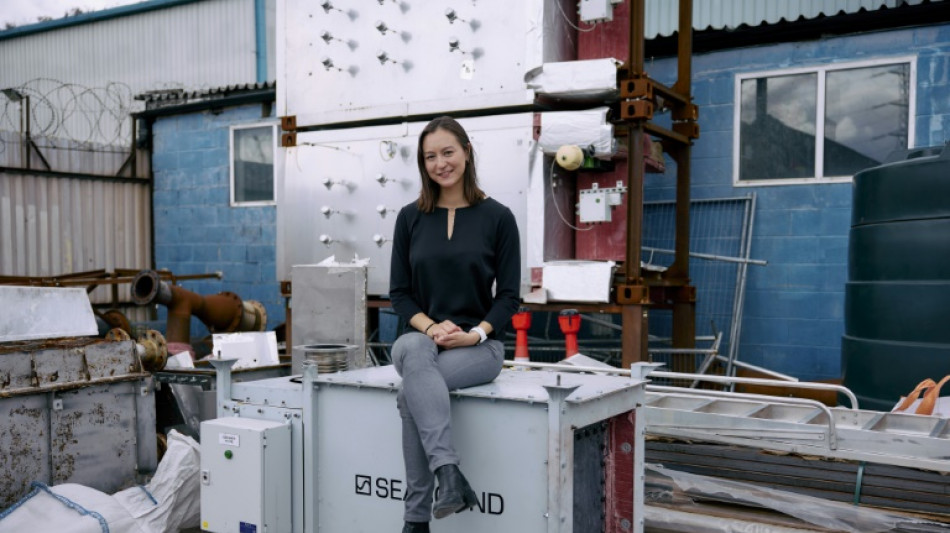
UK startup looks to cut shipping's carbon emissions / Photo: BENJAMIN CREMEL - AFP

 Jay-Z rape accuser says she made 'false accusations'

 Trump's photo of Xi greeting carries signs of AI

 First US trial against TikTok to open Monday

 French literary prize removes novel from longlist after AI claims

 Trump accuser E. Jean Carroll finally has her damages

 Heavy fighting, internet disruption as Ethiopia conflict rages

 Asian markets mixed after oil gains

 UN approves resolution on dealing with rising sea levels

 Global stocks mostly fall as oil prices and bond yields rise

 Starbucks to close 250 more cafes in North America

 Stocks fall as oil prices rise and bonds back under pressure

 Top ECB official to resign to take up IMF role

 Eviction of pensioner puts Spain housing crisis in spotlight

 Average EU diesel price hits record 2.23 euros a litre: AFP analysis

 Whitetip Investments Marks 10 Years of Regulation, Transparency & Responsible Trading

 Stocks fall, oil prices rise as global bonds under pressure

 Hungary detects invasive spotted lanternfly for first time in EU

 Forex Expo Dubai 2026 Breaks Guinness World Record Again With 23,816 Attendees

 Asian markets fall on US-China jitters as leaders meet

 As Moscow steps up attacks, Kyiv residents brace for harsh winter

 Markets mixed as China's Xi arrives for US talks

 Archaeological 'breakthrough' could confirm origins of Paris

 Australian PM says OpenAI hacked government health website

 Rio breaks record for rainiest September amid powerful El Nino

 Mandela Digital Extends Early Access Programme to 11 February 2027 Following Strong Response

In a small London workshop, a prototype mimics the process of capturing carbon emissions from a cargo ship's engine.
For two celebrated young designers, it is the beginning of a journey aimed at helping the maritime sector decarbonise.
"We're simulating what happens on a ship," Alisha Fredriksson told AFP of the technology she developed alongside her friend Roujia Wen.
The women, both aged in their early thirties, met at university and have since founded the company Seabound.
Its work on "ocean-ready carbon capture" has seen the friends shortlisted for this year's Young Inventor Prize, which rewards technology contributing to sustainable development goals put forward by the United Nations.
Winning the award on Wednesday "would be an extra boost to the team... a validation that the world cares about the shipping industry and its decarbonisation journey", said Fredriksson.
Shipping accounts for three percent of global emissions, while the International Maritime Organization (IMO) recently voted in favour of a pricing system to help tackle excess carbon.
At Seabound's miniature courtyard factory, Fredriksson showed off the prototype, which is fitted with a generator.
"We're burning fuel, and that creates CO2," she explained, as exhaust gas was routed through a complex system of pipes into various containers.
The carbon pollution was captured by lime pebbles, while the other elements were released into the atmosphere.
The white-coloured lime acts "like a sponge", said chemical engineer Glexer Corrales, wearing a navy laboratory coat as he tested the quality of the granular-like substance that "is readily available" and "cheap".
Once absorbed, the carbon was transformed into limestone through a chemical process.
Seabound claims that minimal customisation is necessary for its system to work across many types of vessel.
- Shipping transformation -
Technology for carbon capture, utilisation and storage (CCUS) has so far been used primarily on land by heavy industry, for example in the production of cement, glass and steel.
Potential safety risks of using CCUS at sea have yet to be set out by the IMO.
And for the process to be truly beneficial, the amount of carbon captured "must be greater than the carbon produced" through the energy use incurred in installing the system, including on land, IMO official Camille Bourgeon told AFP.
This objective was largely achieved during an initial test in 2023, when Seabound's system captured 78 percent of CO2 emitted aboard a ship run by Lomar Labs.
From 2028, all ships will be required to use a less carbon-intensive fuel, the IMO recently ruled, while a penalty of $380 will be imposed for each tonne of CO2 emitted beyond allowances permitted by the UN shipping body.
The IMO move has created "a big tailwind for our system", said Fredriksson, whose company aims to charge $150 for each tonne of captured CO2, before selling it on to companies requiring it for the production of certain types of fuel.
Seabound plans also to recycle the limestone.
Y.Jeong--CPN