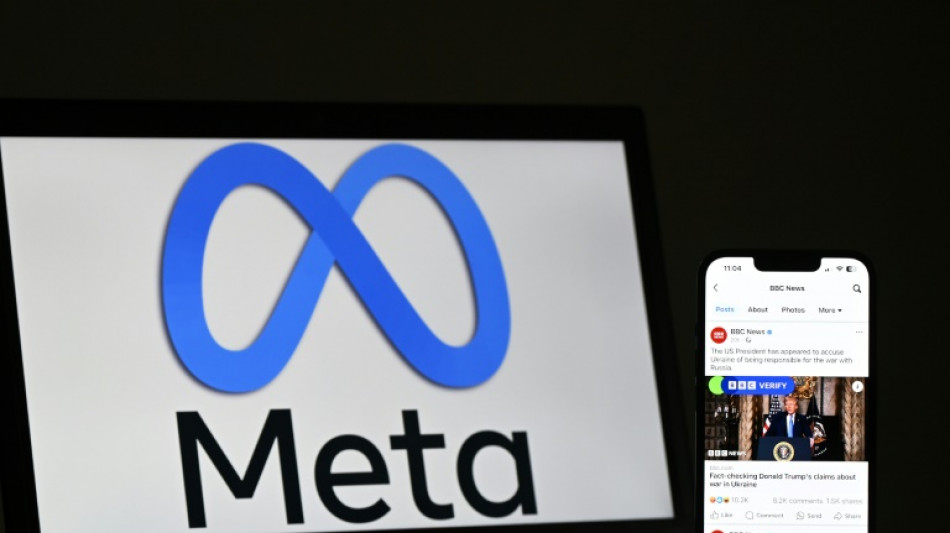
Rise in 'harmful content' since Meta policy rollbacks: survey / Photo: Justin TALLIS - AFP

 Jay-Z rape accuser says she made 'false accusations'

 Trump's photo of Xi greeting carries signs of AI

 First US trial against TikTok to open Monday

 French literary prize removes novel from longlist after AI claims

 Trump accuser E. Jean Carroll finally has her damages

 Heavy fighting, internet disruption as Ethiopia conflict rages

 Asian markets mixed after oil gains

 UN approves resolution on dealing with rising sea levels

 Global stocks mostly fall as oil prices and bond yields rise

 Starbucks to close 250 more cafes in North America

 Stocks fall as oil prices rise and bonds back under pressure

 Top ECB official to resign to take up IMF role

 Eviction of pensioner puts Spain housing crisis in spotlight

 Average EU diesel price hits record 2.23 euros a litre: AFP analysis
 Whitetip Investments Marks 10 Years of Regulation, Transparency & Responsible Trading

 Stocks fall, oil prices rise as global bonds under pressure
 Hungary detects invasive spotted lanternfly for first time in EU
 Forex Expo Dubai 2026 Breaks Guinness World Record Again With 23,816 Attendees

 Asian markets fall on US-China jitters as leaders meet

 As Moscow steps up attacks, Kyiv residents brace for harsh winter

 Markets mixed as China's Xi arrives for US talks

 Archaeological 'breakthrough' could confirm origins of Paris
 Australian PM says OpenAI hacked government health website

 Rio breaks record for rainiest September amid powerful El Nino

 Mandela Digital Extends Early Access Programme to 11 February 2027 Following Strong Response

Harmful content including hate speech has surged across Meta's platforms since the company ended third-party fact-checking in the United States and eased moderation policies, a survey showed Monday.
The survey of around 7,000 active users on Instagram, Facebook and Threads comes after the Palo Alto company ditched US fact-checkers in January and turned over the task of debunking falsehoods to ordinary users under a model known as "Community Notes," popularized by X.
The decision was widely seen as an attempt to appease President Donald Trump's new administration, whose conservative support base has long complained that fact-checking on tech platforms was a way to curtail free speech and censor right-wing content.
Meta also rolled back restrictions around topics such as gender and sexual identity. The tech giant's updated community guidelines said its platforms would permit users to accuse people of "mental illness" or "abnormality" based on their gender or sexual orientation.
"These policy shifts signified a dramatic reversal of content moderation standards the company had built over nearly a decade," said the survey published by digital and human rights groups including UltraViolet, GLAAD, and All Out.
"Among our survey population of approximately 7,000 active users, we found stark evidence of increased harmful content, decreased freedom of expression, and increased self-censorship."
One in six respondents in the survey reported being the victim of some form of gender-based or sexual violence on Meta platforms, while 66 percent said they had witnessed harmful content such as hateful or violent material.
Ninety-two percent of surveyed users said they were concerned about increasing harmful content and felt "less protected from being exposed to or targeted by" such material on Meta's platforms.
Seventy-seven percent of respondents described feeling "less safe" expressing themselves freely.
The company declined to comment on the survey.
In its most recent quarterly report, published in May, Meta insisted that the changes in January had left a minimal impact.
"Following the changes announced in January we've cut enforcement mistakes in the US in half, while during that same time period the low prevalence of violating content on the platform remained largely unchanged for most problem areas," the report said.
But the groups behind the survey insisted that the report did not reflect users' experiences of targeted hate and harassment.
"Social media is not just a place we 'go' anymore. It's a place we live, work, and play. That's why it's more crucial than ever to ensure that all people can safely access these spaces and freely express themselves without fear of retribution," Jenna Sherman, campaign director at UltraViolet, told AFP.
"But after helping to set a standard for content moderation online for nearly a decade, (chief executive) Mark Zuckerberg decided to move his company backwards, abandoning vulnerable users in the process.
"Facebook and Instagram already had an equity problem. Now, it's out of control," Sherman added.
The groups implored Meta to hire an independent third party to "formally analyze changes in harmful content facilitated by the policy changes" made in January, and for the tech giant to swiftly reinstate the content moderation standards that were in place earlier.
The International Fact-Checking Network has previously warned of devastating consequences if Meta broadens its policy shift related to fact-checkers beyond US borders to the company's programs covering more than 100 countries.
AFP currently works in 26 languages with Meta's fact-checking program, including in Asia, Latin America, and the European Union.
O.Hansen--CPN