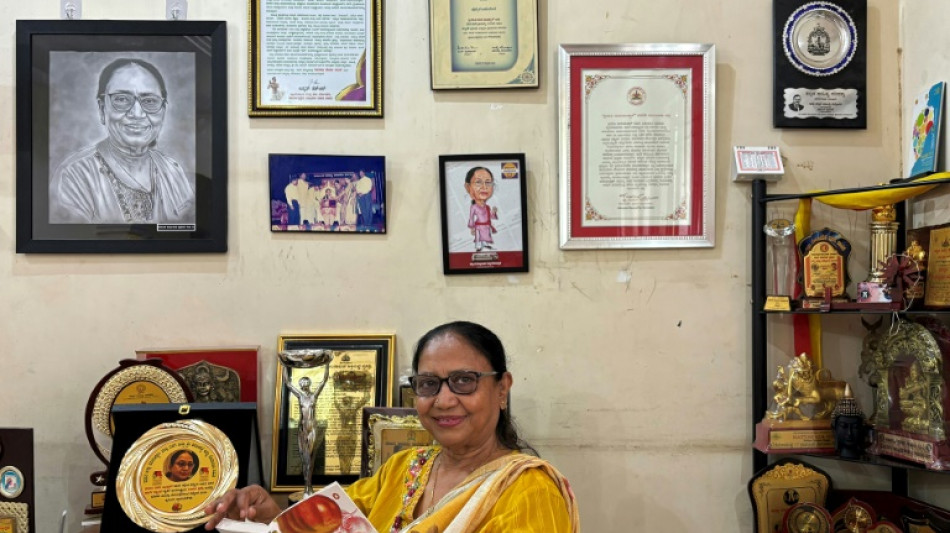
Petals and thorns: India's Booker prize author Banu Mushtaq / Photo: Aishwarya KUMAR - AFP

 TikTok agrees to teen limits in US settlement following Meta

 Venezuela's oil cradle pins hopes on US energy deals

 Lula bans sports betting days ahead of Brazil's election

 Spotting AI writing: how reliable are the detectors?

 US court refuses to overturn Pentagon ban on Anthropic

 South Lebanon children return to school destroyed by Israel strike

 European stock markets climb as oil prices drop
 Asian markets mixed after recent oil surge
 Cash for nature protection: hotelier's offer to Principe islanders

 India rape cases turn focus back onto women's safety

 Rich nations should foot climate bill, says Nepal minister

 Italy bans burqas in schools, caps numbers of foreign students per class

 Napoli hoping to build new stadium, says owner

 What happens if the US bans diesel exports

 Oscar-winner Cotillard fears being moved by AI actor

 Stocks fall, oil prices rise as global bonds back under pressure

 Streamex Converts Interest Into Capital as GLDY Investment Strategy Secures $1M+ Institutional Allocation

 STARTRADER Named Best Fintech Forex Broker at Forex Expo Dubai 2026

 German think tanks urge Merz to stick with reforms after election defeats

 France's top-selling newspaper to slash jobs

 BaazEX Enters the Asian Trading Market With a New Approach to Online Forex Trading.

 Sao Tome voters want to stop exodus of 'neglected' youth

 Mexican cartels target Australia with their African meth

 Rapper-turned-PM faces first big test after Nepal disaster

 Meta launches camera-free AI glasses amid privacy pushback

All writers draw on their experience, whether consciously or not, says Indian author Banu Mushtaq -- including the titular tale of attempted self-immolation in her International Booker Prize-winning short story collection.
Mushtaq, who won the coveted literature prize as the first author writing in Kannada -- an Indian regional language -- said the author's responsibility is to reflect the truth.
"You cannot simply write describing a rose," said the 77-year-old, who is also a lawyer and activist.
"You cannot say it has got such a fragrance, such petals, such colour. You have to write about the thorns also. It is your responsibility, and you have to do it."
Her book "Heart Lamp", a collection of 12 powerful short stories, is also her first book translated into English, with the prize shared with her translator Deepa Bhasthi.
Critics praised the collection for its dry and gentle humour, and its searing commentary on the patriarchy, caste and religion.
Mushtaq has carved an alternative path in life, challenging societal restrictions and perceptions.
As a young girl worried about her future, she said she started writing to improve her "chances of marriage".
Born into a Muslim family in 1948, she studied in Kannada, which is spoken mostly in India's southern Karnataka state by around 43 million people, rather than Urdu, the language of Islamic texts in India and which most Muslim girls learnt.
She attended college, and worked as a journalist and also as a high school teacher.
- 'Confused' -
But after marrying for love, Mushtaq found her life constricted.
"I was not allowed to have any intellectual activities. I was not allowed to write," she said.
"I was in that vacuum. That harmed me."
She recounted how as a young mother aged around 27 with possible postpartum depression, and ground down by domestic life, had doused petrol on herself and on the "spur of a moment" readied to set herself on fire.
Her husband rushed to her with their three-month-old daughter.
"He took the baby and put her on my feet, and he drew my attention to her and he hugged me, and he stopped me," Mushtaq told AFP.
The experience is nearly mirrored in her book -- in its case, the protagonist is stopped by her daughter.
"People get confused that it might be my life," the writer said.
Explaining that while not her exact story, "consciously or subconsciously, something of the author, it reflects in her or his writing".
Books line the walls in Mushtaq's home, in the small southern Indian town of Hassan.
Her many awards and certificates -- including a replica of the Booker prize she won in London in May -- are also on display.
She joked that she was born to write -- at least that is what a Hindu astrological birth chart said about her future.
"I don't know how it was there, but I have seen the birth chart," Mushtaq said with a laugh, speaking in English.
The award has changed her life "in a positive way", she added, while noting the fame has been a little overwhelming.
"I am not against the people, I love people," she said referring to the stream of visitors she gets to her home.
"But with this, a lot of prominence is given to me, and I don't have any time for writing. I feel something odd... Writing gives me a lot of pleasure, a lot of relief."
- 'Patriarchy everywhere' -
Mushtaq's body of work spans six short story collections, an essay collection and poetry.
The stories in "Heart Lamp" were chosen from the six short story collections, dating back to 1990.
The Booker jury hailed her characters -– from spirited grandmothers to bumbling religious clerics –- as "astonishing portraits of survival and resilience".
The stories portray Muslim women going through terrible experiences, including domestic violence, the death of children and extramarital affairs.
Mushtaq said that while the main characters in her books are all Muslim women, the issues are universal.
"They (women) suffer this type of suppression and this type of exploitation, this type of patriarchy everywhere," she said. "A woman is a woman, all over the world."
While accepting that even the people for whom she writes may not like her work, Mushtaq said she remained dedicated to providing wider truths.
"I have to say what is necessary for the society," she said.
"The writer is always pro-people... With the people, and for the people."
X.Cheung--CPN