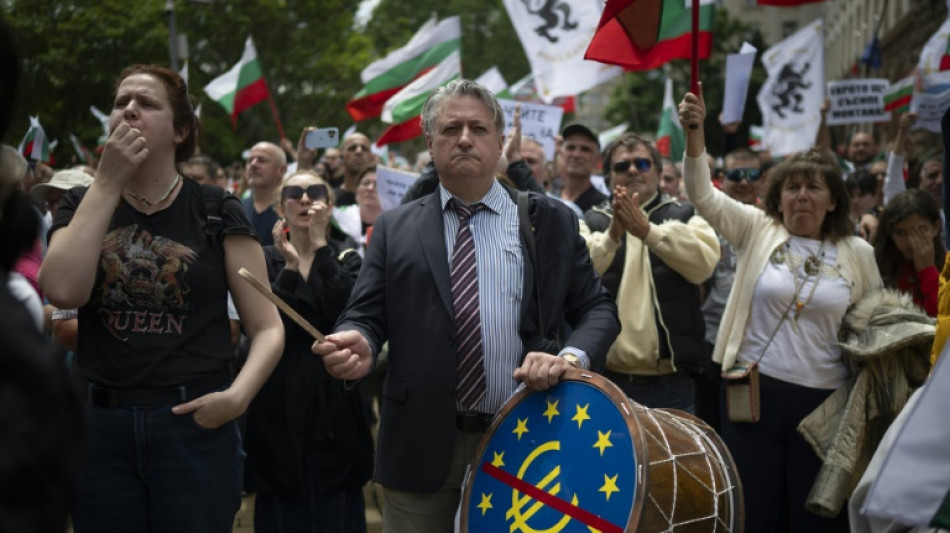
EU gives Bulgaria green light to adopt euro in 2026 / Photo: Nikolay DOYCHINOV - AFP

 TikTok agrees to teen limits in US settlement following Meta
 Venezuela's oil cradle pins hopes on US energy deals

 Lula bans sports betting days ahead of Brazil's election

 Spotting AI writing: how reliable are the detectors?
 US court refuses to overturn Pentagon ban on Anthropic

 South Lebanon children return to school destroyed by Israel strike

 European stock markets climb as oil prices drop

 Asian markets mixed after recent oil surge

 Cash for nature protection: hotelier's offer to Principe islanders

 India rape cases turn focus back onto women's safety

 Rich nations should foot climate bill, says Nepal minister
 Italy bans burqas in schools, caps numbers of foreign students per class

 Napoli hoping to build new stadium, says owner
 What happens if the US bans diesel exports
 Oscar-winner Cotillard fears being moved by AI actor
 Stocks fall, oil prices rise as global bonds back under pressure
 Streamex Converts Interest Into Capital as GLDY Investment Strategy Secures $1M+ Institutional Allocation

 STARTRADER Named Best Fintech Forex Broker at Forex Expo Dubai 2026
 German think tanks urge Merz to stick with reforms after election defeats

 France's top-selling newspaper to slash jobs

 BaazEX Enters the Asian Trading Market With a New Approach to Online Forex Trading.
 Sao Tome voters want to stop exodus of 'neglected' youth

 Mexican cartels target Australia with their African meth
 Rapper-turned-PM faces first big test after Nepal disaster

 Meta launches camera-free AI glasses amid privacy pushback

The EU gave the green light on Wednesday for Bulgaria to adopt the euro on January 1, 2026, in a "historic" step for the southeastern European country set to become the 21st member of the single currency area.
The European Commission said Bulgaria had fulfilled the strict criteria "intended to ensure that a country is ready to adopt the euro and that its economy is sufficiently prepared to do so".
The European Central Bank also gave a positive opinion, hailing Bulgaria's "tremendous dedication to making the adjustments needed".
The push has, however, sparked a backlash from many Bulgarians, with protests and recent surveys showing nearly half of those questioned opposed adopting the euro -- fearing painful economic consequences.
"If Bulgaria joins the eurozone, it will be like boarding the Titanic," Nikolai Ivanov, a retired senior official, told AFP at a recent protest calling for the country's currency -- the lev -- to be maintained.
Bulgaria has had a rocky road to joining the eurozone: the nation has been plagued by political turmoil with seven elections in three years -- the last in October 2024.
The approval by the EU's executive body comes 18 years after Bulgaria joined the bloc.
"Congratulations, Bulgaria!" commission president Ursula von der Leyen said.
"Thanks to the euro, Bulgaria's economy will become stronger, with more trade with euro area partners, foreign direct investment, access to finance, quality jobs and real incomes," she said in a statement.
With a population of 6.4 million, Bulgaria is the poorest nation in the bloc but has spent several years preparing its economy to join the eurozone.
Bulgaria still needs the approval of the EU's finance ministers, who are expected to give their full backing in July, before it formally adopts the euro.
"Today's report is a historic moment for Bulgaria, the euro area and the European Union," said EU economy chief Valdis Dombrovskis.
"Of course, the euro is more than a currency. Following on from Bulgaria becoming a full member of the Schengen area earlier this year, it brings Bulgaria ever closer to the heart of Europe," he added.
- Unsuccessful past attempts -
When the first euro bank notes and coins were rolled out in January 1, 2002, only 12 countries were part of the single-currency area including France, Germany, Ireland, Italy and Spain.
It gradually grew to 20 with Slovenia joining in 2007, Cyprus and Malta in 2008, Slovakia in 2009, Estonia in 2011, Latvia in 2014 then Lithuania in 2015.
Croatia was the most recent country to join in 2023.
Bulgaria wanted to adopt the currency sooner but in the past few years Brussels has concluded its inflation was too high to meet the necessary requirements.
To join the single currency area, member states must show that their economy has converged with other eurozone countries and that they have a handle on their finances.
For example, they must demonstrate inflation is not out of control and is no more than 1.5 percentage points above the rate of the three best-performing EU countries.
Last year, Bulgaria fulfilled every criteria to join except on inflation.
The average inflation rate in Bulgaria during the 12 months to April 2025 was 2.7 percent, just below the reference value.
M.P.Jacobs--CPN