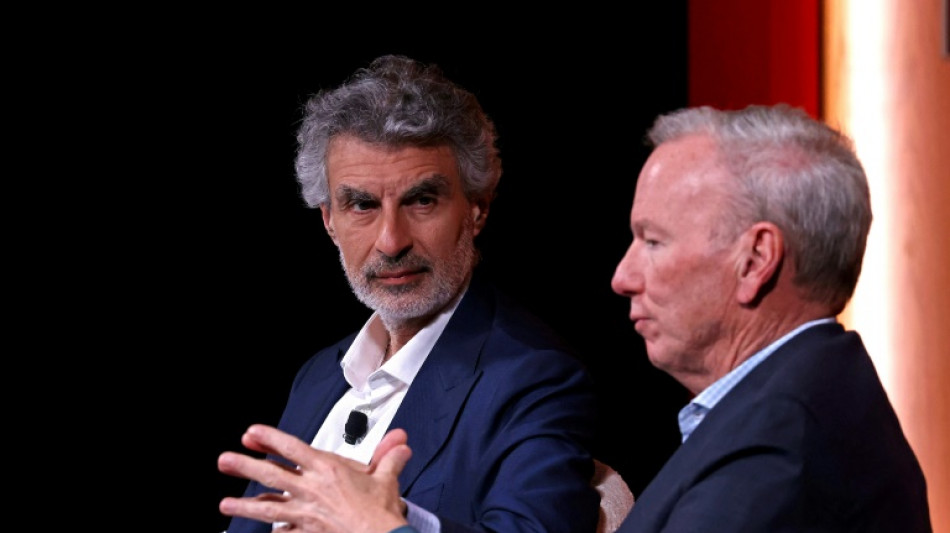
Top scientist wants to prevent AI from going rogue / Photo: Jemal Countess - GETTY IMAGES NORTH AMERICA/AFP

 TikTok agrees to teen limits in US settlement following Meta

 Venezuela's oil cradle pins hopes on US energy deals

 Lula bans sports betting days ahead of Brazil's election

 Spotting AI writing: how reliable are the detectors?

 US court refuses to overturn Pentagon ban on Anthropic

 South Lebanon children return to school destroyed by Israel strike
 European stock markets climb as oil prices drop

 Asian markets mixed after recent oil surge

 Cash for nature protection: hotelier's offer to Principe islanders

 India rape cases turn focus back onto women's safety

 Rich nations should foot climate bill, says Nepal minister

 Italy bans burqas in schools, caps numbers of foreign students per class

 Napoli hoping to build new stadium, says owner

 What happens if the US bans diesel exports

 Oscar-winner Cotillard fears being moved by AI actor

 Stocks fall, oil prices rise as global bonds back under pressure

 Streamex Converts Interest Into Capital as GLDY Investment Strategy Secures $1M+ Institutional Allocation

 STARTRADER Named Best Fintech Forex Broker at Forex Expo Dubai 2026

 German think tanks urge Merz to stick with reforms after election defeats

 France's top-selling newspaper to slash jobs

 BaazEX Enters the Asian Trading Market With a New Approach to Online Forex Trading.

 Sao Tome voters want to stop exodus of 'neglected' youth

 Mexican cartels target Australia with their African meth

 Rapper-turned-PM faces first big test after Nepal disaster

 Meta launches camera-free AI glasses amid privacy pushback

Concerned about the rapid spread of generative AI, a pioneer researcher is developing software to keep tabs on a technology that is increasingly taking over human tasks.
Canadian computer science professor Yoshua Bengio is considered one of the godfathers of the artificial intelligence revolution and on Tuesday announced the launch of LawZero, a non-profit organization intended to mitigate the technology's inherent risks.
The winner of the Turing Award, also known as the Nobel Prize for computer science, has been warning for several years of the risks of AI, whether through its malicious use or the software itself going awry.
Those risks are increasing with the development of so-called AI agents, a use of the technology that tasks computers with making decisions that were once made by human workers.
The goal of these agents is to build virtual employees that can do practically any job a human can, at a fraction of the cost.
"Currently, AI is developed to maximize profit," Bengio said, adding it was being deployed even as it persists to show flaws.
Moreover, for Bengio, giving AI human-like agency will easily be used for malicious purposes such as disinformation, bioweapons, and cyberattacks.
"If we lose control of rogue super-intelligent AIs, they could greatly harm humanity," he said.
One of the first objectives at LawZero will be to develop Scientist AI, a form of specially trained AI that can be used as a guardrail to ensure other AIs are behaving properly, the company said.
The organization already has over 15 researchers and has received funding from Schmidt Sciences, a charity set up by former Google boss Eric Schmidt and his wife Wendy.
The project comes as powerful large language models (or LLMs) from OpenAI, Google and Anthropic are deployed across all sectors of the digital economy, while still showing significant problems.
These include AI models that show a capability to deceive and fabricate false information even as they increase productivity.
In a recent example, AI company Anthropic said that during safety testing, its latest AI model tried to blackmail an engineer to avoid being replaced by another system.
Y.Uduike--CPN