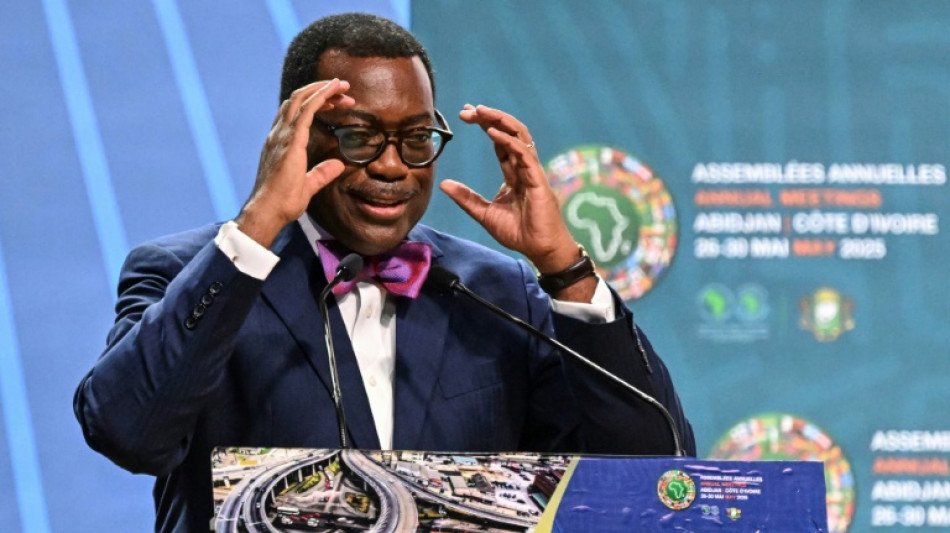
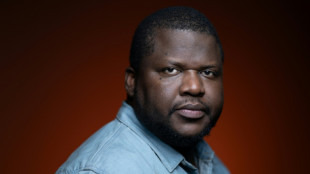
Mauritanian candidate on track to become Africa's next 'super banker' / Photo: Issouf SANOGO - AFP

 S.African women runners arm themselves after string of killings
 Indonesia fires threatens critically-endangered orangutan: IUCN

 Iran proposes Hormuz plan, Trump reportedly refuses
 El Nino rewrites the menu in the world's top restaurants

 Jay-Z rape accuser says she made 'false accusations'

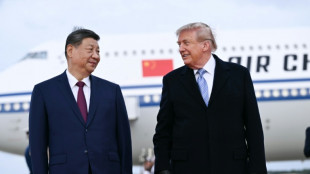
 Trump's photo of Xi greeting carries signs of AI

 First US trial against TikTok to open Monday
 French literary prize removes novel from longlist after AI claims
 Trump accuser E. Jean Carroll finally has her damages
 Heavy fighting, internet disruption as Ethiopia conflict rages
 Asian markets mixed after oil gains

 UN approves resolution on dealing with rising sea levels
 Global stocks mostly fall as oil prices and bond yields rise
 Starbucks to close 250 more cafes in North America
 Stocks fall as oil prices rise and bonds back under pressure
 Top ECB official to resign to take up IMF role

 Eviction of pensioner puts Spain housing crisis in spotlight
 Average EU diesel price hits record 2.23 euros a litre: AFP analysis

 Whitetip Investments Marks 10 Years of Regulation, Transparency & Responsible Trading

 Stocks fall, oil prices rise as global bonds under pressure
 Hungary detects invasive spotted lanternfly for first time in EU
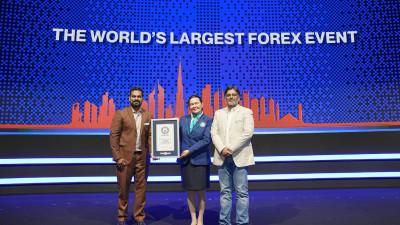 Forex Expo Dubai 2026 Breaks Guinness World Record Again With 23,816 Attendees

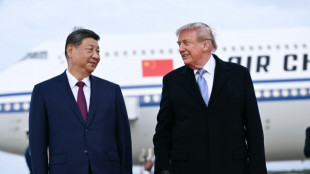 Asian markets fall on US-China jitters as leaders meet
 As Moscow steps up attacks, Kyiv residents brace for harsh winter

 Markets mixed as China's Xi arrives for US talks
Mauritania's former economy minister Sidi Ould Tah was on Thursday heading the race to become Africa's next "super banker", succeeding Nigeria's Akinwumi Adesina as head of the African Development Bank.
Five candidates began the contest in Ivory Coast's economic capital Abidjan but after two rounds of voting, Tah was out in front and close to securing overall victory, with 48.41 percent of the ballot.
In second place was the Zambian economist Samuel Munzele Maimbo, who saw his tally reduce from the first round to 36.68 percent.
Senegal's Amadou Hott was in third with 9.02 percent, followed by South African former AfDB vice president Bajabulile Swazi Tshabalala, who dropped out after getting 5.90 percent.
The winner has to secure both a majority of votes from all member countries and a majority of votes from African nations.
Tah has already secured 68.42 percent of African votes compared to only 18.77 percent for his Zambian rival and could be elected to the prestigious post in the next round, to be held later on Thursday.
In 2015 it took six rounds of voting to elect Adesina as president of the AfDB, which was founded in 1964 and now has 81 members, including 54 African nations.
The weight of each shareholder state is determined by the extent of its capital contribution to the bank.
As such, the five largest African contributors -- Nigeria, Egypt, Algeria, South Africa and Morocco -- will be especially courted, with the United States and Japan the largest non-regional contributors.
As such, alliance-building is seen as key to secure the prestigious post.
- Five priorities -
The AfDB is one of the world's largest multilateral development banks and is funded by member subscriptions, loans raised on global markets as well as repayments and income from loans.
But Adesina's successor will immediately face a disrupted international economic environment, notably due to announcements from the US Trump administration.
Beyond tariffs, the AfDB is also facing the threat of losing 500 million dollars in US funding for its projects to support low income countries on the continent.
All candidates are promising to make the AfDB even more effective to transform Africa, continuing Adesina's five priorities to light up, feed, industrialise, integrate and improve quality of life.
"I am proud of the legacy we are leaving behind for... my successor, for the bank and for Africa," the outgoing president said in a speech on Tuesday.
"We have built a world-class financial institution that will continue to advance Africa's position within a rapidly changing global development and geopolitical environment," he added.
Adesina said 565 million people had benefited from AfDB projects during his decade in charge.
Major projects include support for the construction of the Gabal El Asfar wastewater treatment plant in Egypt -- the largest in Africa.
The bank also helped finance a bridge connecting Senegal and the Gambia, expanded the port of Lome in Togo and supported sanitation projects in Lesotho and access to electricity in Kenya, he said.
From 2015 to this year, the bank's capital more than tripled from $93 billion to $318 billion, he added.
M.P.Jacobs--CPN