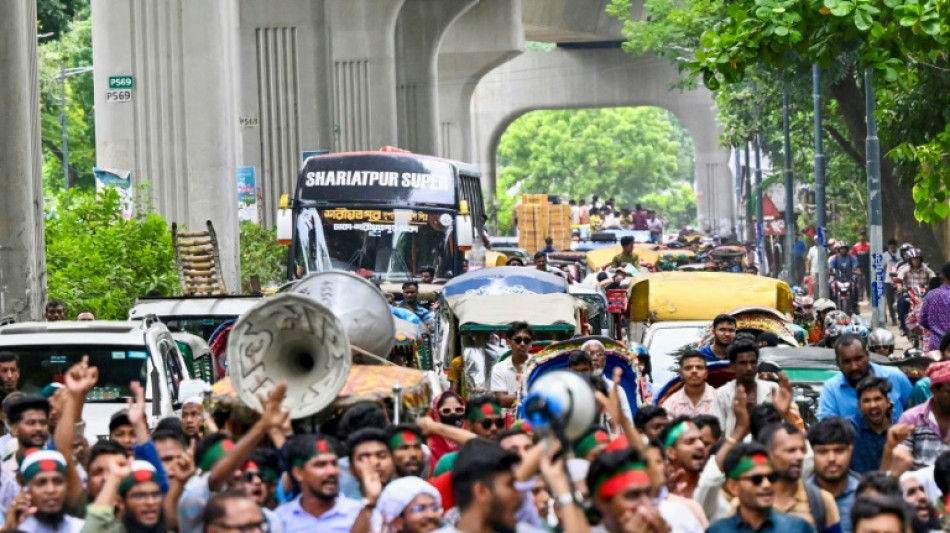
Political protests paralyse Bangladesh daily life / Photo: MUNIR UZ ZAMAN - AFP

 S.African women runners arm themselves after string of killings
 Indonesia fires threatens critically-endangered orangutan: IUCN

 Iran proposes Hormuz plan, Trump reportedly refuses
 El Nino rewrites the menu in the world's top restaurants

 Jay-Z rape accuser says she made 'false accusations'

 Trump's photo of Xi greeting carries signs of AI

 First US trial against TikTok to open Monday
 French literary prize removes novel from longlist after AI claims

 Trump accuser E. Jean Carroll finally has her damages

 Heavy fighting, internet disruption as Ethiopia conflict rages

 Asian markets mixed after oil gains
 UN approves resolution on dealing with rising sea levels
 Global stocks mostly fall as oil prices and bond yields rise

 Starbucks to close 250 more cafes in North America
 Stocks fall as oil prices rise and bonds back under pressure
 Top ECB official to resign to take up IMF role

 Eviction of pensioner puts Spain housing crisis in spotlight
 Average EU diesel price hits record 2.23 euros a litre: AFP analysis

 Whitetip Investments Marks 10 Years of Regulation, Transparency & Responsible Trading

 Stocks fall, oil prices rise as global bonds under pressure
 Hungary detects invasive spotted lanternfly for first time in EU

 Forex Expo Dubai 2026 Breaks Guinness World Record Again With 23,816 Attendees

 Asian markets fall on US-China jitters as leaders meet
 As Moscow steps up attacks, Kyiv residents brace for harsh winter
 Markets mixed as China's Xi arrives for US talks
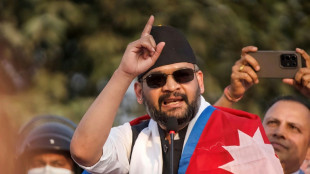
Protests have become part of daily life in Bangladesh's capital, with residents either taking part as political parties jostle for power after an uprising last year -- or avoiding them.
The South Asian nation of around 170 million people has been in political turmoil since former prime minister Sheikh Hasina was ousted in August 2024, fleeing by helicopter as crowds stormed her palace.
Hasina's 15-year-long authoritarian rule contained protests like a pressure cooker, until the student-led movement spearheaded a revolt that toppled her from power.
On Wednesday, at least half a dozen demonstrations were held in the sprawling megacity of Dhaka, home to more than 20 million people.
This was a typical day, with the demonstrations ranging from political rallies and counter-protests, to worker strikes and celebrations at the release of an Islamist leader from death row.
"I got released this morning after being imprisoned for 14 years," A.T.M. Azharul Islam said, waving at thousands of supporters of the country's main Islamist party, Jamaat-e-Islami.
The tight-packed crowd cheered as the senior leader was released from a prison hospital in central Dhaka, a day after the Supreme Court overturned his death sentence and acquitted him of war crimes.
"There was no justice in the past... we expect the court will ensure that the people get justice in the coming days," Islam said.
Leftist parties say they will demonstrate in opposition to his release.
Across Ramna Park in the neighbourhood of Naya Paltan, thousands choked the streets as part of a rally in support of the Bangladesh National Party (BNP).
Political parties are readying for hugely anticipated elections which the interim government has vowed will take place by June 2026 at the latest.
- 'Unpredictable' -
While tens of thousands gather at major intersections across Dhaka with their demands, others spend hours navigating their way through traffic-snarled streets.
"All the major roads are blocked during the day," chicken seller Zakir Hossain said Wednesday.
"We've had to shift our schedules. I start work at midnight now, even though the law and order situation is worsening every day, and muggings have become common."
It worries many, remembering the violence last year when police tried -- and failed -- to crush the protests that toppled Hasina.
"The situation is unpredictable -- the protests can turn violent at any moment," said a 43-year-old housewife, asking not to be identified as her husband is a government employee.
"I never used to call my husband much, but now I do. If he is even a little late coming home from the office, all sorts of bad thoughts come to my mind."
Bangladesh's interim leader Muhammad Yunus, the 84-year-old Nobel Peace Prize winner who is leading the caretaker government as its chief adviser until elections are held, has called for parties to build unity and calm intense political power struggles.
The government warned on Saturday that "unreasonable demands" and obstruction had been "continuously obstructing" its work.
- 'A balance' -
Yunus has said polls could be held as early as December but that having them later would give the government more time for reform.
Rallies organised by the powerful BNP are calling for the government to set an election date, as well as a raft of other demands, including the sacking of multiple members of Yunus's cabinet.
In other protests, tax authority workers, angered at an overhaul of the body that would place it under the finance ministry's control, held a two-week partial strike.
That escalated on Sunday when security forces surrounded the national tax headquarters, before the government later backtracked on its reform.
Civil servants this week also demonstrated at the main government ministry complex to rally against orders changing employment rules -- which the government then said it will reconsider.
On the streets, the protests continue.
"Customers rarely come to the bank when they see the roads blocked," said bank manager Muhammed Sazzad.
While he supported the right to assemble, he suggested the government "could designate a specific area for protests".
Rakib Hasan Anik, a lecturer at the Bangladesh University of Professionals, said that "academic discipline is suffering", with students stuck in traffic and missing class.
"There needs to be a balance," he said. "We can only hope all sides reach a consensus that prioritises the public."
Y.Uduike--CPN