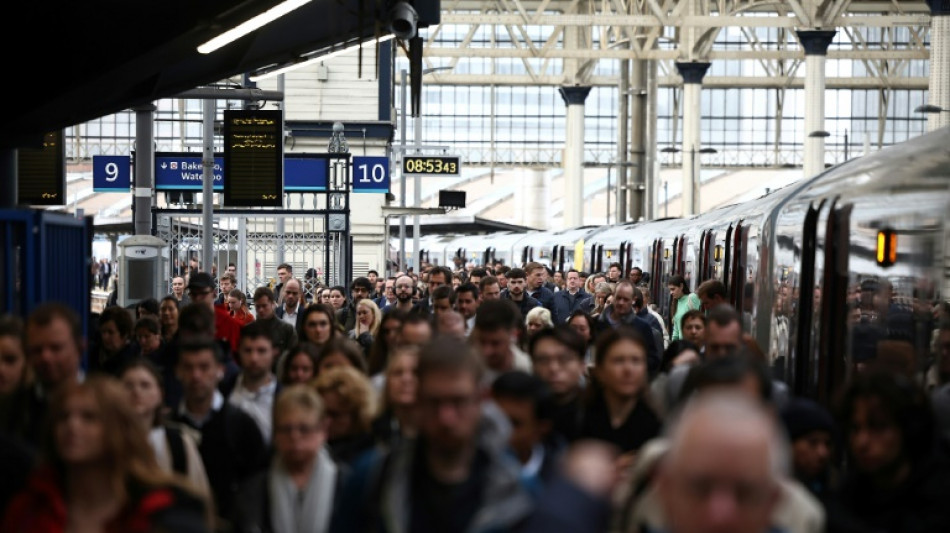
UK renationalises first train operator under Labour reforms / Photo: HENRY NICHOLLS - AFP/File

 S.African women runners arm themselves after string of killings
 Indonesia fires threatens critically-endangered orangutan: IUCN

 Iran proposes Hormuz plan, Trump reportedly refuses
 El Nino rewrites the menu in the world's top restaurants
 Jay-Z rape accuser says she made 'false accusations'

 Trump's photo of Xi greeting carries signs of AI

 First US trial against TikTok to open Monday

 French literary prize removes novel from longlist after AI claims

 Trump accuser E. Jean Carroll finally has her damages

 Heavy fighting, internet disruption as Ethiopia conflict rages

 Asian markets mixed after oil gains

 UN approves resolution on dealing with rising sea levels
 Global stocks mostly fall as oil prices and bond yields rise

 Starbucks to close 250 more cafes in North America
 Stocks fall as oil prices rise and bonds back under pressure
 Top ECB official to resign to take up IMF role

 Eviction of pensioner puts Spain housing crisis in spotlight
 Average EU diesel price hits record 2.23 euros a litre: AFP analysis
 Whitetip Investments Marks 10 Years of Regulation, Transparency & Responsible Trading

 Stocks fall, oil prices rise as global bonds under pressure
 Hungary detects invasive spotted lanternfly for first time in EU
 Forex Expo Dubai 2026 Breaks Guinness World Record Again With 23,816 Attendees

 Asian markets fall on US-China jitters as leaders meet

 As Moscow steps up attacks, Kyiv residents brace for harsh winter

 Markets mixed as China's Xi arrives for US talks
A private train operator servicing parts of southern England, including London, on Sunday became the first to be returned to public ownership under a government plan to renationalise Britain's much-maligned railways.
All UK rail operators are due to be renationalised within the next two years in a key policy launched by Prime Minister Keir Starmer following his Labour party's return to government last July after 14 years in opposition.
"South Western Railway is now under public ownership. And this is just the start," Starmer said on X, formerly Twitter, naming the service kickstarting his government's plan.
He vowed the renationalisation "will put passengers first", with "better services, with simpler ticketing, on more comfortable trains".
Train passengers in Britain suffer from frequent cancellations, in addition to high ticket prices and regular confusion over which services they can be used on.
The privatisation of rail operations took place in the mid-1990s under the Conservative prime minister of the time, John Major, but the rail network remained public, run by Network Rail.
Four of the 14 operators in England are already run by the state owing to poor performance in recent years, but this was originally meant to be a temporary fix before a return to the private sector.
Labour triumphed over the Conservative party in elections last year, with its manifesto including promises to fix the country's ailing transport services.
Legislation was approved in November to bring rail operators into public ownership when the private companies' contracts expire -- or sooner in the event of poor management –- and be managed by "Great British Railways".
Transport Secretary Heidi Alexander said in a statement that will end "30 years of fragmentation", but warned that "change isn't going to happen overnight".
- 'Public good' -
"We've always been clear that public ownership isn't a silver bullet, but we are really firing this starting gun in that race for a truly 21st-century railway, and that does mean refocusing away from private profit and towards the public good," she added.
In an example of how passengers might not immediately notice much difference, South Western's first service under public ownership on Sunday was set to include a rail replacement bus because of engineering work.
Government figures show that the equivalent of four percent of train services in Britain were cancelled in the year to April 26.
The rate was three percent for South Western.
Rail unions -- which have staged a stream of strikes in recent years over pay and conditions due to a cost-of-living crisis -- welcomed the state takeover.
"We're delighted that Britain's railways are being brought back where they belong -- into the public sector," said Mick Whelan, general secretary of union Aslef.
"Everyone in the rail industry knows that privatisation... didn't, and doesn't, work," he added.
Two operators serving towns and cities in southeastern and eastern England are next to be brought back into public ownership by late 2025.
All the current contracts are set to expire by 2027.
UK media reported that the renationalisation of South Western means a third of journeys are now on publicly owned services.
The government has said renationalisation will save up to £150 million ($200 million) per year because it will no longer have to pay compensation fees to rail operators.
The main rail operators in Scotland and Wales, where transport policy is handled by the devolved administrations in Edinburgh and Cardiff, are also state-owned.
M.Davis--CPN