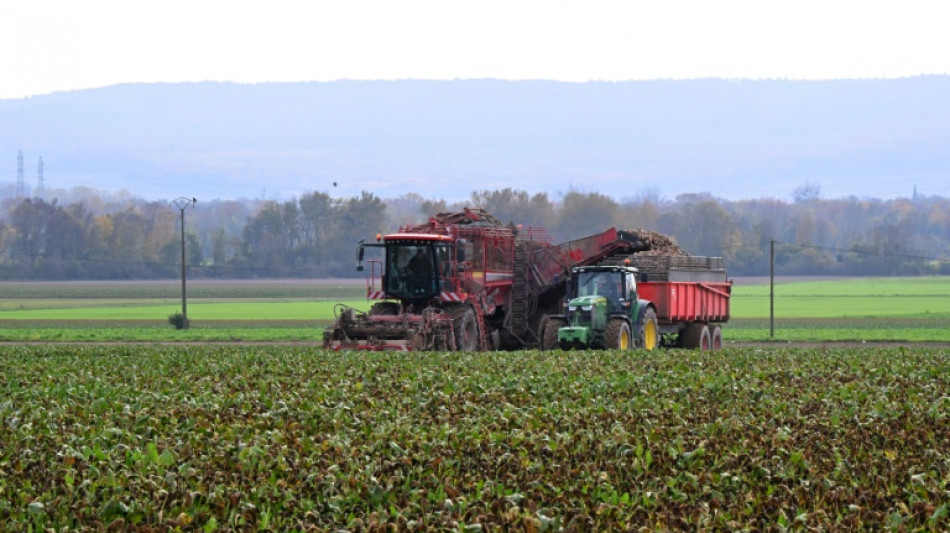
EU ready to tax Russian fertilisers as early as July / Photo: FRANCOIS NASCIMBENI - AFP/File

 S.African women runners arm themselves after string of killings

 Indonesia fires threatens critically-endangered orangutan: IUCN

 Iran proposes Hormuz plan, Trump reportedly refuses
 El Nino rewrites the menu in the world's top restaurants
 Jay-Z rape accuser says she made 'false accusations'

 Trump's photo of Xi greeting carries signs of AI

 First US trial against TikTok to open Monday

 French literary prize removes novel from longlist after AI claims
 Trump accuser E. Jean Carroll finally has her damages
 Heavy fighting, internet disruption as Ethiopia conflict rages

 Asian markets mixed after oil gains

 UN approves resolution on dealing with rising sea levels

 Global stocks mostly fall as oil prices and bond yields rise
 Starbucks to close 250 more cafes in North America
 Stocks fall as oil prices rise and bonds back under pressure
 Top ECB official to resign to take up IMF role

 Eviction of pensioner puts Spain housing crisis in spotlight
 Average EU diesel price hits record 2.23 euros a litre: AFP analysis

 Whitetip Investments Marks 10 Years of Regulation, Transparency & Responsible Trading

 Stocks fall, oil prices rise as global bonds under pressure
 Hungary detects invasive spotted lanternfly for first time in EU
 Forex Expo Dubai 2026 Breaks Guinness World Record Again With 23,816 Attendees

 Asian markets fall on US-China jitters as leaders meet

 As Moscow steps up attacks, Kyiv residents brace for harsh winter
 Markets mixed as China's Xi arrives for US talks

EU lawmakers are set to greenlight tariffs on fertiliser imports from Russia on Thursday, despite European farmers' fears the move risks sending global prices soaring.
Over a quarter of the 27-nation bloc's imports of nitrogen-based fertilisers come from Russia, with more entering from Moscow ally Belarus -- which the European Commission now seeks to bring to an end.
Seeking to allay farmers' worries, Brussels says it will impose the duties from July and gradually increase them up to 2028 until they reach a level that would fully cut off the flow.
Three years after Russia's invasion of Ukraine, the EU must stop fuelling "the Russian war machine" and "limit the dependency of Europe's farmers to Russian fertilisers", said lawmaker Inese Vaidere, spearheading the push in the EU parliament to impose the tariffs.
Barring any last-minute drama, the European Parliament is expected to approve the tariffs -- although some right-wing lawmakers had been calling for a one-year suspension.
The move is not welcomed by farmers.
With rising production costs, pan-European farmers' group Copa-Cogeca explained, using Russian fertilisers was "the most competitive in terms of price, due to well-established logistics" for supplying the EU.
Brussels also intends for the levies to prevent the indirect export of Russian gas, which is used to produce fertilisers.
The EU also wants to increase the bloc's own fertiliser production, and its moves are welcomed by the fertiliser industry in the bloc.
"Time is running out. We've been basically calling for action at the EU level for three years," said Tiffanie Stephani of Norwegian fertiliser manufacturer Yara.
But she admitted the farmers' concerns were "more than legitimate".
- 'Punishing farmers' -
The EU has its work cut out to reassure farmers, who are already angry about administrative burdens, squeezed revenues and what they see as unfair competition from less-regulated overseas rivals.
The tariff could be "potentially devastating" for the agriculture sector, warned Copa-Cogeca, adding: "European farmers must not become collateral damage."
A farmer in central Belgium, Amaury Poncelet, accused the EU of hurting the sector.
After spreading nitrogen fertiliser on his field in Berloz -- which he buys from a dealer in Ghent without knowing where it comes from -- the grain and beet farmer said he "doesn't understand the European Union's idea of punishing its farmers".
"We're losing money because of these European decisions that treat us like pawns who don't matter," he said.
The EU has suggested that duties on imports from North Africa, Central Asia, the United States, Trinidad and Tobago, and Nigeria could be removed to alleviate pressure on prices, among other mitigating measures, should the duties lead to price shocks.
Yara's Stephani pointed to estimates showing that, with tariffs on Russian imports, there would be an increase of fertiliser prices of five to 10 dollars per tonne "because of different logistic costs".
Prices vary, but a tonne of nitrogen fertiliser is currently worth around $400.
J.Bondarev--CPN