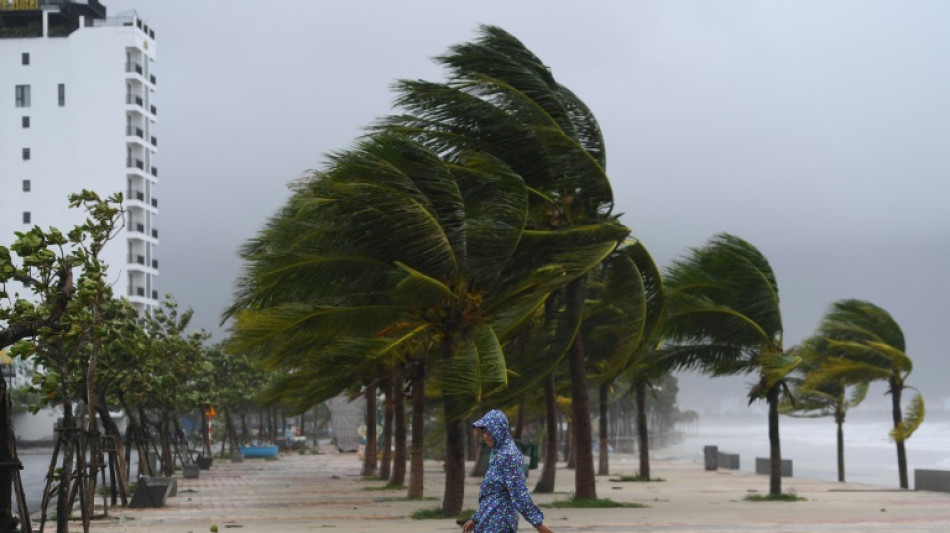
Typhoon Noru tears across Vietnam, Laos / Photo: Nhac NGUYEN - AFP

 Lights out in Laos as electricity exports surge

 Steven Strogatz weighs AI mathematics advances and their consequences for researchers

 Anthropic boss calls for AI slowdown, Altman and Musk agree

 French IT giant Capgemini sells subsidiary after row over ICE links

 Quebec Brokerage Qubit Insurance Announces New Data on Coverage Shortfalls as Rebuilding Costs Rise

 Lady Gaga welcomes first child with fiance: US media

 Bhutan business bets on hazelnuts for farming future

 'Widow's Bay' and 'The Pitt' are favorites for Emmys night

 Coastal erosion forces cancellation of California music festival

 Argentina's Dirty War rears its head in Venice film

 UK lawmakers throw out bill to legalise assisted dying

 US inflation steady in August, fueling Fed rate hike expectations

 New York marks 25th anniversary of 9/11 attacks

 Nepal flood reconstruction bill to be $4.78 bn: foreign ministry

 JUMO and Standard Bank launch Social Finance Framework to scale inclusive finance in Africa

 Doomsday tech: could AI really kill us all?

 French comedy show 'Call my agent' makes film comeback

 It's all coming back: Celine Dion fans gear up for Paris return

 Researchers eye AI revolution in natural disaster forecasts

 US braces for inflation report that may push Fed to hike rates

 Musk threatens legal action over documentary

 Latin America fact-check group asks Meta not to replace verification practice

 AI Risks to Enter 60–80% of Liability and Cyber Insurance Underwriting by 2028, ScienceSoft Predicts

 Tribal Launches Campfire, Letting Business and Technical Teams Build on Salesforce Together

 Stocks fall as fresh oil surge fans inflation fears

Typhoon Noru tore roofs from homes and caused power outages across central Vietnam Wednesday, with hundreds of thousands of people taking refuge, after the storm claimed at least 10 lives in the Philippines.
In Danang, Vietnam's third-largest city, high-rise buildings shook as the typhoon made landfall in the early hours of Wednesday, bringing winds of up to around 120 kilometres (75 miles) per hour, according to the national forecaster.
More than 300,000 people in Vietnam hunkered down in shelters overnight after experts predicted the storm would be one of the biggest to ever hit the country.
By Wednesday evening, it weakened to a tropical storm as it crossed into southern Laos, but forecasters in Vietnam warned of landslides and serious flooding in the typhoon's wake.
The defence ministry has mobilised around 40,000 soldiers and 200,000 militia members, equipped with armoured vehicles and boats in preparation for rescue and relief operations, state media said.
In the tourist city of Hoi An, the Hoai River was close to bursting its banks, while the ground was littered with metal roof sheeting and fallen trees that had damaged cars and blocked roads.
Several streets in the old town were under water.
"The typhoon was terrible last night. I could not sleep as the wind was so strong and loud," resident Nguyen Thi Hien told AFP.
Around 300 houses in the coastal province of Quang Tri had their roofs blown off on Tuesday as the wind began picking up speed.
"I heard the sound of fallen trees and signboards outside. I was scared. But we were prepared so luckily the losses were not that bad."
Residents rushed to clean up the debris early on Wednesday, with some shops already open and tourists walking the streets, taking pictures of the floodwater.
Reshma D'Souza, from India, spent a frightening night in her hotel room. At around 1 am, she said, she saw that the "wall was vibrating".
"(It was) shaking, so I was just praying and I was so scared."
Airports and offices across central provinces began to reopen on Wednesday afternoon.
But key sections of the highway linking Hanoi in the north with commercial hub Ho Chi Minh City in the south remained closed due to landslides and floods, according to state media.
- Deaths in Philippines -
Noru hit Vietnam after slamming into the Philippines earlier this week as a super typhoon with winds of up to 195 kph, leaving 10 dead and eight missing, the civil defence office said.
In Laos, authorities ordered a close watch on dams and urged people to seek shelter for themselves and for livestock.
Noru is then expected to move over Thailand's northeastern Ubon Ratchathani province on Thursday, gradually weakening into a tropical depression.
In Cambodia, officials warned residents in low-lying areas already hit by heavy rains in recent days to be alert to the danger of flash floods.
Vietnam is frequently lashed by heavy storms in the rainy season between June and November, with central coastal provinces the worst affected.
Scientists have warned the storms are becoming more powerful as the world gets warmer because of climate change.
burs-pdw/dhc
M.Mendoza--CPN